
Astrological Studies
Some suggestions for the aspiring Western Jyotiṣika
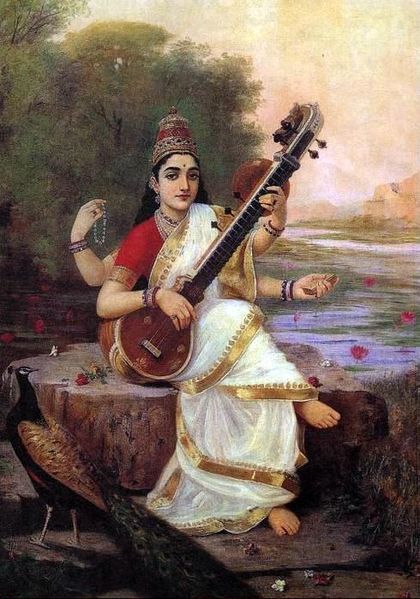
Saraswati
painted by Raja Ravi Varma , c. 1896
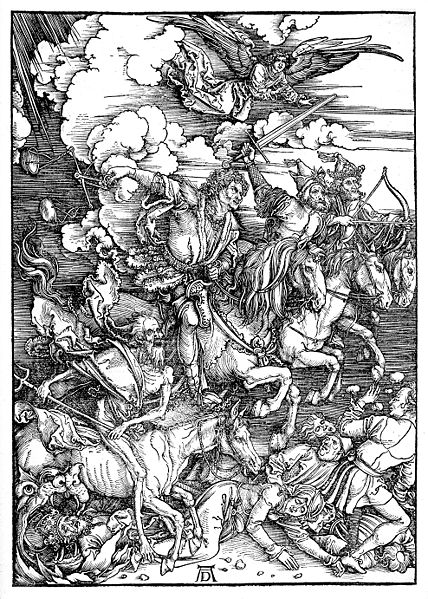
Albrecht Durer woodcut circa 1497-CE
Four Horsemen of the Apocalypse
from the Book of Revelation
QUOTATION from
~~Memories Dreams Reflections 1875-1961 Carl Jung
" It all depends on how we look at things,
and not how they are in themselves."
" If you're going to have a complicated story, you must work to a map -- otherwise you can never make amap of it afterwards."
~~Lord of the Rings 1892-1973 linguist J.R.R. Tolkien
speaking in 1971, commenting on his 18-year writing plan for The Lord of the Rings
" And there appeared a great wonder in heaven;
a woman clothed with the sun, and the moon under her feet,
and upon her head a crown of twelve stars."
~~ Book of Revelation 12:1
-
Matching Energy - How and Why We Attract and Repulse Others
-
Matching Up or Down- partner attraction * ākarṣaṇa * and repulsion * vikarshana * along the Spiritual Path
-
Marriage Conflict- Key to Spiritual True Love
Neutrality versus Prayer- affirmation versus petition
-
Guilt and Grief- some psychic management techniques
-
Punishment Energy- stuck pain and anger
-
Attachment-Detachment Balance within relationships, managing Fear of Rejection
- Debt- A psychic approach to financial rebalancing. Overspending as a healing instinct.
-
Disease - Applying psychic skills to recover natural balance.
-
Anger = fear; management suggestions Anxiety = fear, constriction, anguish, worry
- Enemies - psychic rebalancing of Inner and Outer Enemies
Case Study: Shani/Simha forces Ethical conflict in the family
-
Psychic Energy Fuel Gauge * ask your Body
-
Illegal or Immoral Activities * counseling the Jyotisha client
-
Suicide - A psychic perspective on moral choices
-
Communicating with the Deceased re-evaluating conventional boundaries
-
Cosmology - The Big Picture
-
No Single Indicator Can Form an Accurate Basis for Jyotisha Prediction
-
Jyotisha: Tool of Consciousness? or Terror of Superstition?
-
Corrective Action imposed by difficult graha - Jyotisha evidence of past-life mistreatment of others
-
Expectations: How Thoughts Dictate the Life Experience
-
Jyotishavidya and Tropical astrology - Some Key Differences
-
Superstition and Divination- handling fears of Retribution and Punishment
-
Timing: Kumbha Vivah
-
Remedies in Jyotishavidya : the most effective remedy is Always Service
-
Is it beneficial to * worth-ship * worship Jyotisha deities?
- Psychic Preparation for an Accurate Jyotisha Reading
- Divination: what it is, why it's necessary
- Meditation Benefits of Learning One's Jyotisha Charts
- Compassion versus Sympathy - A key psychic distinction
- Common Sense vs. Love - how sensible adults deprive themselves of happiness
-
The Serious - to - Joy Psychic Continuum - steps to move energy steadily toward Joy
-
Forgiveness - The Path to Psychic Freedom
- Letter to Client: Forgiveness and the Busy Mind
- Cruelty and Forgiveness for Fierce Teachers - he way out of devastating relationships
-
Healing Consciousness - healers and their pitfalls
-
[akashiic memory patterns] reincarnation, completing pre-incarnationally planned cycles, wisdom, morality vs. Magic
-
[akashiic memory patterns] if I change my thoughts, can I change my karma?
-
Can one person eliminate another person's karma? [akashiic memory patterns]
-
Puja versus Seva : which works better to remedy pre-incarnationally planned suffering?
-
The Astrological Profession -compared with psychotherapist, magician, shaman, priest, etc.
-
Astrological studies - suggestions for getting started in a practice of the Jyotisha samayavidya
-
I want to learn to practice the Jyotisha Samayavidya. Where should I begin?
-
Clairvoyance and Clairaudience - detecting subtle energy patterns
-
Spiritual Lineage Teachers -A Humble Opinion
-
Psychic Teachers - the Messenger vs. The Message
I want to learn Vedic Astrology.Where should I begin?
YouTube = now brimming with expert presentations of principles of Jyotishavidya.
For better or for worse, core cultural orientation defines the scope and style delivery of knowledge.
Getting started - first-step essentials
Some Jyotisha Beginner books in English - many new titles have become available since this list was composed
Most Authoritative Jyotisha Books? according to B.V. Raman
I already own Jyotisha software - how can I get from casting charts to actually reading charts?
I have trouble with foreign religious cults. Is Jyotisha a part of Hinduism? [Jyotisha history]
I have trouble with concepts of reincarnation and fatalism.
Will my training in tropical, western astrology help me learn Jyotisha?
How can I get started doing Jyotisha readings? I'm afraid to make amistake .
See also: Annotated Bibliography of Jyotisha Texts
Jyotisha samayavidya vs Tropical Astrological Systems : some key differences
QUOTATION Vocabulary:from the ~~ Koeln Digital Sanskrit Lexicon www.sanskrit-lexicon.uni-koeln.de
light (of the sun, dawn, fire, lightning)
-
brightness (of the sky)
light appearing in the 3 worlds,
-
viz. On earth, in the intermediate region, and in the sky or heaven
-
[the last being called uttama or uttara]
Also personified as
-
" fire" on earth,
-
" ether or air" in the intermediate region,
-
and"sun" in the sky
fire, sun and moon
- fire, flash of lightning
moonlight
eye-light; he eye
The heavenly bodies, planets and stars
- course or movements of the heavenly bodies, science of those movements
The light of heaven, celestial world
light as the divine principle of life or source of intelligence, intelligence
- " human intelligence"
- highest light or truth
light as the type of freedom or bliss or victory
of certain formularies containing the word
science of the movements of the heavenly bodies
Horaa
-
aho-ratra = hour
-
half of a zodiacal sign
-
horoscopy
I really love your site. The information provided on your website is super-valuable. All of those quotations with a different perspective of looking at things i.e. by explaining why such an event/planet is so called malefic. Previously I thought that Saturn in Aries would cause harm to a person because Saturn himself is angry with the person and wishes to destroy the life in its possible ways (I based this perspective on articles I read before I came to know about your website).
But I came to know that Saturn is a planet of scarcity and a strict teacher (among other things) who causes scarcity in relation of things he controls. For example, in Aries, scarcity of vitality, fear of competitors, et-cetera, and I can work on it consciously. It helps
.I read your article on various Yuga(s), and I must say that I "felt it". The outer workings of life and other things, but I wish I could know why the soul has to "move on" through good deeds and move closer to the God.
I would really wish if your site could remain preserved for generations to see (although it might look like an exaggeration). I am not complimenting your work just for the sake of it, but trust me when I say that your website is the best *Jyotisha* Jyotish* website I' ve ever seen. Learners may not need the websites which don' t provide a reasoning.
I have a question: (I don' t know if I should say this or not but the compliments above were genuine and weren' t given just because I wanted to ask a question.)
Do we need to use a house system for determining planetary position? Does it yield * Better* predictions?
I saw your post wherein you said that Equal-house method could be used for determining house positions, but using this house system would change the house position of planets (obvio.). I was convinced but when I checked your chart on the website, you mentioned the house position of Saturn in 2nd house which should have been in the 1st house based on the Equal-house system plus being closer to the ascending line. Iwould really be happy if you could solve this dilemma.
I also understood the point that 6th-from should be based on sign rather than house e.g. when used in case of Karkata Chandra, 6th from it will be Dhanus, and it's safe to assume that for svakshetra Chandra, the person will feel animosity towards Dhanus because he maybe overly attached with his home and homeland and doesn' t wish to undertake travel (this would be the same regardless of the degrees of the Chandra). Iunderstand the example is vague. This is the same reason we don' t have *house system* for * divisional charts *.
But I' m confused what should be the house system (if it's necessary) which can be used. My *Meena * *Guru* (28"46' ) in 9th is closer to the Sripati's Midheaven degree of 3 in sign Aries thus placing Jupiter in 10th. But my * Sun* (6 degrees) and *Mercury * (0.33 degrees) in Taurus in 11th comes to 10th when used equal house method. Ascending degree is 10 degree Cancer.
Would you consider the aspect between Mars and Jupiter wherein *Kuja* is at 2 degrees *Thula Libra* and *Guru* at 28 degrees * pisces Meena *?
(I totally understand that you' re very busy and can only answer limited number of people, ishall feel no sadness even when I don' t receive a reply because maybe you don' t have time or maybe you won' t even read this mail)
(I hope that you' ll accept reading offers even after few more years because I' m really excited for one. I' m currently 19 so I guess I need to wait for few more years)
(P.S. The compliments were genuine. Your website is the only resource people can *trust*)
Sorry for keeping it too long. Iwish best for you. Glad you made this website.
Thank you,
A:Namaste,
Thanks very much for your compliments on the learning materials available at www.barbarapijan.coam
I am delighted to know that you are finding the website information to be useful in Jyotisha studies. I hope to continue to be able to add example nativities and commentary, as time permits.
Nineteen is a good age to begin the lifetime study of jyotishavidya. High quality Jyotisha software is strongly recommended.
It is not recommended to glance at one's own nativity until at least seven years of focused study have been completed. Rather, study the nativities of public figures. Choose noble (or notorious) figures that you admire, or that you find fascinating. Determine the relationship between their Jyotishavidya nativity
and the factual historic record of their behavior.
The samayavidya is descriptive, not prescriptive. Avoid vague terms such as "better" or "harm". There is no good or bad in Jyotisha. There is only description of the unfoldment of human experience. Describe the actions and material-social situation of the human-person, and look for planetary factors which are traditionally known to correlate with that factual behavior. Avoid superstition. Avoid jumping to conclusions. As the eminent Karnataka Jyotishi B.V.Raman often chastised his students, there must be at least three indicators clearly pointing toward the same outcome. One factor is never sufficient for a prediction.
Jyotisha is not just one set of tools. It is many tools combined into a comprehensive system. It takes time to learn. Do not quibble with the validity of the Jyotisha interpretive principles and tools until you have sufficient experience. Follow the classical models while you are learning. After one has mastered the conceptual tools (graha, bhava, rashi, nakshatra, dasha, drishti, varga, etcetera) and developed a body of practical experience in using the tools, then
Q: I was wondering if doing a puja for KSY would remove the good and bad effects or KSY or just the bad. Good and bad is really all relative to me. Whatever happens takes one to the path which they are meant to be on.
A: Puja
Puja is OK if the intention behind the puja is to achieve deep personal surrender to reality as-it-is. If the puja ritual serves as a reminder that one is striving toward patience and greater understanding of the human condition, then Puja is a positive action.
Puja ideally is a respectful invitation to the spirits with whom one would like to enter into collaboration toward a specific goal. Puja is OK if it is a cooperative ritual where one asks for the support and intelligence of the deity to enter one's mind so that one may serve others with neutrality and compassion.
However, the mindless, egoic-mind driven ritual of petitionary prayer (give me this thing, give me that power) is worthless. Very popular, but utterly dysfunctional, and spiritually worthless! The power is never outside oneself, it is always inside.
Blockage to power is always caused by negative beliefs. Puja is, at best, aneutral act of praise and appreciation; a thank-you to the collaborating spirits.
But in terms of getting results, removing blockage to success, puja itself will not expose the negative thoughts which are causing the problem. Indeed, improper (petitionary) puja tends to mask the mental errors which are driving the dissatisfaction.
question whether those tools are producing accurate predictions. The first years of study must be dedicated to understanding the grids (amsha) and the personalities of the graha.
Jyotishavidya is a geometric, trigonometric knowledge base. Jyotisha uses many types of amsha. Bhava are one example of an amsha = division of space. Yes, amsha spatial portion s provide an essential interpretative gridwork for tracking and organizing the flow of planetary rays.
Yes, bhava are required for organizational clarity. One mainstream practice sets the first degree of tanusthāna-1 to match the degree of the Earthen-body birthing indriya-lagna . Each bhava contains 30 degrees. If indriya-lagna = 29-degrees Tula, then for bhava-based predictive purposes, all graha in Thula occupy bhava-1, all graha in Vṛścika occupy bhava-2.
Working Jyotishi often use a variety of bhava delineations to gain non-predictive insight into the nativity. For example, one popular graphic used for insight is su-darshana.
Another graphic which can provide insights (but not predictions) is the bhava-chalita. Chala Skt. = Eng. Moving. The chalita-varga is an off-grid, unfixed view. Bhava-chalita shows the graha released from the constraints of the predictive grid. Bhava-chalita can provide a corrective grid-adjusted view, to help the Jyotishi to see the nativity from a an additional perspective. However, the se more specialized tools should not be used until the basic predictive tools have been mastered.
There is no need to move closer to the creative source. You were born divine; you are already there. The Divine creates all and the Divine resides in all. There is no required action, although compassion is strongly recommended. There is an extraordinary opportunity, offered by each Earth life, to develop a greater understanding of the creations, from this uniquely terrestrial viewpoint. The purpose of the Earthly adventure is to gain further understanding (dharma) of the miracle of Creation.
Wishing you and your family every happiness, healing from sorrow, guidance by inner light, and success in all of life's endeavors,
Sincerely,
Barbara Pijan Lama, Jyotishavidya
Its a wonderful thing to find your site.
My wife really loves astrology and does free readings for people who in dire need.
For our anniversary, iwanted to gift her some books that can help me continue this service forever.
Can you suggest the books the she might read apart from your site?
Your guidance will really help her.
Thanks, K.
A:
NamasteThanks very much for your nice compliments.
The Jyotisha book marketplace offers hundreds of books available in paper and electronic form, written mainly in English, sanskrit, Hindi, and Tamil, but occasionally in other languages as well. There are also many varieties of "astrology" that are currently in practice on this beautiful blue-jewel planet.
There are books which focus on mathematical or interpretive technique, books which focus on philosophical or esoteric principles, and books which focus on historical or comparative traditions.
Perhaps it would be useful to define your wife's interests using more specific vocabulary words, and use those keywords to search the available literature.
It also might be worth a moment to check the American College of Vedic Astrology acvaonline.org and the British Association for Vedic Astrology www.bava.org These English-language professional organizations might have recommended literature lists.
Please give my respects to your wife. It is a precious service to offer free divinatory readings to those dire need! May her Seva continue to flourish.
Wishing you and your family every happiness, healing from sorrow, guidance by inner light, and success in all of life's endeavors,
Sincerely, BP Lama, Jyotishavidya
A: there are many fine English-language Jyotisha beginner books.
Both of Bepin Behari's books entitled Fundamentals of Vedic Astrology and Planets in Signs and Houses are recommended starter books.
Although it may seem counterintuitive, the Sanskrit shloka collections such as Brihat Parasara Hora Shastra are rather opaque (even for a capable Sanskritist) and laden with medieval medical-sexual concepts.
Therefore, it = generally easier and more accessible to begin with a modern text that was written for modern audiences, such as Shri Behari has written.
However, the most essential learning material will be the collection of nativities of well-known public-figures, your friends, and your family members. Also recommended to purchase a robust Jyotisha software such as Shri Jyoti Star or other top-quality s/w.
Traditionally, Vedic astrology is a family business.
Secret formulae, the familyAyanamsha, and other protected techniques, have been passed over the generations from astrologer elders to their apprentice children.
Also, the practice of Jyotisha samayavidya has been taught by Guru to Sishya from a religious scholar-authority to devotee-student. In both cases, the absolute authority of the teacher is unquestioned.
For millennia, uncritical acceptance of the teacher's personal interpretation of the ancient astrological scriptures and their proprietary calculations has been central to the transmission ofJyotisha samayavidya in the Eastern hemisphere.
In the late 20th century, as computers became widely available, the first tentative systematic testingof various ayanamsha settings , astronomical formulae, and other calculations became possible.
The Lahiri Committee was formed in India to establish a standardized government-approved Ayanamsha .
Also as the paternalistic Age of Pisces started to dwindle, the absolute authority of father-figures and guru-figures began to be challenged worldwide.
Attention to the master-teacher is still as important in learning the knowledge tradition of Jyotishavidya -- as it is in learning any other craft.Jyotisha relies very heavily on the practitioner's intuition. Access to a guide who can consistently role-model a successful application of intuitive judgment remains an extremely helpful and perhaps critically necessary asset for the student who hopes to make successful Jyotisha divinations.
However, for the conscious individual, an external flesh-figure instructor-guide might not be necessary. The Guru Within can also fill this essential guidance role.
Using networked computers, abeginning student may now access the opportunity to learn and practice Jyotisha samayavidyaa in a much more objectively validated, data-tested way. However, it is important to acknowledge that the samayavidya of Jyotisha is a very complicated body of knowledge and the professional software is not yet perfect.
Nevertheless, the availability of high-quality, affordable beginner Jyotisha tutorials written in modern vernacular language (primarily English) makes it possible to "skip" the traditional devotee/apprentice step and get straight to the vidya itself.
In order to make consistently accurate Jyotisha judgments, astudent *will* need to develop communicative link with the Inner Teachers through meditation . However, the principles of the vidya and introductory, standard astronomical calculations -- previously available only to the initiated -- can now be accessed by anyone with a personal computer.
The best way to begin the process of education in the many traditions of the Jyotisha samayavidya is to calculate the charts of your friends, family, and perhaps a few admired public figures.
Start matching the milestone dates of your parents, siblings, spouse, and friends to their Vimshottari Dasha periods. Look for acorrespondence between their kundali-varga and their personal histories and character, which you already know -- or, in the case of public figures, which biographical data can be easily researched in encyclopedia formats such as Wikipedia.
A group of well-known biographies will provide some reliable data to work with. To flow the instructor from the Inner Teachers, simply live in a balanced way, and open the radio-transmitter that lives in the corpus callosum called the pineal gland (, meditate). After assembling a group of nativities for rational study, learning to clearly hear the voice of intuition is the most important step toward making accurate divinatory predictions.
Q: hi Barbara,
I really love your site.
It is one of the most thorough and rich resources I have come across.
I've really been getting into Jyotish for the past 3 months,
and have read through a number of books: Light on Life; The Greatness of Saturn-- both Svoboda,
willI am Levacy's introduction to Vedic Astrology,
and James Braha's Hindu Astrology for the Western Astrologer.
I've come to understand that it is a very complex field very capable of helping someone spiritually,
emotionally and psychologically.
I just purchased the Das Goravani Program--Goravani Jyotish and started entering in birth information of some of my friends.
In the program it provides a score for different charts,
and I was surprised and now bummed out that my chart--which I was somewhat pleased with--received a rather low score (29).
Ithen entered in my ex-girlfriend's info and she received a 99.
This is higher than almost every person who's birth info was provided with the program--which I then started to look up.
From my understanding, jyotish is a very vast and deep practice--one that defies being condensed into a single score.
But my understanding of jyotish is also very limited.
And this little blip is throwing a wrench into my whole spiritual practice--not just of jyotish,
but of meditation, yoga--all things of spiritual exploration.
I know that jyotish is part of the vedas,
connected to ayurveda and a significant part of a spiritual tradition that I've really been getting into.
It's been opening new doors,
and I've been learning a lot about myself.
I'm a recovering alcoholic and since I've become sober about 8 months ago have been trying to create or rekindle a spiritual connection.
Anyway,
this score really bummed me out and threw into question all that I
have been studying--and ultimately threw into question a lot of my spiritual
beliefs.
It seems foolish--to get this upset something like this,
and I've
been able to let it go to some extent.
But I would like your input on this,
if you are familiar with that program,
et-cetera.
I apologize if I went on too long.
I'm sure you get a lot of people telling you a lot about their lives.
Thank you so much.
A:Namaste,
It is true, many share the gift of their life puzzles and challenges. It is part of the beauty of this seva of Jyotishavidya.
About the sudden self-doubt or even self-contempt at the moment, here are three observations which might be helpful :
1- When the programmer wrote that little scoring module, it = likely that he was experimenting with some value-weighting systems.
-
The score is intended as an amusement for practicing astrologers, and it is not based on anything scriptural. I have the same software and I can tell you that the only correlation I see between that score and real life is money. People with super high scores apparently tend to do very well financially over time; usually by age 60-70 they have a lot of loot.
-
The lowest scores less than zero seem to generally match people who float around materially and don't own much. The lowest I have is a minus 17. The highest score I have of 1000's of clients in that little amusement item is +120. Everyone from 95 to 120 is a millionaire+. They are not necessarily all happy in daily life as a matter of fact most are not, since they worry about their money. But their investments tend to do well.
-
Vast majority of nativities are in the middle score range, 20-90. That's really all I can say about Das' fun-with-numbers score. It's just an amusement and as a beginner you can safely ignore it!
2- In his professional autobiography "My Experiences in Astrology," the esteemed literary Jyotishi B.V. Raman (1912-1998) tells some sweetly funny stories about becoming obsessed with all the negative potential in his own nativity.
-
The way Shri Raman tells the tale, he = young Jyotishi"upstart"always hotly quizzing his elderly grandfather,
nown expert of predictive Jyotisha, about what would happen when thus-and-so yoga in young B.V.'s chart gave fruit.
-
His grandfather constantly told him to forget the astrology and do his mantra, or alternatively grandfather (who well knew many complex yoga and their outcomes) would tell the young aspirant,"look here, you have auspicious Guru in kendra-10, that is protection enough for a good life'.
-
Sounds odd that such a generalized truism as 'Guru in kendra-10' would form his erudite grandfather's response to so many of young B.V.'s questions.
-
But indeed, the wise elder knew exactly the pitfalls of a young, emotionally vulnerable student's tendency to personalize the system rules of Jyotisha samayavidya which results not in enlightenment but in despair.
3- Cardinal rule in Jyotisha = don't keep looking at your own charts. I know it's fascinating but it's very misleading until you know the Jyotisha samayavidya rule-base.
Unfortunately humans live in terror of self-judgment (because we know, intuitively, about the concluding self-judgment at the end of every incarnation).
Being caught in a maelstrom of self-judgment, you run the risk of losing what little objectivity a beginner has anyway, and coming up with half-baked, irrational outcomes that can hurt one's self-esteem just when one are trying to heal. Faith is needed right now not criticism or self-doubt!
As doctors, when they get sick, go to another doctor for diagnosis, so astrologers know that there can be far too much anxiety and subjectivity in the mind when a beginner reads one's own Jyotishavidya nativity
. When an astrologer wants a reading, asensible Jyotishi consults another astrologer for perspective.
-
That is just a fact about the human mind. It is completely impossible to be objective about one's own chart. To learn Jyotisha samayavidya one must (must) examine as many charts as you can, from friends, family, and public figures.
-
Match the purported principles of Jyotisha vidya to real-life histories and see what works in real life.
-
Anything else is dogmatism, superstition, or fantasy.
take my advice: do not speculate about your own chart. In regard to your own life, have complete unshakable faith in Divine Providence, ground your existence in the light of Divine Intelligence, and live to serve. Forget using Jyotisha samayavidya to understand yourself spiritually, at least forget that until you know 20-50 charts backwards and forwards enough that you can identify the main principles in action, on the spot, when you walk through a nativity.
This study takes years not days not months but years and years. Yet, if you keep at it, remaining fascinated and diligent and scientific in mentality and method, eventually you'll earn some sharp pattern-recognition skills and you'll make some accurate predictions.
-
If one is recovering from alcoholism, criminal abuse, loss of a lover, betrayal, or any type of trauma, one is in a fragile state mentally and emotionally. Such a delicate conditions needs 100% validation with no negatives. It is too painful to dissect one's own charts using all the necessary structural criticism and value judgments of a complete Jyotisha analysis.
Forget about akashiic-memory pattern. Indeed, akashiic-memory pattern is NOT a system of punishment but akashiic-memory pattern (which is simply an Earth-game duality rule) has been so grossly misrepresented as a type of cosmic vengeance that it = generally not helpful for the mis-indoctrinated to work with the concept of akashiic-memory pattern.
Ground your knowledge of Self in Faith and faith alone. Don't analyze yourself yet. When people get emotionally isolated, through grief, guilt, or fear, they assume that " self" is a towering reality, but the reality = Self is a mental formality created via boundaried energy interactions with other beings. Avoid navel-gazing self-obsessions. Don't try to evaluate yourself in a spiritual vacuum as if you are the only person alive.
However, do examine other people's akashiic-memory pattern - which is to say, the dualistic ping-pong psychic interactions that other people are demonstrating. Look closely. It will become increasingly obvious that every action is paired with its reaction, and that every relationship has two roles. akashiic-memory pattern meaning " rule of action" (kri) says that if one plays any role, then one must also play the paired role.
Intuitively, all Learners know where their pre-incarnationally planned process is leading. Current actions are the result of which paired action is presently being matched. Look carefully at the expectations of those around you.
Notice that expectations produce outcomes.Expectations are the seeds of akashiic-memory pattern, and each Jyotisha configuration defines an expectation . Astudy of dozens maybe hundreds of karma-dharma/debit-credit ledgers will give you some neutral, educated objective knowledge about the bookkeeping system of akashiic-memory pattern.
Then and only then -- after maybe five years -- it can be OK to start looking at one's own nativity with genuine numerical objectivity and a gentle smile of pre-incarnationally planned amusement.
As a beginner, exactly as you report, an aspiring student of the vidya can get attacked by an onslaught of negative value judgments (a "score" ) which feels like criticism and hurts much more than it helps. The whole reason to undertake study in the Jyotisha samayavidya is to help guide others to more clearly see their own chosen paths. It is never helpful to criticize or blame. (In fact lower astral actions such as bullying and inducing fear will trigger another pre-incarnationally planned dual-pair outcome for the astrologer). Therefore, offer advice only when asked and only when positive guidance can be delivered.
Years ago, iknew a very spiritual guy who threw a beautiful and precious book of ancient divinations - the I Ching - right into a burning trash heap one night because he was so upset. He could have served as a valuable guide for others if he had first objectively studied the readings contained in the I Ching * Book of Changes in reference to world events or to more impersonal questions like his job.
Unfortunately, instead, he kept obsessively asking about "himself" as if a little book could provide the core soul validation that he was seeking. Being so vulnerable to doubt at that time in his life, he was wounded by the judgmental, naegative readings that he was generating about himself. At a critical moment in his life, this intuitively gifted man dumped "the whole spiritual guidance thing." He then slipped into a terrible reactive materialism which delayed his spiritual progress for decades.
He should have sought core validation ONLY via his trust in divine love from Source, and not gone looking for any type of valuation (pro or con) from human texts until he was free of core doubt and core-secure emotionally.
The sad thing = this guy (now in his eighties) is tremendously sensitive, intelligent, and intuitive. Yet, he hurt himself so badly with premature self-divination that he remained balled up in self-defensive materialism for decades and he never helped anyone else to clarify their own spiritual identity.
It = tragic mistake . However, it is one that you can avoid if you WAIT until you have a good solid collection of objective real-world examples in your repertoire before making any value judgments about yourself.
The Divine loves everyone equally from criminals to saints. So do not worry whether you will be good or bad, rich or poor, handsome or ugly, healthy or sick. Those are human social judgments and they pale in comparison to the all-healing love of Source.
What matters = one believes unshakably in the fundamental rightness and goodness of your being here on Earth.
PRESUME that everything you are doing = helpful and correct for Learning Purpose.
Language about error and failure is not allowed when talking about the self. No I don't mean clinical narcissistic anxiety: ) I mean having that unshakable abhaya faith in your own unquestionable goodness securely in place BEFORE dabbling in any sort of value judgments, weightings, predictions, scores, etc.
Stabilize your core in absolute trust of the universal beneficence and make sure that you are completely protected from self-doubt before taking even a tiny peek at your own Jyotishavidya nativity!
Even starting to comprehend the scripts embedded in the Jyotishavidya nativity
is like looking into Shiva's mouth - it can be terrifying. Study the charts of others. Compare and contrast.
Also, read the great world literature, study human nature, see how human character traits assemble into complexes (e.g., greed pairs with fear; tolerance pairs with gratitude).
-
These patterns can be learned better from imaginative human storytellers like Faust 1749-1832 polymath Johann Wolfgang von Goethe or Charles Dickens; only later when you know the standard scripts for human (seven scripts, seven planets) will you be able to map the literary sense of human character into the behavioral predictors of Jyotisha samayavidya.
So... Maybe your ex-girlfriend is going to be a rich old lady. Nifty. And maybe one may have a smaller bank account, along with a bigger treasury of wit and wisdom.
Human material social moral and aesthetic value judgments are psychically charged and they can be used either to hurt people or to encourage them. Whatever the Jyotisha prediction is, make sure it gets used to encourage always, never to hurt.
Indeed the only values worth cultivating are those that are portable across incarnations, such as wisdom and compassion. As the Christian gospels say, 'it is easier for a camel to pass through the eye of a needle than for a rich person to pass through the gates of heaven." Predictions of financial well-being , beauty, glamour, et-cetera are fun but those values are fleeting. Encourage the values that really count.
Wishing you and your family every happiness, healing from sorrow, guidance by inner light, and success in all of life' s endeavors,
Sincerely,
Barbara Pijan Lama, Jyotishavidya
Q:
I have a background in tropical, western astrology . I've started reading books in Indian astrology (English language) but I find some of the explanations confusing and contradictory.
Is knowledge of the European astrological tradition an advantage in learning Jyotisha?
A:Learning Jyotishavidya from books may be growth-challenging experience, because the vidya is presently packaged within heritage cultural concepts.
Yet, the learning goals can be achieved when there is pronounced intelligence for symbol-systems, apersistent natural curiosity, and mature acceptance if the time commitment. As research in student learning has proven for many decades, the single determining factor in student success in ANY learning curriculum is motivation.
The literary marketplace offers a variety of learner books in English . (See recommended list at the top of this page.)
background in so-called tropical [European] astrology (since Ptolemy) can be a help or a hindrance. It's a help for familiarity with the 12 zodiacal signs and the seven classical planets. The characteristics of the graha have many similarities across the two traditions.
-
But it's a hindrance sometimes, too.
-
Many of the interpretive principles are apples-and-oranges different. The samayavidya is actually a combination of two astrologies. Jyotishavidya contains a solar astrology * rashi-bhava system * and also a lunar astrology Nakshatra system. The lunar system is older and more influential in psychological profiling. The solar system * Ra * is more predictive of material events. The tradition as currently received dates back approximately 12,000 solar years.
-
The lunar categories underlie the solar philosophy, and both systems are rooted in an ancient mythology that = generally unfamiliar to Westerners.
-
The short answer is, except for familiarity with some of the signs-and-houses vocabulary, it is not much advantage in learning Jyotisha samayavidya to be skilled in the tropical astrology.
Also, people have commented that they resist or resent losing their tropical-astrolog y psychological profile . Having become accustomed to a certain validation. Exempli gregria,"I am a Gemini so I am very social" a person may feel their profiling skills are invalidated in Jyotisha.
-
In Jyotishashastra, much more emphasis in placed on Chandra and ascendant. Surya (Sun) is not a basis for personality judgment at all, except in partial evaluation of public role or career. Looking up traits by solar birth-day, acommon practice among tropicalists, won't work at all.
-
Psychological and social traits in Jyotisha are organized by lagna, and thus a person must know their birth *time* to know what lagna category applies to their personality in this life.
If you're ready to make the leap into another worldview, the Jyotisha samayavidya is fascinating.
-
However, the time commitments are big, especially in the beginning. Along with book study and case practice, Jyotisha also demands a certain amount of meditation and usually some translation skills too.
-
A scholarly inclination is helpful. Jyotisha samayavidya is 12,000 year old, highly diverse tradition. Over the millennia, Jyotisha samayavidya has been syncretically incorporated into many religious cultures. Thus the tradition is complex, with many conflicting scriptures that have piled up over the centuries, and furthermore the vidya came somewhat close to dying during the now-past Kali Yuga.
-
For those of us living in the dawn of the Light (right now) it seems to require the patience of Job to learn to distinguish between the barnacle-type accruals of the religious cultures which have so graciously sheltered the Jyotisha samayavidya during the dark era, versus the essential principles of the vidya which far pre-date the religions of the Age of Meena .
Have software - want to start doing readings
Q:
Hi Barbara:
I have read your astrology website and am really impressed with your depth of understanding and insight into this complex science. I am a student of vedic astrology myself and own Goravani's software. I have also done the correspondence course by d. David Frawley of American Institute of Vedic Studies.
Although I have studied astrology and have the basic knowledge of independent situations of houses, lords, aspects, varga charts and vimshottari dashas, I have not yet developed the art of putting it all together and intuitively arriving at a whole picture.
I am interested in getting a reading done by you. With all due respect, iwould like to know if the tape you create is like the interpretation that is available in Goravani software or do you put it all together and intuit a reading out of the effects of all houses, lords, aspects and vargas together?
Please let me know? Looking forward to your reply. Thanks
A : Namaste,
Thanks for your inquiry.
As to whether there is a difference between noting the individual effects of graha, bhava, rashi, varga placement, nakshatra effect, etc. versus weaving all the items together (and eliminating many factors which are not relevant to the question at hand) - as you might suspect, the answer is yes. There is a big difference.
The difference is, as you suggest, amatter of personal intuition. Intuitive selection directs you as the diviner to select the dominant "themes " in a chart by coordinating the principal effects of the current dasha and relevant transits with the basic components (graha, bhava, drishti) of the chart. This intuition comes directly from the soul. It is only"turned on" when the spirit of compassion is running strong.
A successful reading combines knowledge of the knowledge tradition of Jyotishavidya, with deep personal intuition developed in meditation, caring for others, and prayer.
Knowledge-wise, reading a nativity via the historic principles of Jyotishashastra chart is similar to critically analyzing a theatrical play. This viewpoint is naturally influenced by years of reading Shakespearean drama. First, identify the theme, the historical setting, the protagonists and antagonists, and the potential outcome. It is not possible to fully know the outcome until the final line in the script. Yet, human nature is fairly predictable, and the broad themes of akashiic-memory pattern and dharma, sin and redemption, life and death, are eternal studies for students in the School of Earth.
BP-Lama Jyotishavidya interpretive style and values = profoundly humanistic, and notably Western in the philosophy of personal responsibility [not fate]. This viewpoint is influenced by academic skills training in fields of religion and languages.
Most people are sleep-walking in this life. Sadly, the wandering folk may act out their astrological charts in perfect goose-step. These nativities are rather primitive, and as a result ery easy to read. Learners may remark on the arrangment of the bars in their cage, and the sleepwalkers would say Oh! Astrology can be so accurate! Yes, it is.
On the other hand, even a little drop of consciousness permits some people to begin making active changes in the way they respond to the consensus-reality around them. These intentional changes signal the end of the default obligatory-action and the beginning of very positive potential outcomes. Ialways pitch my readings to this potential higher consciousness, noting where an individual might adjust their attitude toward an impending event or longer-term condition.
In this way it may be possible to accommodate the fatalistic component which says that the conditions of our lives are fixed (and, for sleepwalkers, they definitely are!) -- while opening the possibility of a fresh viewpoint, free of resentment, which might allow the person to *own* their [akashiic memory patterns] in a neutral state of awareness.
A healthy by-product of having been introduced to a Jyotisha samayavidya explanation of the forces currently structuring our material and psycho-emotional lives, is that by owning, accepting, even embracing one's own obligations and limitations, Learners may easily develop compassion for people in worse conditions than oneself.
As Socrates said, the unexamined life is not worth living. Jyotisha samayavidya is a wonderful tool for self-examination. BP Lama Jyotishavidya uses the 5th Vendaga in the reflective, psychological, western tradition of self-inquiry.
Traditional Jyotisha samayavidya also provides fairly robust predictive tools, and these are fascinating. However, the ultimate purpose of knowing (some aspects of) the future is to adjust one's reactions to the inevitable, as [akashiic memory patterns] unfolds.
Everyone has easy periods and difficult periods. Everyone enjoys a degree of social approval, and a degree of marginalization. Everyone carries some type of stigma; everyone receives some element of praise. Everyone experiences birth and death, gain and loss, health and sickness. We can look for timing of marriage, children, periods of illness, deaths et-cetera. - it's all in there, on schedule. Stage left, stage right.
naturally, people have plenty of anxiety about the future. Although this anxiety clouds their judgment and prevents much compassion, it is often possible to allay fears about /negative/ future events by pointing out that these are, after all, the completely mechanical roll-out of [akashiic memory] .
Of course people clamor to know when they will receive external validations such as praise, sense-gratification, money. The periods of favorable bhava-lords can suggest the arrival-time of these apparently external blessings. but in general, it is beneficial to emphasize the recurring patterns in the person's life, the ups and the downs, so that Learners may take whatever steps they can to appreciate the architecturally structured outlines of their fate - wyrd .
Acceptance of the Structure of the Learning Pathway is fully necessary. Acceptance of the Plan is the required first step toward Conscious integration between what Learners may wish to do versus the pressure of what Others want one to do.
If you have completed the Frawley correspondence course, you already own a considerable knowledge base in Jyotishashastra. The study-course is well reputed, and d. Frawley himself has an elite reputation.
A next step toward practicing the samayavidya is to allow the flow of meditative, balanced intuition to direct the attention. The intuition is an etheric liquid that can be encouraged to flow through a series of gateways. It can flow through the pineal gland in the corpus callosum of the brain, through the heart and through the hands, and elsewhere. As it flows, it can guide the practitioner's choice of where to place the focus of attention.
There are hundreds - really thousands - of factors inter-operating in any kundali-varga pattern. In real life, iselect 9-times-12 points to use in any given reading. The reader's choice is guided by intuition. Intuition arises into conscious awareness at the physical-response level through meditation, prayer, and most importantly, through ministries of service while caring for others.
With a beautiful name like Scholastica, you are no doubt a very loving and careful person. Use this natural compassion to guide your inner teacher. External gurus are very helpful of course but in the end, it is the inner-tutor who prevails.
Readings are occasionally available depending on other obligations. While waiting for the calendar to re-open, it would be recommended to use the Jyotisha software to construct charts for all your friends and relatives. Examine their Vimshottari dasha timelines and compare to the known events in their lives. This is the basis of the shastra. Practice practice practice learning to identify the empirically verifiable coordination between planetary positions and the timing of events.
In the beginning, study of the samayavidya is similar to homeopathy study. The unique requirement to combine intellectual analysis with spiritual intuition means that the learner will learn much faster using sample subjects that you can read BOTH intuitively AND analytically. Most folks have a solid psycho-emotional impression of close friends and relatives; the learner sort out quickly what their main motives and behaviors are. Then add in the analysis, which is everything you learned from the Frawley correspondence course, and other texts both modern and classic.
Keeping accurate records is important in the beginning of studies. Do not rely on poetic impressions or symbolic meanings. Get real-life data and organize it.
Electronic preadsheets can be useful comparing column-to-column the consensus-reality event dates such as marriages, illnesses, promotions, children. Learners may wish to compare the event-dates against the current lines of their Vimshottari Dasha.
This proving method is easy to use. Tracking the unfoldment of events in the lives of real people also has the side benefit of disproving certain superstitious claims. For example, much of the misogynistic lore about so-called evil births of women, which have crept into the historic legacy of Jyotishavidya, can easily be disproven with simple recordkeeping.
There is a huge volume of poorly understood traditional literature within the current library of Jyotishashastra, most of it from the medieval period 600-CE -1600-CE . This database circulates in Sanskrit, tamil, malayalam, bengali, Hindi, and recently in English and other European languages. There is a plethora of modern Jyotisha literature in Hindi and English. It is not feasible or beneficial to read all or even most of it.
For most of western-hemisphere learners, it is also not feasible to sit at the feet of the guru. Although, truth to tell, the guru's job is to precisely instruct the learner to weed out all the unnecessary stuff and focus on the handful of patterns that are recognizable.
Divination is a vidya of pattern recognition.
By applying a system of vigorous testing of the basic principles of the vidya to the data provided in the charts of people whom you know well, combined with a grounded meditation practice to heighten the flow of intuition, Learners may follow a perfectly fine path toward acquisition of mastery of the Jyotisha samayavidya in the modern world.
Good luck to you, scholastica. It is hoped that this viewpoint on "the difference" between intellectual knowledge-base and meditative, reflective intuition, and how they must be combined to achieve a successful reading, is helpful to you.
Sincerely, bPL
Q:
I've been studying Jyotisha on my own for about 2 years. I have to get out there and start doing readings... but I'm a fraid to make amistake and hurt someone.
A :Building a knowledge base
As with all Jyotisha practice, looking at a variety of charts is the best path to understanding of varga significance. Be sure not to fixate on one or two emotionally charged nativities.
There is too much anxiety associated with the nativities of persons regarding who one has powerful expectations (positive or negative).
Rather, study a variety of nativities of persons well-known to you such as parents and grandparents, siblings and cousins, co-workers and neighbors, in order to establish a neutral and data-driven knowledge base.
Also, study the publicly documented lives of famous historical figures. Scholars have written extensively about many of the great leaders, artists, scientists, saints, and criminals of past centuries. Modern technology allows a keyword search to reveal many intimate details of famous persons, thus making these legendary figures into excellent case-study targets.
The knowledge tradition of Jyotishashastra is not a strictly rational, empirical science. Successful practice of the vidya requires the interaction of contemplative awareness along with logical application of interpretive principle.
Jyotishashastra engages both lunar intuition and solar reasoning.
It is important to see a substantial database of charts showing wide variety of Jyotisha nativities in order to validate the legacy teachings of the classics. Otherwise, unfortunately, the whole enterprise can deteriorate into religious politics, lineage conflict, and fear-based village superstition.
Getting started - first-step essentials
Read lots of charts!
Read lots of charts!
Read lots of charts!
It is not necessary to be an "expert" . When one is just beginning to offer readings and one can only say a few things for certain, the spiritual validation in herent in recognition of the unique qualities of each incarnations is still helpful to the client. Even the minimum acknowledgement will be appreciated so long as your language is positive and constructive.
At the level of simple soul validation, something is always better than nothing! Many people wander through life never receiving recognition that they are a soul and they have a purpose. Even if your reading is a bit off about the details of their path, simply validating the truth that there *is * a unique path for this individual is indeed a spiritual service!
At the beginning, you can be building your collection of nativities in order to validate the effect of varga, dasha timelines, graha character, et-cetera. In the beginning, your skills are improving but not fully ripe. Nevertheless, the reading is an energy exchange for both reader and readee.
At a psychic level, folks do not value what they have not bought. Nothing is given therefore nothing is received.
Therefore, it is recommended to accept a very small fee, and to donate this fee to a favorite charity. When you are established in the practice, it will be OK to start earning personal income as the proper fruit of your dedicated study.
However, in the beginning, it is wise to invoke a psychic protection against inadvertently harming someone's peace of mind.
Ask for the supervising indulgence of the spirits - and give the money to a compassionate cause. This completes and purifies the energy exchange
In this loop, the client has expressed their belief in the value of the reading by making a small payment. Acharitable beneficiary has received that payment, which purifies the energy. Yet the learner-reader is only the middleman. The learner-reader is providing acknowledged value. Yet, the beginning reading has successfully avoided the over-reach common to those who may overestimate their own knowledge while underestimating the great scope of the vidya.
Giving all earnings to charity allows the beginner to be humble, but continue to get the practice experience!
Also - this is REALLY important - do not give any negative predictions.
make it that your sole objectives are
-
to acquire verified nativities
-
to offer positive soul validation (for example " I see you are very intelligent, compassionate, service-oriented, clear communicator")
-
to collect a donation for your charitable cause
Be sure to advise your earliest clients that
-
an accurate TOB is absolutely required since beginners cannot yet do rectification.
-
their reading will be very brief,
-
you will need to ask them some questions about how the purported planetary effect really do work in their real lives
-
their donation to you will be given to a temple or a charity organization (according to your ishtadevata).
Be sure to give ALL of your profits (except to cover the cost of materials) to a worthy cause.
Q: Which ayanamsha should I use? The different ayanamsha choices seem to produce very different charts?
A : most practitioners use Lahiri Ayanamsha. That is by far the most common, probably more than 90% of astrologers use Lahiri.
The other specialty ayanamsha choices are rather esoteric and the beginner student should wait until one has some expertise before experimenting with them.
Q: - Can I base predictions upon my navamsha? I think my navamsha is a stronger chart.
A :material-social Predictions should be made from the D-1 kundali. Emotional-spiritual predictions can be made from the D-9 chart. The two charts can never be separated. They are absolutely interactive. Predictions made on the basis of one without the other will not hold up.
A few material predictions related to marriage are based on the navamsha - for example, the timing of marriage ceremonies can be predicted via the D-9 lagna and its axis. Similarly, ahighly accurate yet somewhat broad prediction of the course and special knowledge involved in one's profession al career is indeed derived from the 10th navamsha.
Nevertheless career predictions must coordinate with the grosser functions of the karma-bhava of the D-1 and marriage predictions from D-9 must coordinate and mutually confirm with the general patterns of the 7th from Chandra + samatā bhava.
Most material outcomes such as finance, health, education, children et-cetera. are predicted directly from the radix chart. Once a graha's effect has reached the Bottom, grossest level of manifestation which is the D-1 radix root chart, then it is wuite unlikely to reverse itself. It has already entered the"chute" en-route to the material plane and it would take a great deal of effort to reverse that natural impetus toward manifestation.
Yet, the more conscious the person has become -- the more your client is aware that our thoughts and the emotional charge upon each thought are the machine which generates our reality -- the more meaningful the D-9 navamsha chart becomes. If one comes to understand and appreciate that everything in the navamsha chart is the direct precursor and immediate active cause of the outcomes which will manifest via the D-1, then one can gain a tremendous understanding of the mechanics of our incarnational process.
What Shri Raman probably means = occasionally a graha which is very weak in radix gains major strength in navamsha. In that case don't expect the graha to act weak because it has a sort of secret strength that will emerge during its periods. In fact if its only strength is in navamsha then a partner is required to help realize the outcome of the period. Learner's lifepartner's being-ness (their thoughts, actions, etc) not the Learner's will control this particular manifestation.
But he would not be saying to predict directly from the navamsha. For example if a graha is the rogesha-6 in radix but karmesha -10 in navamsha, predict it to behave like an rogesha-6 (health), not an karmesha -10 (career).
Usually predicting the effects of a graha during its period is a multi-leveled assessment. Most of the behaviors of a graha in the D-1 will relate directly to the Learner's personal, material or emotional experience. Most of the behaviors of a graha in the D-9 will either reflect the Learner's much higher spiritual perceptions or (more commonly) will predict the behavior of the spouse, partner, adviser, other.
-
For example the bandesha-4 of the navamsha usually dictates the spouse's career, and when the bandesha-4 navamsha is activated, the spouse's boss will do something consistent with that bandesha-4 graha. If bandesha-4 navamsha is a strong Surya , the spouse will get recognition at work, probably a promotion up the hierarchy.
Be careful in using value-judgment adjectives like strong to describe a kundali. If what you mean is "flattering" or materially productive say so. Remember NOT to try to learn Jyotisha samayavidya from studying one's own chart. No one is objective about their own personal nativity. The human fear of punitive judgment is just too deeply embedded as a result of the doctrinal persecutions of the Era of Meena (now receding) This fear prevents humans from seeing themselves as neutral objects of mental projection, which is truthfully what we are.
Study the charts of people you know well, such as family members, and also the nativities of public figures whom
Q: I was wondering if doing a puja for KSY would remove the good and bad effects or KSY or just the bad. Good and bad is really all relative to me. Whatever happens takes one to the path which they are meant to be on.
A: Puja
Puja is OK if the intention behind the puja is to achieve deep personal surrender to reality as-it-is. If the puja ritual serves as a reminder that one is striving toward patience and greater understanding of the human condition, then Puja is a positive action.
Puja ideally is a respectful invitation to the spirits with whom one would like to enter into collaboration toward a specific goal. Puja is OK if it is a cooperative ritual where one asks for the support and intelligence of the deity to enter one's mind so that one may serve others with neutrality and compassion.
However, the mindless, egoic-mind driven ritual of petitionary prayer (give me this thing, give me that power) is worthless. Very popular, but utterly dysfunctional, and spiritually worthless! The power is never outside oneself, it is always inside.
Blockage to power is always caused by negative beliefs. Puja is, at best, aneutral act of praise and appreciation; a thank-you to the collaborating spirits.
But in terms of getting results, removing blockage to success, puja itself will not expose the negative thoughts which are causing the problem. Indeed, improper (petitionary) puja tends to mask the mental errors which are driving the dissatisfaction.
find admirable, fascinating, or otherwise interesting enough to sustain a long-term reflective inquiry into their nativity.
Trouble with the Hindu Culture part of Jyotisha
Q:
Dear Barbara,
Is Vedic astrology part of Hinduism? Very little of your reading referred to Hindu gods or concepts, but once or twice you did talk about Hindu gods.
That bothers me. Ireally don't like cults, especially foreign religious cults. Is Jyotisha tied to missionary Hinduism or "airport" cults?
A :
Namaste,
polarizing catalysis related to unfamiliar cultural paradigms
Ancient Vaidik roots of Jyotisha samayavidya
Yes, you're right about Vedic Astrology (called "Jyotisha" in Sanskrit) being related to Hinduism. However, Jyotisha samayavidya is much older than Hinduism as that conglomeration of beliefs and rituals of worship is understood today. The canonical Veda would appear (linguistically) to pre-date the emergence of Indus area religious cultures by several thousand years.
" Veda" means "knowledge" . * especially knowledge via seeing and hearing.
The older roots of Jyotisha samayavidya may be found in a Vaidik culture which itself traces an ancient lineage reaching back to the time of Lemuria. Jyotisha is called a component or member of the Veda (vedanga). Ved is an Indo-European root syllable related to the English words wisdom and vision and video and evidence.
Although the oldest layers of the tradition hail from a time before verbal speech, when ideas could be instantly transmitted in holographic symbolic form, Jyotisha like all inherited human cultural knowledge went through a period of oral transmission. In pre-literate times, the orally recounted Jyotisha appears to have been mainly a system of describing omens found in acts of nature. However, it may have been a much richer vidya even as humanity was descending into the cloud of unknowing... it is difficult to make sweeping statements about an era that was lost to history for all but a few Seers.
The surviving shloka describe movements of the Earthen-Moon which formed certain omens. Asystem was developed (adapted and likely simplified from older more sophisticated vidya) to predict what lunar omens would occur over the period of a lunar year -- including the dreaded running-away-from kind of omen, the ab-omen (ab = away-from) the ab-omin-ation. (Yikes!)
Vedic times historically are somewhere approximately around 3000 BCE-600-CE , although dating of the era is * extremely * contentious! It's a fairly big jump from the Moon-omens-system = Nakshatra = to the medieval/modern Jyotisha practices that are broadly used today, but the roots of Jyotishavidya definitely go back that far. Arecommended book on the Vaidik-era origins of Jyotisha is Valerie Roebuck, the Circle of Stars.
The knowledge preserved in the Vedaa (the knowings, the reckonings) including the Moon-omens was passed down by memorized chanting. From ancient Lemurian origins far predating the mists of pre-literate time, the stanzas were kept significantly intact by strictly regulated poetic meter of Vedic Sanskrit which guaranteed purity of sound transmission.
Vedanga
The Veda is sometimes modeled as a wheel with six spokes.
When the Veda - a great body of knowledge - is considered to be a person (purusa) then each of the anga can be metaphorically considered as a limb of a living body.
Conventionally listed as 5th of the 6 vedanga (anga = part, component) Jyotisha samayavidya is a huge and ancient library which forms a coherent section of the Vedic wisdom database.
The six Vedanga or veda-components are similar to six essential parts of an engine. Remove one part and the engine cannot go.
The curious modern developments of evangelical Hinduism and other syncretic cultural missionary movements are parts of the much larger wheel but they are not located near the core of the vidya.
As it is said, religions come and religions go, but astrology remains the same.
Unfortunately, in a passion of patriotism, some of the more recent Bharati commentators being schooled well in their inherited versions of Jyotisha samayavidya, writing in international English, have asserted that Jyotisha is an expression of modern Hinduism. And while all praise and appreciation is due to the profound devotion of the Protectors of the Breath (bhram) it is really not possible to squeeze a 12,000 year old tradition into a relatively recent religion (or group of religions).
300 Combinations 1912-1998 Jyotiṣika BV Raman especially liked the terminology of "Hindu Astrology" . However Jyotisha is a vidya = 'knowledge-base'. Jyotisha not a religion, nor is it encompassed, contained, defined, controlled, or limited by any religion.
One way to mentally segregate these two cultural activities - Jyotisha vs. Missionary religion - is to watch for the occurrence of 'deontic modal verbs' in the discourse. The English-language preaching discourse of the modern evangelical cults is peppered with words like 'should', 'have to', 'must'. (or the Germanic equivalents of these terms in Dutch, German, scandinavian et-cetera.) should and similar terms are guilt-driven socialization directives and have little to do with truth. If the language of Jyotisha predictions contains ethical terms like should, that is a signal of cultural morality being imposed as a stricture or limitation upon the much broader Jyotisha samayavidya.
Q:
What is the relationship of Vedic Jyotisha to modern Hinduism?
A :
The patchwork-quilt collection of many different Indian religions that we currently call by the umbrella-name idea of"Hinduism" was an umbrella concept created by British colonial scholars in India in the 1700's. In practical terms, however, most of the multiple religions which are grouped together as "Hinduism"also trace their roots to the ancient Vaidik cultures. Therefore, Jyotisha, as a"branch" of the sacred Vedaa, is completely accepted in all the religions called"Hinduism" - as well as Jainism, and most schools of Buddhism.
From a certain perspective, the role of the Veda in Hinduism could possibly be compared to the role of the Hebrew Bible in Christianity. Within the Christian sacred scriptures, Hebrew Bible is often called"Old Testament" .
Hebrew Bible is a document (actually, many documents knitted together) which originated in the religion of Judaism. Judaism is ritually and theologically different from Christianity, and also MUCH older. Hebrew Bible is at least 1000 years older than Christianity itself. Yet, christians universally respect the Hebrew Bible, and they take many of their core teachings from that holy scripture.
Just as Christians venerate the canonical teachings (scripture) of the ancient Jewish religion, Hindus venerate the canonical teachings of the ancient Vedic religions. Traditional Hindus treat the Veda as their respected teacher, and try to follow its guidance. However, just as Christians are clearly not pure Jews, so Hindus are clearly not pure Vaidik.
Unfortunately in recent years, awave of patriotic Hindu chauvinism in India has caused some Bharati astrologers to call Jyotisha by the name of"Hindu Astrology."
But, we who seek the truth of Jyotisha need not be concerned with the linguistic politics. Jyotisha is an ancient"vidya" or body of knowledge, accessible to all sincere seekers regardless of current politics or religious dogma. Bottom line: there is no need to be Hindu in order to understand or practice Jyotisha.
This is of course entirely my personal opinion. Hope this perspective is helpful to you.
Sincerely, barbara
,
Q:
I browsed through your website and found the material extremely useful. I am keen to learn vedic astrology and was wondering if you had any tips or advice that could help me develop building blocks of Astrology.
If you know of any websites or books that will help me develop structured understanding of astrology and am also curious about how you managed to enrich yourself with the knowledge.
A:
Thanks so much for your compliments on barbatapijan.cm
It is very much a work in progress! It is delightful to know that students of Jyotishavidya find the information and perspective on the site to be useful in studies.
Learning English run the gamut from complexly inscrutable t0 accessibly simple. Bepin Behari: Planets in Signs and Houses = easy starter text. Behari also wrote more esoteric stuff but that is confusing in the beginning. David Frawley's early books are also clearly organized for the intermediate-beginner.
The most important components are (1) to have a passion for the Vidya (become a little bit obsessed with it!) and (2) to trust one's intuition. Without firm confidence in intuition, Learners may drown in a sea of conflicting instructions.
The second most important tool is top-quality software. Obtaining one's own Jyotisha software and reading the nativities of one's own fellow Learners = friends, family, and celebrities = best possible course of study.
The best packages may be pricey but they are worth the expense for the committed student. There are less costly s/w packages in India and a quite good free one, from Pandit Narasimha Rao, downloadable from Boston.
Eventually, it helps to start reading the Jyotishavidya classics. However, the old method of memorizing line-after-line of metered shloka is not very effective. The shloka are very cryptic, only a skeleton. The skeleton-keys must be supplemented by explanations from a teacher.
In the old days, aliving talking teacher was essential. In modern times the skeleton can be fleshed out with teachings from internet and books. However, all praises - the chanting-memorizing method did preserve the Vidya in skeletal form during centuries of worldwide darkness.
Nor is it necessary, ibelieve, for the sincere and reflective practitioner to have a guru in the traditional arrangement. That custom too had obvious historical validity, but software and books have considerably replaced the master's knowledge base. Willing spirit guides can greatly help. Yet, one need not have a physical master.
Luckily we spend almost no time on computations these days, so we can spend the greater effort on interpretation. This is where meditation and compassion are essential. Examining a nativity, one can see right away the good and evil in any lifetime.
The question is, having seen that, what to say about it? If astrologers are going to be useful members of society and not just dilettantes, we ought to be able to help people live better, more conscious lives through the insights of the Vidya. Therefore compassion is key!
Wishing you all the best in your studies,
Sincerely, barbara
Barbara Pijan Lama, Jyotishavidya -
Trouble with reincarnation and fatalism .
Q:
Dear Barbara
I admit to intellectual difficulty with some concepts like reincarnation and karma, especially those relating to fatalism. I do not want to be a negative person, and those concepts seem very negative to me.
I don't accept escapism or passing the buck. Ibelieve we have one life and our job is to live that life with full moral responsibility. Ialso believe we have a choice as to how we live, at every step along the way.
Isn't Karma a fatalistic concept? Won't thinking like that, believing that this life is sort of "disposable" because we have infinitely more chances to clean up the hurt we inflict on others, won't this prevent people from taking responsibility in their lives?
There are multiple unmistakable elements of truth in your reading, relating to past events, present realities and future visions. Ireally didn't want to get involved in this type of speculative thinking since I am deeply committed to a moral path of life.
So now I am fascinated and would like to know more. However, idon't want to get involved in negative thinking. I was raised to believe that we are given only One Life - make or break-and I want to make this life as good as possible.
With sincere confusion
A :
Namaste,
Excellent questions! You are clearly a reflective moral thinker. We need more astrologers like you!
Your worries about the negative moral effects of believing in reincarnation are very old indeed. In fact, at the Council of Nicea in 325CE, the bishops of what had recently become the Roman-Rite Hierarchy denounced reincarnation as a heretical doctrine. They didn't say exactly why, but their decision stuck, and many people think it's because of the moral complications you note.
However, looking more closely, we can see that subscribing to the concept of reincarnation can have some powerful moral advantages. If we have multiple incarnations that accumulate [akashiic memory patterns] as we go, it is very much in our interest to work diligently to reduce that pre-incarnationally planned heap as much as possible in eachr.
There is no absolute fatalism in authentic Jyotishavidya.
The basic concept of karma = [akashiic memory patterns] = a thought or action put in motion in a previous life, will cause a re-action in a future life.
Western culture is comfortable with the idea that a thought or action put in motion in one's childhood will affect one's adulthood. It takes only a slight expansion of that concept to entertain the possibility that if there were parallel lives , they probably would affect current and future lives.
There is However, aprinciple of relative fatalism in Jyotisha.
It only applies to low-consciousness people.
It works like this:
Folks who live without reflection, addicted to one sensual experience after the next - or one fear to the next - (but either way trapped into thinking only about themselves) will be spending all their attention on food, money, sex, entertainment, getting status, et-cetera.
They are always in the grip of fearing something or desiring something. They never pull their head out of the sand to get the"big picture" of how their actions are affecting self and others.
This sort of person is essentially on auto-pilot. Their choices at every juncture are dictated by fear - especially fear of death - or desire for short-term sensual experience. We see them playing the game of"The who dies with the most toys, wins " or obsessing about their health or finances, overrun by one wave of anxiety after the next. They have no peace.
However, they are very easy to predict because the Jyotisha chart shows where the past-life fears and desires are stored, and when those ancient seeds will sprout.
I'll bet you know people like this. They actually form the majority of our global population. These people's lives are *very * easy to predict with their Jyotisha charts, because these low-consciousness folks are essentially sleep-walking through a maze of experiences. That maze is constructed unfortunately from nothing but the sprouting seeds of fear and desire. These folks simply do not have the conscious awareness that their minute-to-minute choices regarding *how to respond* to the sprouting seeds, are directly affecting future unfoldment of their lives. They are not yet mature enough to even be aware that they are making choices! they simply experience things happening *to* them from the outside. Mentally these folks live in a victim state throughout life. It's not very pleasant but it is very easy to predict!
Luckily, there are some higher-consciousness on our planet as well. You, are likely in this higher groupr.
Higher consciousness folks can, occasionally, pull their head out of the sand. They are blessed with the capacity for reflection. They enter this life with a higher level of spiritual and emotional maturity. Interestingly, higher consciousness folks often have a very challenging first half of life. Their lives improve dramatically after the gochara Saturn opposition, approx age 42-45.
Higher consciousness folks sometimes "wake up" from the victim state, and become aware that their decision on *how to respond* to their current pressures is completely under their control.
True, the sprouting seeds of parallel life fear and desire will sprout on their own natural timeline. They're sprouting all around us, in 3-D, 24/7, real-time reality. That we can't so much control. But our mental, emotional, and often physical experience does not depend so much on what is objectively happening. Our happiness comes from how we respond to what is happening. The more a person"wakes up"and seizes the moment, making a conscious decision to respond not with anger but with neutrality and compassion - the more that person starts to"outgrow" the defaults in his or her Jyotisha chart.
Each time the outside happening is greeted with aware, accepting responsibility (not guilt!) of knowing that this circumstance, whatever it is, is simply the natural karmic reaction to whatever seed was planted -- the cycle if action-reaction is broken. It is not necessary to know anything about the seed. It is only necessary to train one's awareness to respond with neutrality - with higher love - so as not to get stuck in the action-reaction that binds us to the "world." I believe this is what Jesus was saying.
If you are curious, you can find out about the seeds through Jyotisha, or past-life regression, or meditations on parallel lives . But, as 14th Dalai Lama 1935- Policy of Kindness Tenzing Gyatso so often says, there is no need to waste time exploring parallel lives . Our work lies here, in the current tangible third-density life.
The higher-consciousness person actually wants opportunities to"practice" their maturity. That is why more spiritual people often have much more difficult lives, especially in the first half of life. Eventually, the spiritual person gains the strength through practice, to expand their attitude of aware, accepting responsibility (not guilt!) into every area of their life.
Eventually, they replace every victim experience with the experience of being in complete control. By controlling their reactions to the cycle of outside experiences which was put in motion long before, they make themselves completely free. As one moves toward spiritual freedom through responsibility for one's actions are reactions, the Jyotisha chart has increasingly less predictive power. Eventually, it will mean nothing.
Yet, for travelers on the path of return to the Creative Source, the Jyotishavidya nativity
offers a valuable map, which can promote spiritual awareness and inspire deeper moral commitment.
A favorite examples of a person who was seen out-growingf his Jyotisha chart
-
Satyagraha 1869-1948 Mahatma Mohandas Gandhi .
Mahatma Gandhi's Chandra-yuti-Rahu in bhava-9 suggests a deep emotional need to feel the excitement [Rahu] of understanding (9) the highest customary teachings. His mom = woman of exceptional and visible piety. Gandhi's Chandra in Aśleṣa - Naga shows a fierce need to embrace and not surrender the mother's faith. Aśleṣa the Leash cannot let go.
[Rahu in bhava-9] signals a lifetime of urgent ambition to be seen a person of special importance (Rahu importance, privilege) in the world of doctrine, philosophy, ideals. Rahu is a mix-master and wherever Rahu is residing, it is reasonable to expect to see some intensive cultural mixing.Chandra-9 provides a vitally important emotional connection to the customary ritual piety of his ethnicity, his cultural roots, and his mother.
Gandhi's gift was his ability to remain deeply true to his own birthright doctrine while actively promoting religious pluralism as the best model for an Independent India. But with Guru-6 naturally he had many, many enemies and accusers who were invested in the factional religious violence and these enemies did everything they could to fan the flames of hatred (6).
[Chandra in classroom-9] indicatess Somana's familiar face in the social department of public guidance and paradigms of belief. Chandra is also Gandiji's ātmakāraka which adds a spiritual purpose to the parenting, sheltering, old Ways, habitual, rhythmic (spinning) behaviors which caused this great but humble leader to become an international icon of nonviolent civil disobedience. Other social justice leaders such as
Generally, there is never enough money due to the native constantly investing whatever funds are available into knowledge-obtainment such as time for study, travel for study, books for study etc. (and not much in funds either due to Shani-2).
Vriddhi-pati-11 Surya-Kanya -12 indicates low earnings. Surya = karaka for confidence and entitlements who is also indicator of income is plunged into iniquity in vyaya bhava, effectively ensuring a life of penury. Albeit Professor Shani could, as the diligent yogakaraka, produce capability in languages which would ultimately bring the knowledge-treasure so much sought. But money? Very little. And his affinity [Chandra] for foreigners [Rahu] looked to produce a grand notoriety - perhaps a famous criminal!
At the birth of Satyagraha 1869-1948 Mahatma Mohandas Gandhi, the local astrologers issued his fair-skinned financially privileged merchant parents a dire warning for their older son: tightly control him, else he will end up imprisoned through criminal association with dark, oily foreigners [Rahu] - and die in penniless disgrace...
Although he is now revered as a great saint and the moral father of modern India, Gandhi was in and out of nasty prisons his whole life due to three graha Shukra-Budha-Mangala in bhava-12 representing sanctuary-including-prisons. However, he had increasingly high consciousness from boyhood.
Every time he was beaten, spit on, or imprisoned, he did not take it personally. He remained focused upon the obtainment of that Pearl of Great Price; he gained strength each time another egoic-mind obstacle to that obtainment was removed. He did consort with the polluted outcastes of India
[Rahu] - but he did not revile in horror (as his parents surely would have.) Rather, he reacted with neutrality to their filthy reality, saw their integrity [Surya] beneath their squalor, and gained strength.
Becoming emotionally identified * Chandra * with the isolated, marginalized, despised Indians of South Africa, he abandoned his parents' anxious-for-status lifestyle in favor of the activist's poverty. But he met poverty with neutrality (not fear or judgment) because Shani-2 occupies the favorable 5/9 angle from Chandra-10. Ultimately, accepting the harshness of his circumstances allowed Gandhi to stop wasting energy in trying to change reality -- and this essential decision gave him more strength!
Eventually he had enough strength to overthrow the British in India!! He did suffer imprisonment, squalor, mixing with low people and casteless foreigners, and he did die penniless. In widowhood he was not able to remarry due to Shani-2. So his middle-class parents certainly had reason to worry :)
Did Satyagraha 1869-1948 Mahatma Mohandas Gandhi suffer unresolvable personal agony from these sprouted seeds? No! He lived and died a centered, prayerful man. He used loss as fuel to energize his highest goal: returning consciously to the heart of God. Many observerss believe that he arrived.
The Exploding Backpack: a tale of Inner Narrative
Many years ago, ipicked up my young son from kindergarten. Iwitnessed a scene that reminded me about consciousness and akashiic-memory patterns!
-
The bell rang, and a small boy ran out the school door at top speed. His fully-loaded backpack was clearly unzipped, and his shoe was untied. But he was busy running. On the 100-foot route from the school door to his mom's car, his backpack disgorged pencils, books, markers, hat.
-
When he tripped on the shoelace, plastic lunchbox with thermos, all the way from the bottom of the pack, sailed up into the air above the crowd, and fell to the concrete with a loud crack. The boy looked at his debris trail in amazement."My pack exploded!" he screamed exultantly. He must have felt like he was in a cartoon!
-
But his mother was angry, since all the supplies in his backpack (which she had bought and paid for) were trampled by the herd of stampeding children that followed her front-runner son. She smacked him hard - right in front of the other parents and all his friends.
-
Everyone felt bad - but especially the victim of the exploding backpack!
-
If we as mature adults examine the instant replay, we see that in fact the backpack did not"explode" . In the heat of his burning desire to be the first one out the door, the boy failed to zip his pack. He left his shoelace untied, and he ran too fast. The natural laws of material dynamics played out. He was really not a victim of anything except unconsciousness.His mom was apparently an act-first-think-later type too.
But he surely felt like a victim. Many things had happened *to* him, in a very short time!
Belief in reincarnation is not absolutely necessary for appreciating a Jyotishavidya nativity
It is possible to see the micro-version of the action-reaction-repercussions-on-other people cycle quite clearly in the current life alone. That little boy probably has a strong Mars - running, getting hit, explosions, etc. If the boy wants to avoid future "explosions," angry hitting moms, etc. he will need to be aware that his desire to run out first must be counterbalanced by attention to shoelaces and backpack zippers. He will need eventually to take responsibility for his desire-nature and how he chooses to act it out.
In Jyotisha readings, inever suggest that folks restrain their desire-nature. Desire-complexes are natural "sprouting seeds " that must run their course. Life will always be complicated! But, we don't need to hyper-explain the mystical roots of that desire nature, unless we are naturally interested in those ancestral complexities. On a practical level, we just need to be aware of the effect our actions and thoughts are having on us and the people around us.
It is true that the Jyotisha chart is an effective spiritual tool for seeing the complexity of one's desire-nature, and thereby being prepared for the moral work when it arises. Blessedly, it is also true that the essence of that work -- applying the Golden Rule -- is extremely simple. (Not easy, but simple!)
It is quite possible to use the Jyotisha chart in real-time of the current lifetime, without any reference to reincarnation, and still have full benefit of being forewarned, and forearmed!
14th Dalai Lama 1935- Policy of Kindness Tenzing Gyatso says often, that our decision to treat each person (especially ourselves!) with kindness, while simultaneously resisting the urge toward anger and blaming, is a moment-to-moment moral commitment which does not require any complex philosophical explanation. Clearly our true purpose here on earth is to apply that higher-love rule not in any parallel life or future life, but right now!
However I personally find that at the level of technical Jyotisha, reincarnation is essential for my understanding. I am by education and by trade, aphilosopher. On the tapes, italk about parallel life seeds sprouting in the current life as a way of historically explaining things.
Also, ifind that the reincarnation idea therapeutically helps folks to gain a little emotional buffer against their lifelong guilt. Many people subtly believe that bad things only happen to bad people. The old western morality (esp. Calvinism) has made a lot of folks doubt that they will ever be accepted by a loving God. Fearing rejection from God if they can't fix all their problems in one lifetime, they often reject God entirely.
Reincarnation is a nice buffer for these victims because it allows multiple lifetimes to fix all the problems, and therefore releases fear of rejection. The concept of reincarnation may help them rebuild their trust that they too will someday be mature enough to accept guilt-free responsibility for their actions/reactions, and thereby ultimately be free enough to merge into the heart of a loving God. So, reincarnation can be a very therapeutic teaching when intelligently and lovingly applied.
But for folks who do not need the concept, it remains true that to stop the endless cycle of reaction, one needs only to control one's response to the current event. It is not necessary to know anything about the seed.
We can have it both ways, according to taste!
" à chacun son goût"
Regarding Tibetan traditional astrology
Philippe Cornu' s Tibetan Astrology book is (at the time of this writing) the only substantial English instructional text (translated from the French) currently available in the USA in the broad field of Tibetan Astrology . There are plenty of descriptive texts written by non-astrologers, but unfortunately few instructional manuals available in English.
Therefore, first let me say that the very existence of this book is a service to the scholarly astrological community, and I am grateful to the author and translator for their attempt.
Now: the planned misalignments requiring realignment attention .
I too have trouble understanding the presentations in this book. Since Tibetan astrology is about 50% Indian astrology and 50% Chinese astrology, it seems critically important that any author of Tibetan astrology books for the Western audience be educated in both Jyotisha samayavidya and classical Chinese systems.
Unfortunately, the examples and references in Cornu' s book are from tropical European astrology. This is a show-stopper for me. Also, iagree with you, there seem to be some calculation errors in the book, which is also a show-stopper for beginners. Nevertheless I' m sure it = huge undertakinto write it, and the author/translator deserve congratulations for getting the first major western (French/English) offering to market.
It helps tremendously to read classical Tibetan in order to access the (literary part of) Tibetan astrology. If you are deeply interested in Tibetan Astrology it seems necessary to make this language commitment (and to spend lots of research time in Dharamshala, where the partially restored Tibetan classical libraries are now located).
However, even with literary skills, sorting through the many and contradictory classical Tibetan"astro-medical" texts would take several lifetimes. Ican read rudimentary classical Tibetan. Because of my family connections, I have access to certain texts.
Nevertheless, the texts themselves do not make too much sense without a guru to filter out the nonsense (to an English-accustomed reader) of the loopy, off-topic descriptions that are meant to display the writer's erudition and test the reader's preparedness to enter into a practice where denotational meanings can shift levels (material-emotional-social-mental-spiritual) suddenly.
Tibetan texts are very playful, but it is hard to be allowed to enter this play until one is quite familiar with the context. The writers lived in medieval times when it really was possible for a lifelong monk-scholar to know"everything" thus the texts often bring in as references examples that do not make sense to the modern positivistic mind.
Tibetan astrology has a medieval viewpoint absolutely and is almost entirely dedicated to finding auspicious times for events. It is a Nakshatra -Paksha system. The Nakshatra part of the legacy is represented by a vocabulary which draws heavily upon the IE (Sanskrit-Prakrit) vocabulary of the Kashmiri missionary monks who brought Buddhism into Tibet.
The paksha or magical diagram part of the legacy is from Chinese geomancy and its terminology is Chinese in origin.
The Nakshatra part of the Tibetan tradition is accessible for the thinking Jyotishi. For example, aparticular Nakshatra might give auspicious timing for dropping animal dung into the fields for fertilizing; the same Nakshatra benefits combing and cutting a nun's long hair before she enters the convent. Why? If you can follow along
with what modern people would call"symbolism" , the reason is their association with the hole or hollow place. In Sanskrit, 'Kumbha' = a hollow place (drum, pot) which can be beaten to make asignal from the effect of the impacted air.
In the Celtic language Welsh, still spoken today, the same root 'Kumb' makes "cym"a hollow place between steep mountainsides. And of the few Celtic word-roots surviving in modern English, 'cym' matches "comb" the tool with spikes and hollows that humans worldwide use as a hair management device.
Traditionally in subsistence farming, the plow digs a hollow furrow in the field into which the dung is dropped then mixed with top soil. Also in the close-to-the-earth language of old Tibet, there is nothing wrong with implying"closing the hole" of impregnation that is part of the nun's consecrated vow of celibacy. The English syllable cun* was once a word in non-stigmatized usage, but is now considered vulgar, represents the female's hollow cym.
Also importantly, the lamas I know who practice what they call astrology actually rely much more heavily on intuitive divination than on the application of rational astrological principles. They don't use manuals and they don't all agree on which rules should guide a planetary reading.
This cultural diversity of opinion (depending on the lama's lineage and tutors) is perfectly fine in the end, since the proof of the pudding is the divinatory result. Despite the apparent chaos and conflict in scripture, the system produces accurate readings - more so if the lama is gifted.
However, since intuition cannot be learned from a book. Intuition requires diligent meditative awareness, constant conscious practice of interior vision. This defining skill is unlikely to be learnt from a book! (Mr. Cornu' s or anyone else' s!).
Vedic Jyotisha samayavidya has a different practice style and apparently no cultural contact with Chinese divinatory systems. The Sanskrit written tradition is long, consistent, rational, and not broken into warring sects. (Jyotisha traditional features variations on interpretation over the past 5000 years, but never ideological conflict.)
Anyone with a basic reading knowledge of Sanskrit, agood memory, and a strong personal intuition can get started independently. Jyotisha samayavidya traditional scripture is stored in several languages However, and eventually Learners may want to develop Jyotisha literacy in Telugu, tamil, mayalam, and Kannada as well.
It is of course immensely helpful to have a master teacher for any esoteric subject. However, because the Jyotisha samayavidya is (generally) internally consistent, the rules can indeed be learnt from books. Of course, the rules gives us the science but successful practice of Jyotisha rules forces creation of an art . To master the art, one generally needs an artful master teacher.
Intuition is undeniably a vital and irreplaceable component of Jyotisha readings, but the rational framework of Jyotisha samayavidya is very straightforwardly intellectual.
If you are interested in learning Tibetan astrology, iwould recommend pursuing the Sanskrit or Chinese literature first. Or, undertake to apprentice directly with a skilled translator lama.
Wishing you every happiness and success in your study of the samayavidya,
Q:
Respected Madam, naamaskar.
I read about the Jamini aspect of astrology. There happens to be several astrological studies, eg. Hindu, Vedic, chinese, arabic, Jaimini etc. Do all reveal the same results? Which system of astrology should one follow, or can all be used together at a time.
I find Shri Sanjay Rath, using completely Jaimine, is it more accurate than the Vedic. Jaimine is based mainly on the soul aspect (Karkas) of native. Best Regards
A Namaste, the se are all very useful questions.
IMO: all world systems are complementary, but each system is immersed in its own local culture.
Within the broad, historical Vedic tradition, जैमिनीय Jaimini system and Parashara system are compatible and not contradictory. Yet, the student should master one system first, before starting the other one.
All world traditions of astrology can give accurate interpretive and predictive results according to the sincerity, intuition, and communicative skill of the astrologer.
All respond to the seven graha. Then some systems add more pieces such as Rahu-Ketu, or Uranos/Neptune/Pluto. To secure the fundamentals, stick with the seven classical planets.
Any opportunity for Divine Intelligence to penetrate the darkness of human mind is a good thing. All of these systems are channels for Divine Intelligence to manifest along pathways that match the planets in the sky.
Unfortunately during the long dark centuries of the Kali Yuga there was much accrual of fear and superstition upon the bright and truthful knowledge of astrology. Even today many societies and individuals have not climbed out of this pit and do not see even the first rays of the brilliant sun. So, it is necessary to remove the junk of superstitious claims and practices from all world astrology systems in order to find the truth underneath.
It does seem like some of the systems have become nothing more than false religion, warding off evil spirits and wearing amulets and talismans. Actually, there is nothing to ward off, All reality originates in one's own thoughts ! But digging out the truth from some of these legacy systems can be a huge task.
जैमिनीय
If you like the Jaimini approach then that is a fine place to begin skills training. Jaimini karaka assignments can be very useful as an interpretive tool - especially for purpose of locating the client's family kin relatives.
Jaimini system is commonly combined with Parashari techniques, but Jaimini rashi drishti can be puzzling for some Jyotishika.
Jaimini drishti = fully legitimate. Indeed, every item in the nativity will eventually see every other item. Whether one draws in the Jaimini drishti first and overlays Parashara, or the reverse, the picture that may be obtained by selectively combining J+P techniques can be rich and authentic.
In consulting practice, if the nativity begins to look too complicated, one may feel bewildered by apparently conflicting patterns. Too much detail can obscure the salient points which usually do provide the answers to immediate queries. Usually a more clean graphic is better for divination purpose.
Parashari techniques have the virtue of simplicity overall. Yet, Jaimini techniques give valid results. And Mr. Sanjay Rath has done a great service in explicating these texts for a modern audience.
Re: western tropical astrology and Tibetan classical astrology. These two systems suffer from flaws due to internal contradictions in the tradition = the damage of time, syncretism, and text transmission errors.
Yet, in each generation there are born some extremely skilled practitioners of these systems who can give correct predictions because their intuition is so finely tuned. In the end, each astrologer works within the system which appeals to one's personality - logically, aestheticly, culturally, and intuitively.
All astrologies use the same sky-screen, viewed from Earth, as their map of as above, so below; as within, so without. They all address the same human Learning Curriculum: experiences of birth, marriage, children, parents, social approval, material-object collections, illness, identity-loss, and bio-decease.
All of the historic systems from the post-Atlantean era which have been bequeathed to us moderns = rationally comprehensible. But - always and in every case - the accuracy of predictions depends on the interpretive skill and meditative attunements of the practitioner.
Wishing you every happiness and success in your study of the samayavidya,
Sincerely, BP Lama, Jyotishavidya
Q:
I have been looking for a qualified Jyotish Guru for years... have no luck in finding the right teacher. Ifeel so frustrated and grumpy about this blockage on my path. What is stuck? Can you help me find a teacher here in my area?
A :
Personally I don't know of any guru-guide to whom I might refer Jyotisha students, but as always I can recommend the method of offering a bit of service to those who are students needing teachers.
-
For example, considering offering some school tutoring service to students needing a bit of extra help . Any study topic is OK for 'Seva' tutoring service, so long as you are qualified to tutor in that special topic. Basic school topics such as maths and writing composition are excellent choices for tutor-service offering; but if you have a university diploma in a special topic, by all means consider service in that specialty.
The seva method involves giving first, to those immediately below oneself, that which one wants to get. The Seva method will usually release any blockage and show you the easy path toward getting a good teacher.
Q:
Are you friends of Anmarie of England................Who wrote Circle of Stars??????
A :
Thanks for your note. The Circle of Stars was written byValerie J. Roebuck Ph.D., published by Vega Books (orig. 1992, republished 2002). Currently out of print, but worth looking for in used-book shops.
I am not a personal friend of the author, but I admire her scholarly work.
Thanks for your interest, and best wishes for success in your Jyotisha studies.
Sincerely, BP Lama, Jyotishavidya
Q: Hi Barbara, ... I'm interested in learning jyotish and wanted to start by looking at my own chart. ...
A: Namaste,
...In regards to starting the study of the samayavidya with one's own nativity, it is strongly recommended to Not Do That.
It is almost impossible to take an objective view regarding one's own nativity. The emotional egoic-mind membrane usually wants to romanticize one's personal nativity. In the first wave of study, before the student has a sense of the normal range of applications for the Jyotisha samayavidya principles, beginning students can attribute all sorts of extreme results to the natal geometry. Nervous anticipation about terrible mysteries being"discovered" can disrupt the rational assessment process, and the anxious beginner can lapse into superstition or despair.
To avoid being misled about what knowledge Jyotisha can and cannot provide, begin your study upon the nativities of your family relatives. Also, utilize the nativities of celebrity leadership figures whose life events and character are well known. Only after obtaining Objective confirmation of the core principles of Jyotisha, through observing the"range of normal" results of the various yoga, can one's own nativity be apprehended with a cool and scientific view.
Wishing you every happiness and success in your study of the samayavidya,
Sincerely, BP Lama, Jyotishavidya
Q: OMG, there is so much to learn and I am getting fixated into little yoga meanings and going around in loops and loops! I want to know EVERYTHING about my chart so that I can map out my future. Can you answer these 25 questions? (below)
A: sorry, although I wish I did have time to answer all your questions. They appear to be very well formulated, and it looks like you have just the right kind of analytical mind to learn the principles of the vidya and start applying those principles to individual nativities.
- It would be recommended to avoid focusing on one's own chart as the first case study.
- Rather, find the configurations which interest you within case studies of family members and public figures.
In particular, examine the Jyotisha nativities of historical and celebrity figures who have demonstrated success in the behaviors that interest you.
For example,
-
thinking of becoming a physician? Examine the nativity of successful medical doctors, scientists etc.
-
Thinking of politics? Want to know if you have the charisma to win elections? Study the nativities of top politicians in your country.
Studying successful examples from history and contemporary life is the best way to avoid subjectivity and to see how the principles manifest in the lives of real people.
Also remember to keep it simple. Always consider the karaka graha before getting into the logic of fancy planetary yoga-combinations.
Wishing you every happiness and success in your study of the samayavidya,
Sincerely, bPL
Q: I've been studying Jyotisha and offering readings to friends and family for a few years. Yes, istill have a lifetime of learning ahead of me but I know the basic principles. Also there are Jyotishi in my family tree, going back several generations to the old country. My readings for family have been spot-on.
Here is my problem: I did a very time-consuming (free of course) reading for a demanding friend-of-a-friend and that person, who received my free reading, said evil things about the reading and about me. According to her I got everything wrong and I am a shrew. Iwonder if she faked her birth time or some other stupid thing ... just to trap me? Anyway, want to know if I should quit readings now, since this experience was just nasty and I feel really bad about it. Maybe Jyotish is the wrong path for me.
A: thanks for your lovely, reflective observations. All practicing Jyotishi will recognize your self-doubt. We all struggle with it. Luckily there are some useful techniques that can smooth the communication channels and transform apparent failures (like your off-target divination ) into win-win spiritual success.
Astrologer's Faith in Vocation
-
First of all, have faith. If you feel the potential to serve others and you are content to accept a small learner's fee while your divinatory skills are improving, then follow your heart and continue to study the vidya.
Spiritual Validation
-
Second, iMO, what querents need from an astrologer, first and foremost, is spiritual validation. That means that we as agents of the divine (we are!) should remember to reassure the native that first and most importantly, they have passed many tests in parallel lives and the very fact of having a body in the current life proves that their consciousness is high enough to merit gaining a body. 10,000 candidates compete for each available body. Just getting permission to take birth is a huge prize!
Positive Vocabulary
-
Furthermore, while some cultures are more pessimistic or fatalistic than others, in truth every soul thrives on a positive view of its future. Considerations of vocabulary will help every astrologer to serve others more effectively. Choose a positive 'spin' on the explanations. The 90-10 rule is recommended: 90 percent positive information about what Learners may be doing well, how society values their contribution, their likely sources of material-emotional-mental-spiritual happiness -- then perhaps 10 percent future work (usually related to Shani or Rahu) about managing heavy responsibilities (Shani ) or anticipating a surge of self-promoting desire (Rāhu ).
-
Preincarnationally planned process is frightening to most people: the negative imagination spins out of control due to Fear of Fear. While a sugar-coated pollyanna reading is not useful for most adults, using the language of spiritual validation and encouragement to do the work -- , work constantly to transform ignorance into wisdom in this life -- provides the most beneficial service.
-
When reading a Jyotishavidya nativity
, it can be helpful to speak (or write) to the native as one would speak to oneself: realistically in full material detail, but with an attitude of psycho-emotional encouragement which recognizes the truth of one's feelings, and based in committed trust in the ultimate goodness of the divine. Jyotisha samayavidya is a highly spiritual practice not due to any rituals but due to the fact that people trust us Jyotishi to confirm and describe their fundamental goodness in the eyes of the Divine. We function like a combination of priest, guru, and angel (messenger). So, be gentle!
Money-Price and Establishing Material Value
-
In reality, people do not value what they have not paid for. Ignorant people are often unpleasant, and they can treat free things like trash . Afree reading has no commercial value, and if a person does not value the guidance they are receiving, they can mistreat the information and mistreat the astrologer.
-
I cannot recommend the practice of giving free readings for this psychic reason. You must charge something! However, after charging a fee of any size, it is perfectly OK to donate all profits to your favorite charity. There is no need to keep the money unless it is needed for your living or teaching expenses. By contrast, if in one's own mind there is the conviction that the reading indeed has no value, one ought quite logically to cease doing something which has no value!
-
It is an especially good idea in the beginning of practice years, when one is more likely to make mistake s, to direct most of the fee toward charity. But certainly the Jyotishi may have living expenses, including one's constant and continuing Jyotisha education; fees from readings may be used for one's own sustenance as needed. For example, reading fees can be used to buy food and shelter, feed one's children, buy books for study, or to buy incense for your puja!
Tithe = an Essential Component of Successful Practice
-
Also, it is always recommended to tithe, again for psychic reasons to cleanse the money. The tithe can range from a minimum 10% up to 100% of the fee. For example, itithe to the Tibetan Nuns Project www.tnp.org where the proceeds support several nuns in Dharamsala India. And naturally I need to support the teaching-materials website and a home with children. The tithing rule about charging money is an ancient rule known by all wise people with divinatory skills.
Psychic Self-Protection
-
Sad but true: as an astrologer, you must take steps to psychically protect yourself from being treated like trash by ignorant people. People do not value what they have not paid for.
-
Be sure that you charge a fee; then tithe whatever proportion of that fee seems intuitively proper to you (minimum 10%).
-
Otherwise I am sorry to say that like many divines you may be vulnerable to being mistreated for your kindness, including harsh responses to your prognostication, belittlement, and ridicule.
-
Please respect your abilities and protect yourself from harm.
Free Readings - useful or not?
Sorrows of the Victim Hell, and requests for Free Readings
Often people who ask for readings are living in a moment of being crushed by their own [akashiic memory patterns] // karma // they are suffering awful diseases or otherwise severely out of balance physically, mentally, financially and emotionally.
For the truly indigent it = generally true that: those stuck in severe victim state cannot utilize a full reading because their severe temporary imbalance-seeking-a-remedy makes it impossible to absorb new information. Therefore, they do not need a free, full reading even though they assert so.
Those who are psychologically trapped in a victim state often believe that the only possible solution to their problems is of a material nature (free services, more money, miracle disease cures etc). Of course, nothing could be farther from the truth.
Those enslaved into a materialistic victim mind often chronically confuse
-
the free and ever-present interior originating reality of Grace and Power
-
with the decidedly un-free and limited exterior projected reality of money and time.
The victim-minded are trapped in 'super-stition' which means literally 'standing outside'. Superstition is a horribly debilitating mentality that asserts a (fantasized) outside agent and places this agent in control of one's own creative intelligence. Victims of superstition positively and accurately know intensely acutely urgently FEEL that they must have"more" .
-
They are not wrong of course. What they need is More Grace and More Power
-
but because the victim's perceptions are so spiritually handicapped they are only able to ask for More Money or More Material Stuff.
Sadly, the fact of being in a victim state indicates that this population is not yet ready to appreciate the fact that they are minute-to-minute creating their own reality.
-
Therefore receiving divinatory information about their incarnational map and plan via a Jyotisha reading will not help them. Unfortunately for the unprepared, knowledge of this plan requires an attitude of personal responsibility and non-blaming forgiveness, which the unprepared do not understand and do not value.
-
Ironically the best service one can render to the truly indigent is to briefly validate and confirm that all of their reported agonies and sufferings are right on schedule. The very act of spiritual validation - simply confirming the inescapable rightness of each divine being upon their own path - can be extremely uplifting even for a person who is deeply mired in a negative narrative.
-
Folks who are really stuck and unable to access their own power generally hope that at least someone (outside their own self) has a broader view, and you can be that someone in a neutral, compassionate, moment of validation which does not involve more detail than can be digested.
Compassion and Skillful Limits
If Divination is not useful or appropriate, what can be done?
SEVA
This type of brief (2-3 short paragraphs) validation is requested by dozens of incoming email queries from victim-minded folk.
The requests usually begin with a request for sympathy followed by a statement of the querent's certainty that these readings are surely quite easy for me to do and that my reasoning process can't possibly take much time. In other words, the person requesting a free reading usually starts the request by saying how little value the reading possesses.
naturally, when I read this sort of language, iregister that this person is not aware of their own inner value. Such a person has what moderns call 'low self-esteem' on the inside. Sadly, then, nothing coming from outside sources will be able to take root in their consciousness because there is no interior 'matching picture ' of self-value to anchor the outside information in place. There must be matching values for outer information to 'stick'.
At this point in the victim's life, there is nothing that any outsider can do to alleviate their suffering. Mechanically speaking, the native must begin to alleviate this condition on one's own volition, from the inside.
Luckily, this is quite easy to do! There is an absolutely FREE and always-available process which helps people dig out of their own narrative of disempowerment, unworthiness, unattractiveness, and fear. It is Seva.
The"seva" method of empowerment = selfless service to others. The recipient Others must specifically match the type or class of persons who are suffering from precisely one's own troubles, However, the beneficiary of one's charitable help should have the condition in a slightly worse degree.
For example,
-
the woman whose husband is disloyal, will benefit from charitable offering (not giving money by the way - this is personal hands-on help with real people) to women who have been badly beaten or thrown into the streets. The idea is to see the"wife-victim-picture" in a stronger, more vivid form in the worse victims.
-
Learners may indeed realize that one holds an identical fearful expectation, albeit perhaps a paler, less insidious version. Once the victim-picture and its interlinked subconscious expectations is exposed into consciousness, it becomes quite easy to dislodge the expectation and recompose the inner narrative.
For the victim-minded, I will
not deliver a complex and at the moment useless divinatory reading. Rather, istrongly recommend Seva as a powerful destroyer of ignorance and voluntary force of personal upliftment.
-
Perhaps after a period of practicing Seva one who was stuck in the victim hell will start to emerge into an understanding that the materialization of spiritual information is indeed highly valuable. That is why religious people build golden cathedrals and temples. Wisdom is very very valuable!
-
Compassion is not the same thing as sympathy or pity, but compassion is essential for accurate readings, therefore, the practice of offering a compassionate but very brief response to the victim-minded is IMO helpful in building one's divinatory intelligence in the longer term.
-
Yet, the point here is to resist the 'sympathetic' pity motivated impulse to give detailed free readings to those who are not ready to use the information, as the result is both exhausting for the Jyotishi and irrelevant to the victim.
Dear one, if you are called to the vidya, then you are on the right path! Brihaspati the Preacher-Teacher -- so strong and generous !! -- will protect you.
Keep studying, keep meditating, keep validating yourself and others. We are all here for a reason and indeed there are no mistake s.
Although criticism of your early efforts may be embarrassing and hurtful, it is also not a mistake .
Consider the 90-10 rule, consider the benefits of consciously choosing a gracious vocabulary, and above all please consider charging a fee!
All of these techniques will help to clean your delivery channels so that the divine can work more effectively through your divinatory genius.
Wishing you every success in life and in the practice of Jyotisha samayavidya,
Sincerely, bP Lama, Jyotisha
...I have been studying jyotish for some time now and have come to recognize your page as an place of a lot of knowledge.
I believe my birth to be very auspicious for an astrologer.
Or another words I was put on this earth by God to do astrology and heal others.
I am still learning, however, ....There is just a lot of odd things I see in my chart.
I do have past live memories
and I also believe that I am close to Moksha.
Living up to the Dahrma of my chart is not a easy task.....
I have never been able to afford training from any astrologer.
Ireally think I am supposed to be some kind of guru at least that is what my chart says.
It has been hard for me to find someone I feel can teach me. ...
I have started to cast a website and see a lot of things on your sight that would be helpful for me to create mine.
Is it alright to use some of your Content.
I am trying to follow .... you talk about and it also corresponds to the darhma of my chart if I have read it correctly.
...Had dream of Ganasha (Jupiter was closest to the earth at this time).
Well I have 1 year in western astrology and one year into vedic astrology.
This learning is all on a part time basis.
I am creating the page to train my self because I will have to research it then regurgitate it to make the page.
I will also be doing reading of people I know to help me in my research....
My chart shows me as rich but is more rich in knowledge then material goods....
A.Namaste ,
First: allow me to wish you best success in your Jyotisha studies. True service, really helping others, is a beautiful spiritual path.
Second: if you wish to copy text from my website, that is OK with me. However, if you quote from me, please put any text that you might copy from me into quotation marks ""and please provide attribution. For example you could write"this text was written by Barbara Pijan" or just add a link to my page at the end of the quotation. OK? My website is copyrighted but small quotations or paraphrases for educational purposes are completely OK .
Third: please be careful: you are a beginner. In your narrative, religious beliefs (moksha, dharma) are mixed with facts (Jupiter was close to Earth), and facts are mixed with predictions (that you will be a teacher). Be very careful to avoid this type of category mixing and strive for clear thought. Otherwise the Jyotisha samayavidya narrative deteriorates into a mish-mosh of hope and random events (which is the way most people live anyway).
Remember, Jyotisha is the science of calendars. Our job is to cite the Grand Calendar as accurately as possible. We are not poets, parents, or psychologists. We are calendar-readers.
When studying Jyotisha samayavidya: go slow, don't jump to conclusions, be careful to use many examples , and (very important) ignore your own nativity until you have at least five years of experience.
For mental health, please remember that beliefs cannot be measured. Facts can be measured. Try to use precise definitions of terms. Focus on the rules and the data .
Remember that one single indicator is never enough. Before drawing any conclusion, there should be at least three indicators pointing in the same direction. If you get three, you can make atentative prediction based on the rules.
Fourth: most successful Jyotishi have at least one strong graha in vyaya-bhava-12 or 12th-from-Chandra.
Wishing you every happiness and success in your study of the samayavidya,
Sincerely, bP Lama Jyotisha
Thanks and regards
A.
Namaste,Thanks very much for your nice compliments on the materials available at barbarapijan.com I'm very happy to know that you are finding the case-studies and interpretive articles to be useful in your research. As always, it is recommended to study the nativities of public figures and those well-known to you such as family and community members.
Obsessive focus upon individual elements of one's own nativity is never a productive method of study for the Jyotisha samayavidya and indeed this unhealthy approach may produce mental ailment. Therefore, it is recommended to study empirical data and the outcomes in public record while observing how the particular chart element (such as the particular nakshatra-pada location of a graha or a lagna).
Importantly, in study, please resist the temptation to apply moral judgment of "good" or "bad" behavior to the actions of the graha. The graha are not bound by human morality.
In the meantime, please know that Seva is a universal corrective to all ignorance and disturbances. Serve others who are in a worse condition than yourself. You may quickly discern how they are creating their own situation via their repeating thoughts and beliefs. This mirror-image provided by the Seva beneficiary may show clearly the ways in which one's own thoughts and beliefs are creating the present situation.
Wishing you and your family every happiness, healing from sorrow, guidance by inner light, and success in all of life's endeavors,
Sincerely,
Barbara Pijan Lama, Jyotishavidya
In the past you've written
"... wouldn't it be great if some smart person would start an organized, properly cited, reputable Jyotisha-pedia? Wikipedia has some Jyotisha articles in the Hinduism section, but Jyotisha-vidya really deserves its own hub."
Have you ever thought of asking for help with the website, perhaps from students or other scholars of Jyotish-vidya, to help you run and update it, so that it becomes more like a community effort?
A.Namaste,
Thanks for your insight. Iwasn't hoping to covert my personal website, which is rather complex and opinionated, into a bona fide community resource.
Rather, the vision was to generate a one-stop-shop for historical resources in the traditions (plural) of the Jyotisha samayavidya. There are so many iterations and syncretic lores of worldwide Jyotisha samayavidya, including Tibetan, cambodian, tajiki-Persian, Lal Kitab, arabic, and dozens more... how glorious to have copies of their scriptures or links to reputable pages in some network-linked arrangement.
At the outset, i'd like to see the mainstream rulebooks and commentaries (BPHS, Jaimini etc) plus clear, scholarly explanations of the plethora of predictive techniques that have accrued over the centuries. Asection on traditional remedies would be fabulous - and huge.
The central knowledge-base development enterprise would need to be conducted in an intellectual culture of civil dialogue. Reporting on phenomena of Jyotisha would need to be free of rhetorical punditry, boasting, and self-righteous overstatement.
However, modern civil discourse is increasingly well understood by the educated classes. Now that the New Age is truly upon us, and many forms of shared resource are occurring, it seems that a civil, shared Jyotisha-vidya resource could realistically be produced within the Anglosphere.
I've been watching the developments of Wikipedia's excellent religion sections. Most of the Wikipedia religion pages I've seen recently do a great job. They simply report on the doctrines, rituals, and sacred cultures of religions without making a thesis for theological debate. They also report on the history of doctrinal debates, but without arguing. They simply report.
At university, there is a research writing assignment for international students who are often not familiar with the process of critical thinking. Often, first lesson for first-time research writers is the distinction between a thesis argument and a report . Areport simply states the facts of what happened, such as a newspaper report. However, athesis argument must firstly state the * cited* facts, and secondly draw an evidence-based conclusion.
The envisioned Jyotisha-pedia type hub would have all reports, and no final conclusions. The hub pages could report on commentaries of notable Jyotishi who have developed coherent arguments for using their preferred techniques. However, opinions and final conclusions should stay on various personal websites, like mine.
In a nutshell, i'm dreaming of an objective collection of media resources contributed by student-scholars of Jyotisha samayavidya, free of sectarian rhetoric, providing a clearly-marked gateway into the samayavidya for the next generation of Jyotishi.
wishing you every happiness and continuing success in studies,
Sincerely, BP Lama, Jyotishavidya
Subject: Jyotish Learning - I am taking your teachings for my own learning
Dear Mother,
I have recently enrolled for a Jyotish class to learn something on Vedic astrology, ikeep taking insight from your teachings on your website. Iwant to seek for your permission and blessings so that all what I do should be in favor of Dharma and I should not do anything that is not righteous.
I bow down to the mother principle of universe.
Thank You,
....Mumbai, India
Namaste,
Thanks very much for your compliments on the research materials available at www.barbarapijan.coam
The research materials are freely shared. No permission is needed to use the materials. However, in the modern world, polite research manners dictate that if you copy something from another author, please attribute the original source.
It is delightful to know that you are finding the website information to be useful in Jyotisha studies. Wishing you the blessing of deep wisdom through attentive practice of the samayavidya.
Wishing you and your family every happiness, healing from sorrow, guidance by inner light, and success in all of life' s endeavors,
Sincerely,
Barbara Pijan Lama, Jyotishavidya

[How Readings Work] = [Sample Sacred Jewels Ratna Recommendation] = [Seva]
file update = 07-Jun-2026
 [Copyright © 1994-2034 by Barbara Pijan Lama]
= [Contact]
= [How to Request a Jyotishavidya Reading]
[Copyright © 1994-2034 by Barbara Pijan Lama]
= [Contact]
= [How to Request a Jyotishavidya Reading]
Barbara Pijan Lama Jyotishavidya Vedic Astrology Surya Sun Chandra Moon Mangala Mars Budha Mercury Guru Jupiter Shukra Venus Shani Saturn Rahu Ketu Graha Planets Dasha Timeline Calendar Nakshatra Navamsha Marriage Children Treasury Career Spiritual Wisdom Cycles of re-Death and re-Birth
The information on barbarapijan.com , including all readings and reports, is provided for educational purposes only. Wishing you every happiness and continuing success in studies!
"And now my friends,
all that is true, all that is noble,
all that is just and pure,
all that is loveable and gracious,
whatever is excellent and admirable -
fill all your thoughts with these things."
~~ Paul of Tarsus, epistle to the Philippians 4:8
