
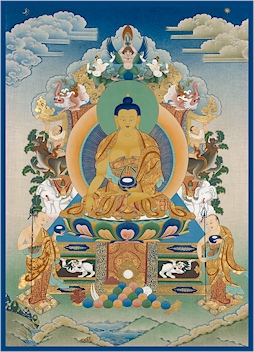
shakyamuni Buddha
en.wikipedia.org/wiki/shakyamuni_Buddha
Tibetan thangka style of Kathmandu

OM graam greem graum sah gurve namah
OM jhram jhreem jroum sah gurave namah
OM Hrim Shrim Krim Dharani Dharaya Namah
OM srideva krushnaya oorthishitaya namaha
12 Bhava
counted
from
Dhanus indriya-lagna
see also: from Dhanus Chandra
the 12 houses counted from Sagittarius ascendant
Bhava 1 - Dhanus - Haya * Sagittarius
Lagnesha Guru rules svabhava of friendly Kuja.
bhava-1 signifies fleshly vitality and personal identity .
Tanu bhava energizes individual competition for social validation based on physical behaviors and traits.
The Dhanus Learner may seek to develop the physical personality identity through association with humanistic philosophy, agreat and optimistic belief in the uplifting power of education, collegial or wisdom-oriented assemblies, public ceremonial festivities, priestly ritual, and sacred teachings.
The social personality has an inherent affinity for expansion and growth.
-
the Learner enjoys learning and traveling, religious and educational events, university life and culture.
-
Particularly influenced by one's father (whether favorably or not); one prefers an optimisticresponse to life.
Dhanus Learners are generally cheerful, positive, inclusive, opportunity-seeking, open-minded folk who have a strong philosophical interest in teaching and coaching others.
They strive to maintain a competitively knowledgeable personality and physical appearancer.
Appearance
Appearance depends significantly on Guru's condition - sign, house, companion planets, drishti, et-cetera.
-
Tendency toward a tall, broad physique with a pleasant, friendly demeanor. Shani drishti to lagna has a"can-crusher" effect.
-
Dhanus-lagna folk = kapha = milky-colored cast to their complexion, avery slightly soft moonlight patina, which may also have a subtle golden quality relative to their ethnic gene pool. Sallow-looking when ill. Longish legs.
-
Can have hip, thigh, or sacral issues if Guru is compromised.
Otherwise enjoys a reliable, healthy physical body with a Guru-driven tendency to take on weight.
Bhava 2 = Heritage Values - Makara - Draco = Capricorn
Shani rules svabhava of friend Shukra.
Graha in Bhava-2 expression prize * price * appreciation * preciousness or changes to the appreciativeness of the family (2) toward the Learner . The type of appreciation is determined by the character of the graha.
Values are conservative and traditional, speech is limited and cautious, depending on condition of Shani in D-1/D-9 . Dhanus Learners tend to carry forward the banner of family lineage by keeping to the time-honored, historical ways. (Even if those way are deeply dysfunctional, it is difficult for Dhanus indriya-lagna Learner s to alter the strong habits of the family line.)
Dhanus Learners are financially conventional folks who accumulate wealth slowly, by conservative and predictable means such as savings from fixed salaries
Learners may be able to start in a low position [Shani]; nevertheless, one expects to be rewarded for loyalty and longevity.
Knowledge of history and languages is limited by pragmatic considerations. Learners may know the minimum necessary to earn a baccalaureate diploma or obtain a job; but rarely more.
Shani has a pragmatic, sometimes oppressive, effect on aesthetic perception of material values. The artistic taste is mainstream and conventional for the culture. Dhanus folks favor simple, practical, tangible, proven values. They have conventional artistic and musical tastes for their generation and enjoy conforming to the local status quo.
Due to Shani's lordship of the house of speech, the Dhanus native not talk easily or fluently, unless there is an auspicious or liberating drishti into Dhana bhavar.
[Surya in bhava-2] * the family is charismatic, political, and theatrical with characteristically bright faces. Their style of showing appreciation to the Learner depends upon the treasury that one brings into the family coffers.
The father is primarily concerned with maintaining the financial well being of the lineage. Father may be involved in banking, archives, storage, collections, conservation, value, traditional knowledge, genetic breeding, historical records. Patriarchal figures are prone toward self-righteousness and usually the father is the solar center of the lineage.
Makara-2 indicates a pervasive materialism and conformity to the rules of the social order which characterize this lineage of family values.
[Chandra in bhava-2] * the family is sensitive and routinized in their style of showing appreciation to the Learner . Mother may be primarily concerned with maintaining the financial well being of the lineage. She can be involved with banking, archives, storage, collections, conservation, value, genetic breeding, lineage knowledge, historical records. Mother is often the center of this lineage which features pale, gently radiant moonglow faces.
The family lineage is deeply identified with the Old Ways (Soma) but feels a need to order and regulate the values of the traditional folkways.
[Chandra-Makara-Draco] * comforted by hierarchy * sensitive to class-status * needs ritual ordering * ruler of 8 resides in 2
[Mangala in bhava-2] * the family is competitive and outspoken in their style of showing appreciation to the Learner . . Brothers are dominating and vigorous. Often an athletic or warrior lineage. the Learner and the brothers are concerned with financial well-being, which is typically present at birth and energetically pursued by the Learner .
The family may be dynamically successful in their pursuit of material treasures, particularly conserving wealth derived from Mangala acts such as military invasion, forceful explorations, weaponry, engineering, surgical tools, driving, diving, drilling, plumbing, plowing, hunting, excavating, explosives.
Uttama Mangala is distinguished in competitive business. The family are a wellspring producing captains of industry.
Mangala-Makara-Draco [uchcha] * ruler of 5-12 resides in 2
[Budha in bhava-2] * the family is communicative and gesturing in their style of showing appreciation to the Learner . . Younger siblings of either gender may be managers of the financial well being of the lineage. Siblings and cohort-members can be involved with banking, archives, storage, collections, conservation, value, genetic breeding, lineage knowledge, historical records. Siblings are often active in the center of the family lineage.
Lineage expression tends to be regulatory, legalistic, and socially conservative.
[Budha-Makara-Draco] * ruler of 7-10 resides in 2
[Guru in bhava-2] * the family is expansive and inclusive in their style of showing appreciation to the Learner . . In the nativity of a wife, her husband, represented by dhava-karaka Guru, is a curator of the marriage finances. For Husbandly Learners, one's financial holdings are influenced by the paradigm of belief. The Learner's own knowledge of values and history is expanded by the presence of teacher-preachers in the family lineage. Sacred doctrine may play a central role in the family tradition.
Makara-Brihaspati presents a particular challenge to the expression of lineage values-fulfillment . The unique dysfunction of nīcha Guru is materialization of principles which guide humans toward recognition of divinity.
The family tends to overvalue temporal material acquisitions while showing a blindness toward the presence of Source divinity in all life particles. Guru also suffers kendra adhipathi dosha in this role. Nevertheless, Guru's misleading belief in the doctrine of material reality can produce family gains from schooling, border-defense, farming, real-estate and vehicles, since Guru occupies 11th-from-4th.
[Guru-Makara] = [nīcha] * ruler of 1-4 resides in 2
[Shukra in bhava-2] *the family is balanced, aesthetic, and aligned to financial well-being in their style of showing appreciation to the Learner . . In the nativity of a husbandly Learner , Shukra indicates the wife. For either husband or wife, Shukra indicates sister, sisters-in-law, aunts, and feminine associatesare lovers of luxury and beautiful in a distinctively architectural way. the Learner often has a smoothly attractive voice. The sisterly-ones are concerned with financial well-being, which is typically present at birth and improved by the contractual, agreement-making abilities of the family's women and the Learner .
[Shukra-Makara-Draco] ruler of 6-11 resides in 2 * dhanayoga
[Shani in bhava-2] * the family is delayed or stalled in their style of showing appreciation to the Learner . , but in time the necessary social approval will arrive. Shani is very comfortable in svakshetra. Shanicarya casts drishti into 4-8-11 straitening conditions in the childhood home, imposing strictures in the foundational education, limiting the inheritance, and slowing the pace of economic gains. The material treasuries may slowly and lawfully be obtained.
The family carries a weight of perceptual limitation due to materialized values, preventing it from appreciating the spirit of its own lineage. Agents of the government, officers of the social order, the elderly, hierarchs, and other Shani-figures may limit and restrain the family's acquisitions. Shani produces heavy restraint and social obligations upon the lineage, constraining but not denying wealth acquired via social rank and status. Family is often involved in the social governance traditions.
[Shani-Makara-Draco] = [svakshettra] * ruler of 2-3 resides in 2
-
Socialite-model 1963- Marla Maples Trump
Rahu in bhava-2 * The family is ambitious and seeking social mobility. Often the lineage is irregular in some fashion; most Typically, an imposter from another line is claiming legitimacy in the family line (usually a case of disguised parentage. Rahu's angle from Chandra will reveal this impostor.). Rahu-2 indicates a craving to expediently obtain the privileges accorded to the class of bankers, hoarders, treasurers, and preservers.
May an obsessive collector of status-symbol things, and use this collection as a platform for social ascendance. Makara favors social hierarchies; the family's response to the Learner is often deceptively respectful. However, if the family finds it expedient to promote and appreciate the Learner , this may occur. Yet, if the family finds it expedient to disgrace the Learner , this may also occur. Find Rahu's ruler Shani, and evaluate other graha in 2, to determine which path is most instrumental for shape-shifting Rahu.
Lineage features individual or family over-reaching [Rahu] via fabricated but mesmerizing claims to social prestige, rank, and status.
[Ketu in Bhava-2]* the family is dispersed and disregarding in their style of showing appreciation to the Learner . . The family's lineage wealth may dissipate over the period of one's lifetime. Second marriage is rare with Ketu-2, and if it occurs the spouse is eccentrically detached from oneself. Find Ketu's ruler Shani, and evaluate other graha in bhava-2, to determine which outcomes are likeliest.
Sahaja bhava Bhava 3 Kumbha - Ghata = Aquarius
Shani and His co-ruler Rahu jointly control svabhava of Budhar.
- Mental Process, communications skills, writing, messaging, sibling-cousin relationships, teamwork, commerce, short travel, publications, schedules and plans
Mental health tends to be stable but somber. Significant tendency toward depression.
the narrative, mentalized thought process may become rigid and dogmatic if Budha is also Shani-ruled.
Depending on the combined effects of Professor Shani along with Professor Rahu , the internal mentality may become extremely abstract, driven by principles and theories that the Learner has adopted out of a deep passion for scientific inquiry and radical rejection of the conventional theories.
-
Kumbha/3 is also capable of producing a powerful intellectual comprehension of networked relations in conceptual thought, if the angle between Shani and Rahu is supportive of mental engagement in contemporary challenges to standard explanatory theories.
-
In either case, whether rigidly dogmatic or radically free-thinking, the mental process can be very abstract and not easily shared with others.
Prefers to keep one's own counsel. Dislikes meetings and continuous social engagements; but will participate if their job status requires it. They are slow, careful, and terse writers who prefer established style and format. Success in writing government reports, laboratory documents, any rule-bound style.
Dhanus indriya-lagna can be confusing folk. Being Guru-ruled, they are cheerful and optimistic in personality. Yet, their inner thoughts are often gloomy and dominated by rigid beliefs * especially Mula.
-
Mentally somewhat distant from the daily chat and from the lives of siblings and co-workers
-
not a day-to-day team person by social nature, but often mentally interlinked into large, rule-driven systems such as extensive economies and communities of people and ideas. Might"know"a lot of people without having daily interaction with them.
-
Prefer to work independently, as in skilled trades or self-owned business, where they have a free, uninterrupted space and can work according to the principles they believe in with minimal interference from others.
-
If Shani = auspicious, can become financially privileged through dedicated self-initiated and self-sustained labor.
For Dhanus indriya-lagna, Rāhu the co-lord of Kumbha afflicts Sahaja bhava = business administration, commerce, the neighborhood, the work team, siblings, publications, writing, communications media, the personal internal narrative and brief travels.
Mixed signals operate in the sibling group, the cooperative neighbors, and professional work teams (3). The mental health patterns are stable and normal [Shani], but the siblings, team-mates, castmates, classmates, or neighbors may interrupt [Rahu] the steady development [Shani] of sensible narrative by interjecting passionate and risky information into the daily routine chat.
While overall a socially stable group with definite goal-orientation, the siblings and team-mates are nevertheless subject to sudden upheavals due to passionate and risky behavior. Generally, siblings and closely allied team-mates will be mentally rigid, bound to the ideological positivism of the masses, and also possessed of a culturally unusual identity. The immediate younger sibling in particular is prone to taking risks.
naturally, expect more upheaval in sibling-team group and in one's own mental narrative during any dasha of Rahu or transit of Rahu-Ketu through the Simha-Kumbha axis.
Bhava 4 - Meena - Antya = Pisces
Guru rules svabhava of friend Chandra.
- dream-guide of security
- needs an enclosed, sanctuary home property
- may conduct clairsentient or meditative activities in the home
Whether masculine-identified or feminine-identified, one takes a Spiritual-guidance role at home.
-
Generous and expansive in attitude, appreciative of the mother and a nurturing, supportive parent.
Depending on Guru's condition, tend to have a welcoming home where they enjoy the company of a large, extended family.
Likes to share warmth and optimism with everyone in the family, forming beneficent relations with nieces, naephews, and family elders in addition to one's own spouse and children.
-
the home should be a sanctuary of meditative, prayerful, reflective peacefulness
-
spirit guides are welcome here
-
sleeping in encouraged in the home. Parents and children may spend plenty of time in their bedrooms.
Quality and location of home is not important, except that it be large and fairly peaceful.
-
Likes to live near large bodies of fresh spring-fed water, such as upon the shores of a gentle lake.
Educational levels depend on Guru, but in general Dhanus Learners are satisfied with a quiet, spiritual reasonably religious education. Benefits fisher-folk.
Bhava 5 - Mesha - Aja = Aries
Kuja activates svabhava of friendly Surya.
Romance, creativity, children, performance Art, authorship, Genius
-
Theatre of competition and heroic conquest
-
performance art of athletic success, physical domination, blood, race, birth
Dynamic self-expression through competition. Depending entirely on the condition of Mars , the Self may express in an adolescent way (Mesha rules adolescence). the Learner likes kids and action; is a wonderful, natural sports coach, and expresses him/herself with vibrant, immediate, warrior-like enthusiasm. These folks like almost kind of sport, and can be successful sports gamblers if Mars is dignified and they trust their body instincts.
-
Some aggressive behavior from children, especially in adolescence - but this is well understood as natural development phase by the Dhanus native.
-
Dhanus intelligently channels adolescent instability into sports/military competition with excellent results.
Dhanus indriya-lagna make great school teachers, especially in the high schools and especially when sports coaching is part of their duty, but really at any educational level where achieving short-term goals with high energy is the pattern for success. They imbue confidence in children through competitive individual achievement.
Bhava 6 - Vrishabha - Urisha = Taurus
Shukra rules svabhava of Budha
imbalance-seeking-a-remedy
Enemies, debtm Loans, illness, Livestock, pets, servants, employees
Health-status can be compromised by sweet-tooth and sensually indulgent habits. Too much sugar tends toward weight gain and teeth problems.
-
Loves pets and usually has several in the house. If in agriculture will treat animals nicely. Fair treatment of servants and employees. Yet, if suave Shukra is unbalanced, always a risk of mixing service with sensual indulgence. Keynote for workplace romance.
Depending on condition of Shukra , has few real enemies. Generally well-liked and appreciated in their world.
Learners may get into situations requiring the negotiation of polarizing catalysis during periods of the 6th lord just like everyone else, but a sweet attitude toward conflict solves most issues.
Health is more serious problem during rogesha-6 periods, including kidney disease and sometimes excess alcohol sugars.
If alcoholic, will be a happy drunk with many friends... The problem is not social but physical, esp. because these large folk get sedentary in later life. Generally very nice people.
If Shukra-yuti-Chandra, self-indulgent and spoiled, yet so sweet in nature that one remains well-liked by all in the lower ranks. Superiors However, might not be so accommodating.
Bhava 7 * 7th from Dhanus indriya-lagna * 7th from Dhanus Chandra * 7th from Dhanus navamsha
Budha rules svabhava of Shukra.
Balanced Agreements
Marriage, alliance, partnership, agreements, trust, equity
governs the character of shared-equity alliances + one's capacity to keep promises and maintain trust
Marriage may be chatty and communicative, based in real partnership with healthy sexual energy. Mithuna = very sexual sign. Basis of sexual attraction = ākarṣaṇa = conversation!
As always, much depends as always on the condition of Budha.
Partnerships both marriage and business are busy and mentally stimulating. Capable of developing multiple peer-to-peer relationships and working successfully with both men and women.
Career may have a pronounced element of conversation and short-term socializing, school teachers who socialize after work, tradesfolk who repair to the sports bar after finishing a construction project, or sports coaches who gather after games to compare views and celebrate.
-
Contracts, agreements, legal discussions, all types of advising are easy for Dhanus indriya-lagna. Divorce is uncommon, unless the teachings of Professor Budha = subject to prolonged repetition of the key structural elements of the learning pathway (which are in reality multiple opportunities for accepting of gifts of understanding) Usually, via constrictive drishti. Yet multiple relationships are part of the contractual package.
-
This is not a contradiction when Mithuna rules bhava-7; there must be relationship variety in their lives, or they will die of boredom - but this reality casts no aspersion on their core marriage.
-
Rarely in legal disputes, but when they are, their quick access to information and relationship skill is very helpful. They enjoy a creative argument.
Spouse is intelligent, sexual, verbal, may be multilingual and/or multicultural. Spouse or another of Learner's lifepartners may be significantly younger than the Learner . Spouse = skillfull in business functions like sales, marketing, advertising, public relations etc. The marriage partners may also be business partners.
-
9th from a sthira * fixed unmoving lagna
- 7th from a dwisva * changeable = flexible lagna
- 11th from a chara * cardinal - moving lagna
bhava-7 from Dhanavana lagna * [Mithuna-Dvamdva]
Badhesha * Guru
Dvisvatya lagna typically has the experience of production of polarizing catalysis from the Other * mate, adviser, mentor, spouse, business-partner, attorney-counselor, peer colleague, etc.
~~ Bhrigu Sutram Sarga-34 Shloka-11
" If Gemini or Virgo, mercury's Navamsha, be descending,
the husband will be learned, clever and skillful."
If at woman's birth, the 7th bhava or the setting Navamsha be that of Mercury,
her husband will be very learned and clever.
Bhava 8 - Karkata - Kadaga * Cancera-Khepra
Chandra rules svabhava of Mangala.
-
Hidden Matters:
-
Joint Assets, pooled monies, secret information, emergencies,
-
Healing, rejuvenation
Sympathetic, nourishing, sheltering Chandra rules bhava-8; therefore, dhanus is fundamentally transformation-oriented and emotionally geared to a lifetime of rhythmic change. Dedicated to the surgeons, the healers, the tantriki, the camouflaged, guardians of the hidden treasures, the secret-keepers.
May defend and protect [Chandra] any secret-keeper, even a cover-up has harmed others. If Chandra is afflicted, emotionally based food issues may arise.
Cycles of death and rebirth such as surgeries and healing, shocks and recovery, and upheaval followed by the emergence of hidden truths.
-
fluctuates -- whichever bhava is ruled by Chandra the Lord of tides and flows naturally fluctuates.
-
Dhanus may undertake many cycles of rebirth and rejuvenation, often stimulated by a sudden upheaval of trust, and changes of partnership agreement.
Joint assets of marriage fluctuate and there is emotional volatility regarding the issue of hidden sexual relationships. Spouse contributes more emotional assets than material assets into the union.
Yet, the Moon is a very impressionable planet, so matters of joint marital assets, in-law relations, and inheritance will depend on Chandra's role in the radix.
Randhrabhava = 11th-from-10th; the spouse's emotional support is normally a secret source of ultimate gainfulness in Dhanus's career.
The spouse is normally from a family of equal social standing to one's own, typically, reflecting the conventional, time-honored family values of the Learner (see Shani-ruled bhava-2).
Dhanus-born Learners can access touch-based emotional healing modalities therapeutic massage quite easily. Budha rules 7 + 10. The narrative mind spins fast, especially in business dealings. For career and life in general, it particularly facilitates intuitive learning when Dhanus-born Learner shuts down mentally for short periods, to immerse in healing waters and/or massage.
Bhava 9 - Simha - Leya * Leo
Surya rules svabhava of Great Friend Guru
Principles of Philosophical understanding;
global humanism
the High Temple; University;
High-Priesthood; pontiff, proselyte, sacerdotal
Guru; Professor;
Sacred Wisdom
Father-figure; Pitri, patrons, patronage;
doctrinal instruction and paradigm of belief
human perception of Divine Law
-
Temples of Sacred wisdom,
-
preachers, pontiffs, and professors,
-
father-figures, dogma and doctrine,
-
children and grandchildren
-
mountaintop celebration of Divine Light
The inspiration and consolation of Religion is mainly experienced by Dhanus as rational moral philosophy . Their religious attention is mainly focused on the Golden Rule.
As always, if Surya is compromised , then Dhanus may suffer from irrational beliefs, dogmatism, or hypocrisy.
Dhanus indriya-lagna is very philosophical by nature, and they put great stock in their ability to know what's right. However, due to Shani's oppression of bhava-2 they frequently suffer conservative, dogmatic thinking which precludes authentic inquiry.
The father tends to show a strong personality -- possibly dominating, if Surya is excessive. Paternal-professorial types declare a morally righteous position on all philosophical debates, often out of an egoic-mind membrane drive to dominate the discussion rather than having formed an educated opinion.
Whichever bhava Lord Ravi rules = an political and dramatic center-stage for the Learner . For Dhanus-rising the realms of higher religion, political philosophy, and divine-evocation ritual = where one most robustly asserts the Self.
Dhanus-lagna combination of enthusiasm, likeability, relationship skills, and self-righteousness makes a fine politician . Often these are educators and tradesfolk who later enter politics.
egoic-mind Centrality Entitlement
The ideal religious preaching and spiritual guidance style = Guru = inclusive, non-discriminating, laughing, generous, recognizes the presence of the perfect divinity in all beings
-
If Surya the brilliant and confident karaka of Truth should become compromised by unfortunate association, Learners may develop a self-righteous (Ravi) style of preaching-teaching that is self-reflexive, intolerant, and politicized rather than generous and all-inclusive.
-
If such a disability develops, it may manifest in a religious culture of exaggerated self-importance, in which the only acceptable behavior of the sahangha or religious congregation = which directs praise and applause upon the preaching native.
-
For Dhanus-born Learners, if the teachings of Dharmesha-9 Professor Surya are subject to prolonged repetition of the key structural elements of the learning pathway (which are in reality multiple opportunities for accepting of gifts of understanding)Usually, via constrictive drishti. The empowered but constricted dharma-pati may produce religious indoctrinators and father-figures who believe (9) that they possess a superior understanding (9) of wisdom which admits no discussion or correction.
Spiritual creativity of the sahangha and their confidence in the divinity of all births may be stifled by an attention-hungry sermonizer who wishes the public to see an Ideal Father or Perfect Guru.
Bhava 10 - Kanya - Parthya * Virgo
[Busy Bantering Budha] rules svabhava of Shani
Hierarchical Rank, status
Career, profession, civic duty, social Authority, iconic Roles, public Dignity
Favors a communications career such as writing, teaching, sales, business administration, planning, scheduling, schematics, organizing, publishing etc.
Check first: lord of 10th navamsha.
With Budha = karmesha -10 , dhanus-lagna has plenty of mental energy to invest in career development. They are always thinking, analyzing, planning their next move.
Budha like Chandra is very impressionable. The fate of Dhanus's public career will vary dramatically with different positions of Budha. hey are sensitive to important, career-defining variations in information - such as, where it came from, who delivered it, how it is connected to other sources. Clearly this is a great advantage in political careers, where Dhanus flourishes; but it is also valuable for educators and trades-folk operating their own businesses.
Skillful information handling within a potentially very large system of interconnected sources (depending on Budha's strength) distinguishes the Dhanus-lagna career. Their information antennae are always working.
Bhava 11 - Tula - Vanika = Libra
[Sweetly Suave Shukra] rules svabhava of Shani
Marketplace
Networks, friendships, communities, Linkage, associations, income, Gains
Predisposition toward having a steady income and enjoying a lifetime of material goal achievement.
Shukra rules bhava-6 = imbalance-seeking-a-remedy + bhava-11 communities, friendships and marketplace associations.
Dhanus folk are popular with both friends and enemies, at least partly because Dhanus entertains with sensual pleasure. Learners enjoy expanding the social network.
Shukra's natural instinct to develop balanced relationships brings Dhanus into the company of attractive,
politically astute
[Tula] and frequently
financially privileged and/or powerful people.
Ifs Shukra
=
[nīcha] Kanya,
Seeks the company (11) of designers [Tula] ,
- partners
- arrangers
- deal-makers
- contract-crafters
- agreement-seekers
- match-makers
- negotiators
- arbitrators
- diplomats
- traders
- those interested in all of the details of harmonious relationships.
If Shukra is ill-disposed, in dusthamsha, or in Kanya, the traders can be trading illicitly, and the deals made may be quite suspect. Whether the outcome of the relationship sought is positive or negative in the end, the Dhanus native enjoys the company of those seeking to establish relationships.
Shukra Vriddhi-pati-11 favors friendships with women, including pleasant association with female co-workers, neighbors, teachers, teammates, sisters and aunts.
Most likely friends are fashionable, diplomatic, and elegant in character. Particularly Feminine Learners . Yet, husbandly-figures with well-developed talent in art, music, and design are also among the favored links in one's network of associates.
(Less so with [nīcha] shukra.)
A male may be true friends with his female companions; no impropriety is required. Artistic interests are shared among friends. Splendid for arts community, development work in fine and performing arts; arts and music education at the university and global levels;
Most pronounced tangible effects naturally require an empowered Shukra
if rogesha-6 in 11:
Presence of rogesha-6 Shukra in 11 can indicate one who becomes friendly with excessively sensual persons or who has financially privileged but self-indulgent friends. Female friendships may endanger the marriage.
Bhava 12 - Vṛścika - Thriketta = Scorpionis
Kuja activates svabhava of great friend Guru.
Dissolution of the Physical Identity
-
Meditation, sanctuary, confinement,
-
Privacy, dissolution of Form, Loss of Identity
Predisposition to expansive and intense private bedroom and fantasy activities. The dream life is passionate and the spirit guides are active. Nevertheless, Ketu (co-ruler of Vṛścika) may cause the Learner to disregard to the dream-fantasy information, so that much psychic building energy is lost through undirected sexual indulgence.
The meditation and inner sanctuary house is somewhat disrupted by Kuja's ceaseless quest for prey. Kuja is the hunter. Dhanus folk might never completely relax. Vyaya bhava is also the house of bed pleasures and other private sensual enclosures. Unless Kuja is weakened, dhanus folk typically have an active and communicative sexual life.
Body-calming meditation and spa-type deep relaxation are accessible to Dhanus-lagna when they can turn off the mental machine. They enjoy vigorous, demanding types of meditation which require discipline and profound self-inquiry. They like to go hunting in their own subconscious.
Enemies of the marriage, always indicated by the ruler-of-12 and graha within vyaya bhava, tend to be males with penetrating sexual energy. They may be touch healers, or mind-healers, magicians, or tantric teachers.
Dhanus-lagna enjoys foreign travel. If Kuja is strong, may take up residence in a foreign land during Kuja's periods. Often they are engaged in battle or secret missions during these travels. Their bodies are fortresses.
Can withstand tough spiritual discipline such as long winter retreats. However once they have reached their planned goal, they return quickly to the world.
For Dhanus indriya-lagna, Ketu afflicts vyayasthāna-12 Of dreams, meditation, psychic communication with the astral plane and its inhabitants, sanctuary spaces, the private bedroom, extended travels
The Dhanus native is raised with an active [Kuja] even dominating but also psychically ambivalent [Ketu] approach toward asserting one's ability to communicate with astral beings. The private bedroom life is muscularly strong and sexually active but also very sensitive psychically. he bedroom companions and spirit guides are natural tantrik healers .
Dream signals may be confused: on the one hand, Kuja gives sexual prowess, muscular competitive strength, and a joy in movement. On the other hand, Ketu contributes a mystical detachment which can result in a fundamental ambivalence toward the value and use of meditative and intuitive perceptions. Learners may feel too psychically restless to meditate , and thus one's sense of spiritual direction in life may be rather elusive.
Kuja's warrior confidence and Ketu's lack of boundaries combine to create a tendency for the private bedroom lifestyle and extended foreign travels to enter physically dangerous situations .
Self-destructive behaviors may emerge during Vimshottari bhukti of Kuja or Ketu. If Kuja is ill-disposed the Learner must be exceptionally careful when traveling in foreign lands.
The Vṛścika psycho-physical healer's complexmainly affects the inspirational fantasy life and the spirit guides, particularly those guides who occupy one's own ancestral lineage. Self-destructive and anti-marriage (12th= 6th-from-7th) private behaviors along with Ketu-style denial may arise, if Kuja is ill-disposed. If Kuja occupies 12, Learners may prefer to avoid conventional marriage.

[How Readings Work] [Sample Sacred Jewels Ratna Recommendation [Seva]
 file update =
07-Jun-2026
file update =
07-Jun-2026
[Copyright © 1994-2034 by Barbara Pijan Lama] = [Contact] = [How to Request a Jyotishavidya Reading]
Barbara Pijan Lama Jyotishavidya Vedic Astrology Surya Sun Chandra Moon Mangala Mars Budha Mercury Guru Jupiter Shukra Venus Shani Saturn Rahu Ketu Graha Planets Dasha Timeline Calendar Nakshatra Navamsha Marriage Children Treasury Career Spiritual Wisdom Cycles of re-Death and re-Birth
The information on barbarapijan.com , including all readings and reports, is provided for educational purposes only. Wishing you every happiness and continuing success in studies!