|
only search B.P. Lama Jyotishavidya |


D-12 Dvadshamsha
Dvadashans
Dvadashasam
Dvadashaunsh
Sambhu-Varga
the 1/12 Portion
Twelfth Divisional Chart
fruits of the parallel lives
parents
disambiguation: the D-12 varga = different from the dvadamsha table of 144 portions
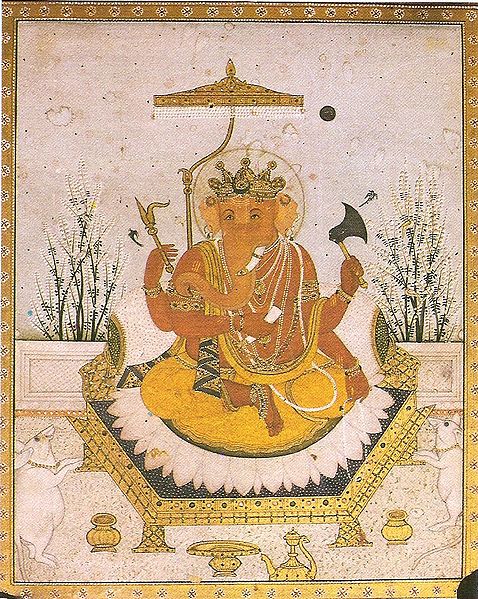
Four-armed Ganesha
Miniature of Nurpur school, circa 1810.
Museum of Chandigarh
QUOTATION from
BPHS Sarga 6: Shloka-15.
- Dvadashamamasha-10
" The reckoning of the Dvadashamamsha -10 (one twelfth of a Rashi, or 2 degrees degrees each) commences from the same Rashi.
In each Rashi the presidency repeats thrice in the order of
- Ganesha,
- AśviniKumara,
- Yama
- and Sarpa
for the 12 Dvadashamamsha -10 ."
* * Accuracy of divisional charts depends entirely on accuracy of birth time
.**Varga charts can be exceptionally useful.
However, if accurate birth time is not available, divisional charts are misleading, and should be ignored.
D-12 = Field of Psychic Expectation for Matters of
- the Parents
- fruits (11) of past-life identity (12)
-
To determine the prognosis for parentage, look first (of course) to all the effects upon karma-bhava [the radix tenth house] representing the baseline of social rank, respectability, and status. For emotional experience of the childhood home and the parenting style of one's primary caretakers, see bhava-4.
-
The bhava which defines and energizes parents sits in 3/11 angle to the dignity-house 10: it is Vyaya bhava, the 12th house of psychic communication, sanctuary, and retreat.
-
Clearly, choosing good parents through psychic networking in the pre-conception astral state (12) is one of the central goals of meditation and spirit communication.
-
Then look to the condition of vyaya bhava in the radix. Will vyaya bhava generate the community support (11) and personal courage (3) necessary to realize its goals? Can it generate public dignity, high levels of social permission, and scope of social action?
-
Outcome depends on the relationship between the 3/11 houses, their rulers and their occupants .
-
Once the radix 3/11 relationship is established, look for confirmation of the fruits of the 12th house in the twelfth divisional chart: D-12 or Dvadash-amsha. Dvadashamamsha -10 reveals fine detail of how the results of pre-birth kibitzing / communication with the ancestors will manifest.
-
The central result of psychic communication being the setting of permission levels, we gain from Dvadashamamsha -10 (presuming an accurate birth time) a confirming level of detail regarding parentage.
Kinship relations in
D-10 varga
-
To see details of the father in Dvadashamamsha -10 , find either
9th-from-lagna or 9th-from-Surya in the D-12(whichever is stronger).
-
To see details of the mother in Dvadashamamsha -10 ,
find 4th-from-lagna or [4th-from-Chandra] in the D-12 - (whichever is stronger).
-
For father, see also the bhratri-karaka, which is the graha holding the 3rd-highest degree in any rashi within the radix.
-
For mother, see also the matri-karaka, which is the graha holding the 4th-highest degree in any rashi within the radix.
-
For father, see Surya and Guru. Graha in dharma bhava, and dharmesha-9 , for the material relationship with Father and his moral belief system. 9th-from-Chandra for the emotional relationship with father.
-
First husband in a woman's nativity, see Guru and the dara-karaka.
-
For mother, see Chandra. Graha in Bandhu bhava, and bandesha-4 , for the material relationship with Mother and her cultural manners and roots.
-
wifely-companion displayed in a masculine nativity, see Shukra and the dara-karaka.
- Mesha
- Vrishabha
- Mithuna
- Karkata
- Simha
- Kanya
- Tulā
- Vṛścika
- Dhanus
- Makara
- Kumbha-Ghata
- Meena - Antya
- Vrishabha
- Mithuna
- Karkata
- Simha
- Kanya
- Tulā
- Vṛścika
- Dhanus
- Makara
- Kumbha-Ghata
- Meena - Antya
- Mesha
- Mithuna
- Karkata
- Simha
- Kanya
- Tulā
- Vṛścika
- Dhanus
- Makara
- Kumbha-Ghata
- Meena - Antya
- Mesha
- Vrishabha
- Karkata
- Simha
- Kanya
- Tulā
- Vṛścika
- Dhanus
- Makara
- Kumbha-Ghata
- Meena - Antya
- Mesha
- Vrishabha
- Mithuna
- Simha
- Kanya
- Tulā
- Vṛścika
- Dhanus
- Makara
- Kumbha-Ghata
- Meena - Antya
- Mesha
- Vrishabha
- Mithuna
- Karkata
- Kanya
- Tulā
- Vṛścika
- Dhanus
- Makara
- Kumbha-Ghata
- Meena - Antya
- Mesha
- Vrishabha
- Mithuna
- Karkata
- Simha
Tula
- Vṛścika
- Dhanus
- Makara
- Kumbha-Ghata
- Meena - Antya
- Mesha
- Vrishabha
- Mithuna
- Karkata
- Simha
- Kanya
- Vṛścika
- Dhanus
- Makara
- Kumbha-Ghata
- Meena - Antya
- Mesha
- Vrishabha
- Mithuna
- Karkata
- Simha
- Kanya
- Tulā
- Dhanus
- Makara
- Kumbha-Ghata
- Meena - Antya
- Mesha
- Vrishabha
- Mithuna
- Karkata
- Simha
- Kanya
- Tulā
- Vṛścika
- Makara
- Kumbha-Ghata
- Meena - Antya
- Mesha
- Vrishabha
- Mithuna
- Karkata
- Simha
- Kanya
- Tulā
- Vṛścika
- Dhanus
- Kumbha-Ghata
- Meena - Antya
- Mesha
- Vrishabha
- Mithuna
- Karkata
- Simha
- Kanya
- Tulā
- Vṛścika
- Dhanus
- Makara
- Meena - Antya
- Mesha
- Vrishabha
- Mithuna
- Karkata
- Simha
- Kanya
- Tulā
- Vṛścika
- Dhanus
- Makara
- Kumbha-Ghata
An Open Heart: Practicing Compassion in Everyday Life
ed. Nicholas Vreeland
" If we have been reborn time after time, it is evident that we have needed many mothers to give birth to us. ... the first cause bringing about bodhicitta is the recognition that all beings have been our mother.
The love and kindness shown us by our mother in this life would be difficult to repay. She endured many sleepless nights to care for us when we were helpless infants. She fed us and would have willingly sacrificed everything, including her own life, to spare ours.
As we contemplate her example of devoted love, we should consider that each and every being throughout existence has treated us this way. Each dog, cat, fish, fly, and human being has at some point in the beginningless past been our mother and shown us overwhelming love and kindness.
- Such a thought should bring about our Appreciation . This is the second cause of bodhicitta.
As we envision the present condition of all these beings, we begin to develop the desire to help them change their lot.
- This is the Third cause, and out of it comes the fourth , a feeling of love cherishing all beings.
This is an attraction toward all beings, similar to what a child feels upon seeing his or her mother.
- This leads us to compassion, which is the fifth cause of bodhicitta . Compassion is a wish to separate these suffering beings, our mothers of the past, from their miserable situation. At this point we also experience loving-kindness, a wish that all beings find happiness.
As we progress through these stages of responsibility, we go from wishing that all sentient beings find happiness and freedom from suffering to personally assuming responsibility for helping them enter this state beyond misery. this is the final cause.
As we scrutinize how best to help others, we are drawn to achieving the fully enlightened and omniscient state of Buddhahood. [end quote]

Copyright 1994-2094 by Barbara Pijan Lama file update =
24-Sep-2022
file update =
24-Sep-2022
Barbara Pijan Lama Jyotishavidya Vedic Astrology Surya Sun Chandra Moon Mangala Mars Budha Mercury Guru Jupiter Shukra Venus Shani Saturn Rahu Ketu Graha Planets Dasha Timeline Nakshatra Navamsha Marriage Children Wealth Career Spirituality Wisdom Death
The information on barbarapijan.com , including all readings and reports, is provided for educational purposes only. Wishing you every happiness and continuing success in studies!