
The Vexed Question of
Ayanamsha
Choosing the Rate of Equinoctial Precession
BP Lama Jyotishavidya uses Chitrapaksha Ayanamsha
recommended
-
brief, clear discussion of tropical vs sidereal [western vs. vedic] by historian of religion and astrological scholar Martin Gansten www.martingansten.com
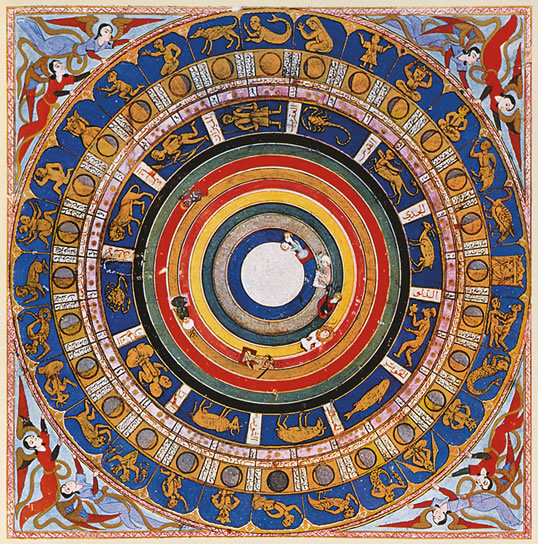
Zubdet Ut Tevarih by Lokman, circa 1583
Topkapi Palace Museum
Bridgeman Art Library
" This celestial map or macrocosm is the opening miniature in the Turkish Zubdat al-Tawarikh, or"History of the World" , showing the seven heavens above the Earth, signs of the zodiac and the 28 lunar mansions." www.saudiaramcoworld.com/issue/201005/arabic.in.the.sky.htm
What is Ayanamsha?
- en.wikipedia.org/wiki/Ayanamsa
Table of mainstream precession rates , as listed by Jyotisha software programmer Das Goravani www.goravani.com
|
Ayanamsha |
Precession rate |
Start year |
|
Lahiri |
50.2719 |
285 CE |
|
Krishnamurti |
50.2388475 |
291 CE |
|
B.V. Raman |
50.33 |
397-CE |
|
Fagan-Bradley [western sidereal] |
50.25 |
221 CE |
|
Yukteshwara |
53.9906 |
499-CE |
Ayanamsha = precession rate
= precessional distance regarding the precession of the equinoxes.
Aya = period of time [cognate to English era, year]
- Ayana = progress
- = forward movement along a pathway = yana
-
Amsha = portion = section
The precession of the equinoxe smeans that the four equinoctial points [spring, summer, autumn, and winter equinoxes] are constantly moving. They will rotate [backwards] through all 360 degrees and return to their starting point every 25920 [solar] years.
There are several viable choices available regarding precessional
[1] start year
[2] rate of movement
The discussion about these choices makes the question of correct ayanamsha a thorny professional issue for practitioners of Jyotishavidyar.
BP Lama uses Chitra-Paksha Ayanamsha
Mr. Lahiri.
The Lahiri Committee.
Lahiri Ayanamsha
Standard Lahiri
-
precession rate = 50.27
-
start year = CE 285
Lahiri ayanamsha is sanctioned by the Government of India and is a very popular metric.
However, keep in mind that Lahiri Ayanamsha was determined by the Lahiri Calendar Committee, of which Shri Lahiri was the chairman.
As the saying goes, camel is a horse that was designed by a committee :)
Generally, Lahiri Ayanamsha works fairly well in practice.
However, many Jyotiṣika use Lahiri because it is popular - not because they have rigorously tested it against other options.
Also, consider that Learners may find several different versions of "Lahiri"
Some Jyotishavidya software sets a conventional Lahiri ayanamsha at 50.2719 seconds/year rate of precession, starting from the year 285 CE.
Other practicing Jyotiṣika may use numbers both higher and lower than 50.2719, and/or different start years. It may nevertheless be claimed that they use a standard Lahiri ayanamsha .
Shri B.V. Raman's Ayanamsha
Of the numerous non-Lahiri ayanamsha options, most are very esoteric and used only by special lineages or research interests.
Krishnamurti ayanamsha and Raman ayanamsha are probably the two most popular non-Lahiri choices.
A unique ayanamsha was developed by 300 Combinations 1912-1998 Jyotiṣika B. V. Raman. This aya-amsha was published by Shri Raman during his lifelong research into the scriptural and technical foundations of the knowledge tradition of Jyotishavidya.
Shri Raman published his research extensively in English. His primary vehicle for dissemination of research and opinion was the famed Jyotisha periodical magazine, Astrological Monthly. Raman wrote and published both case-studies and interpretations of classic texts over a period of fifty plus years.
d. Raman wrote dozens of clearly argued English-language books that articulated the principles of Jyotishavidya. Many Jyotiṣika who had been educated in English-medium schools were influenced by his scientific attitude. Respect was inspired by his grasp of the ancient Sanskrit, tamil, malayalam, and other historic sacred literatures.
Most importantly, bVR devoted many years of his life to researching the astronomical and mathematical foundations of the legacy Jyotisha calculations which produce the various dasha calendars.
d. Raman's reputation for thoroughness in his research convinced many readers of the validity of his ayanamsha and they expected superior results.
Following the dominant popularity of mainstream Lahiri ayanamsha and its variants , bV Raman's uniquely calculated ayanamsha is a favorite among his students.
Ayanamsha mentioned by Holy Science 1855-1936 Shri Yukteswara Giri
Followers of Autobiography of a Yogi 1893-1952 Swami Yogananda have requested that their nativities be calculated using the ayanamsha of Swami Yogananda' s highly respected guru Shri Yukteshwar .
Shri Yukteshwar's ayanamsha is significantly out of the range of conventional precession rates, and is used by only a very small minority of working astrologers. This unique navamsha may be more useful for the study of larger cosmic patterns and perhaps less useful for the task of framing individual human life events.
After reading the SSY's inspiring account of yuga time cycles in The Holy Science = Kaivalya Darshanam , shri Yukteshwar's ayanamsha seemed worthy of experimental application.
but sadly, using real people's birth data and confirming with biographical events from their real lives in mundane earth time, shri Yukteshwar's ayanamsha does not test successfully compared with Raman or Lahiri or the ayanamasha of choice = chitrapaksha.
Additional ayanamsha options
Learners may have a doctrinal or devotional reason to prefer an ayanamsha favored by the person's spiritual lineage. Upon special request and explanation, it may be justified to use the pet ayanamsha of honored spiritual teachers.
Other ayanamsha options include Krishnamurti, proposals of American Rick Houck [who pioneered intensive Jyotishavidya research using computers] , and various western" sidereal" positions.
Practical considerations : discussion and application
The scope of Jyotishavidya evaluation may consider individual lives, fate of nations, or historical time cycles.
After the practitioner has decided which ayanamsha produces the most satisfactory results within the scope of one's own practice, there is no need to keep shopping.
there is no one single final fixed view on correct ayanamsha. Nor does there need to be.
Special research purposes may require attunement with special ayanamsha rates.
I'm learning Astrology both Vedic and Western. I'm reading the Vedic Astrological Books of One of the Great Astrologer of present time Late d. B.V.Ramanji for 4-5 years.
I've a great respect for him. I've a problem Barbara regarding Ayanamsha- when I searched the web for"which Ayanamsha to use"-I got your Article there-written about all the hindu/vedic Ayanamsha-It was very informative-Thank you!
Though I'm a follower of Ramanji and I should use his Ayanamsha without any doubt but since I'm a North Indian and we use Lahiri's Ayanamsha
[by Default Software also selects it.] I was using Lahiri's Ayanamsha for preparing any Chart for a long time. For me it's Dasha -Pratayantar Dasha all were seem to be correct.....But now I'm in a doubt. When I use Raman's Ayanamsha-The Navamansha Chart-I got-I think is very Correct. And Dashamansha Chart is also right I think. and This Navamansha explains my Nature very correctly.
You said that you use Lahiri's Ayanamsha-Since you're a professionaI Astrologer and you're practicing it for quite a long time so I want to know from you-Don't you think The Chart prepared by using Raman's Navamansha gives right Reading than Lahiri's? As we know that we're handicapped without Navamansha Chart-and without seeing it we can't give any prediction very correctly. It is the most important Sub-Chart.
[and please tell me For Rahu-Ketu-Which Value do you use-True or Mean ?] Thanks.
A: Namaste,
Like you, I am a grateful student of the eminent teaching practitioner, Shri Raman.
I met Shri B.V. Raman in 1993 when he was already quite elderly, and I was impressed with his sharp mind as well as his deep humility. In respect for Sri Raman as a writer, translator, and teacher, iapplied Raman's ayanamsha to a variety of Jyotishavidya calculations for several years.
To test and prove, icompared the Vimshottari dasha periods emerging from the lunar degree which would be obtained by Raman's ayanamsha against the known life events of family members and historical figures.
The Vimshottari Dasha sequence produced by calculations made from the Raman Ayanamsha do not match normal biographical event narratives in most cases.
Therefore despite my great respect for Shri B.V. Raman, more conventional Lahiri ayanamsha for making predictions about the unfoldment of experience within the context of individual lives.
It seems wise to leave open the possibility that Raman's ayanamsha, along with the ayanamsha proposed by Shri Yukteswara Giri and additionally several other notable ayanamsha
[precession] rates proposed by other luminaries of Jyotishavidya, can be used successfully to predict larger-scale matters of the fate of nations, big time cycles = yuga, and other greater-than-individual paths.
Raman Ayanamsha tends to produce poor coordination between the real-life events and Vimshottari periods of the expected bhava-pati.
When applied to correct birth datam the Chitra-Paksha Ayanamsha nearly always produces consistently accurate results.
-
Birth of the first child nearly always occurs in the mother's Vimshottari period of [1] Guru or [2] vidya-pati-5 or Dharmesha-9 as counted from the Earthen-body birthing indriya-lagna or as counted from Chandra-lagna
[janma-lagna]
-
Educational diploma usually obtained in periods of [1] Budha or [2] bandesha-4 + samatā-pati-7[4th-from-4th]
-
Dematerialization normally occurs during bhukti of [1] dhanapati-2+ samatā-pati-7as counted from the Earthen-body birthing indriya-lagna]
[2] bhukti of Rahu or Ketu, particularly when they are giving effect of dhanapati-2+ samatā-pati-7[3] Shani [4] yuti-graha giving the effect of the maraka
-
dematerialization of father in bhukti of ruler of either 2nd-from-Surya or 7th-from-Surya .
-
dematerialization of mother during bhukti of either 2nd-from-Soma -- 7th-from-Soma -- 2nd-from-bandhustana -- 7th-from-bandusthāna
Broken yoke [un-yoga] = health, relationship, social, financial crisis = periods of rogesha-6 + vriddhi-pati-11 , or Shani.
Other associations stated by Parashara = work properly the great majority of the time using the Chitra-Paksha Lahiri ayanamsha.
TESTING an ayanamsha
Marriage timing offers a useful test of ayanamsha , because timing of marriage can be reckoned using bhukti-pati of navamsha 1-7.
Using Raman's ayanamsha produces very poor event-timing results in practice.
However, when using Lahiri, marriage occurs reliably in the bhukti of the lords of the first or seventh * navamsha*, or any of the graha-karaka: Shukra, Shani, or Rahu-Ketu.
Also, with timing of marriage, asecond condition must be fulfilled: samchara Rahu-Ketu must be transiting through one of five axes: lagna of kundali or navamsha, naatal nodal axis in either kundali or navamsha, or the axis of Janma-Chandra.
With Chitra-Paksha ayanamsha, if the kundali does not offer a lagna, moon, or Rahu-Ketu axis to satisfy the marriage conditions, then the navamsha R-K or lagna will supply the necessary match.
With Raman's ayanamsha, if the jundali does not supply the necessary nodal axes, raman's rendering of Svamsha and navamsha Moon will not always provide the match. The result is an unhappy situation in which timing of marriage cannot be predicted, or a historic marriage date cannot be used to validate the nativity.
Folks are often emotionally attracted people to the poetry of their navamsha patterns, when they think - as you say -"this explains my nature very correctly" .
Navamsha is the field of one's true dharma more fully articulated; D-9 shows our secret strengths, subconscious expectations, and inherent wisdom - our"better self" . So, if Raman's ayanamsha creates a more intriguing or flattering navamsha, it might be tempting to honor the poetic image of nicer planets.
My own Jyotisha practice is focused on the tasks of [1] making sense of the order of past events while [2] attempting to offer reliable predictions of future events.
I am less inclined to the typically western psychological or poetic style, and more inclined to predictive accuracy.
I am sure that there are some legitimate uses for the western poetic-psychological-archetype approach to astrology [such as in Jungian psychotherapy] , but my personality is more research-oriented.
Therefore my own test results have cemented my decision to stick with Chitra-Paksha ayanamsha into the foreseeable future.
However, another Jyotiṣika might be researching other types of events - perhaps political or economic events, or other non-personal/national/global level phenomena. This researcher might use different tests and get different results. Ican only report on the research I have done myself.
It will be a grand day when Jyotiṣika worldwide can contribute peer-reviewed research to scholarly journals and present their results at conferences, so that a wider basis of understanding can be established in the international Jyotisha practice community.
BTW: mean positions for Rahu-Ketu ]
wishing you every success in your study of the samayavidya,
BP Lama Jyotisha
A: Namaste,
No, tropical zodiac is not used in any way.
Theories should be empirically tested with as much data as possible. Testing a theory against the subjective, unclear personal experience of one's own perceptions will not produce a definitive proof or disproof.
The internet provides abundant biographical data for complete lifetimes of notable persons.
If you have an affinity for the tropical zodiac, it would be recommended to test the nativities of public figures such as military leaders, politicians, royalty, famous authors, celebrities.
Does the tropical zodiac accurately predict the events of their lives which have been recorded, verified, and known to the public?
People believe all sorts of foolishness that has nothing to do with consensus reality. Consensus reality includes definitions of events based on Earth-time and physical locations in space.
Humans generally agree on matters of clock time when something happened and where it occurred [...except lawyers of course] .
Test your beliefs. Do the interpretative modalities of tropical style succeed in accurately predicting the consensus reality results?
wishing you every success in your study of the samayavidya,
BP Lama Jyotishavidya
I have a question for you about the information you have on your website about vedic astrology.
Particularly about the Chandra in [Nakshatra] pages. Are they written according to South Indian astrology or to North Indian, because I notice that when using South Indian astrology the degrees change and Therefore, Chandra changes, when I calculate my chart.
So I don't know whether to read Pūrvābhādra pada Chandra or Uttarabhadrapada.
Hopefully you will clear this up. Thank you for your time.
A:
Oops, it looks like several separate concepts have become conflated.North and South Indian Jyotisha traditions share the same core scriptures and use identical astronomical calculations.
An individual practitioner may vary in accuracy or choice of ayanamsha.
- en.wikipedia.org/wiki/Ayanamsha = easy starting place for the learner
North Indian and South Indian Jyotisha traditions differ in several style traits which do not alter the core logic of the samayavidya. For example, there is regional variation in traditional graphic representations.
- Northern traditions show the Persian aesthetic influence in the diamond pattern graphic of the kundali.
- Southern traditions favor a rectangular graphic.
There is also considerable diversity in prescriptive remedies, great majority of which arise from the local folk traditions and natural pharmacology.
For example
- Lal Kitab [the red book] represents a north-western Bharati tradition much influenced by old Persian worldview. Lal Kitab remedies remain quite popular in in the northern cultures and their worldwide diaspora, including the Caribbean region where many families of northern Indian descent have settled.
- Many of the southern Tamil Jyotishavidya texts present a uniquely Dravidian cultural orientation. Southern remedies tend to call upon local folk deities and utilize herbs which grow naturally in that region.
The nativities which appear on this website are calculated via the Chitra-Paksha Lahiri Ayanamsha
- start year = 285 CE
- precession rate = 50.2719
" Lahiri" = the surname of the man who served as head of the calendar committee. This commitee determined the official ayanamsha for the Government of India to be used for purpose of calculating festivals, panchanga , etc..
The mainstream ayanamsha in both the South Indian and North Indian traditions is Lahiri, but various lineage teachers have developed their own research ayanamsha. Several additional alternatives - for example Krishnamurti ayanamsha - are quite popular around the world.
The question you are asking appears to address not a distinction of north vs. south, but rather a distinction of ayanamsha. It might be helpful to check your software settings.
wishing you every success in your study of the samayavidya,
BP Lama Jyotishavidya
Q:
Subject: Query
How useful is the Fagan Bradley ayanamsa? I was born on 18 September 1960 at 1355 hours in India Delhi. As per Lahari calculation Jupiter is in Dhanus 1'48'14 but as per Fagan Bradley at 0 degree. Similarly Moon is in Leo but as per Fagan Bradley it is 0 degree and the dates of dasha and Mahadasa change?
What is your advice? ]
A:
Namaste,
Thanks for your note. No opinion available on the Fagan Bradley ayanamsha .
It might be a great contribution to the worldwide Jyotishavidya community if you were to complete a replicable test.
For example, auseful test might consist of 50 public-figure nativities assessed via Chitra-Paksha Lahiri Ayanamsha compared to 50 public-figure nativities assessed via Fagan Bradley ayanamsha.
Wishing you and your family every happiness, healing from sorrow, guidance by inner light, and success in all of life's endeavors,
Barbara Pijan Lama, Jyotishavidya

[How Readings Work] = [Seva]
 updated:
16 October 2026
updated:
16 October 2026
[Copyright © 1994-2034 by Barbara Pijan Lama] = [Contact] = [How to Order Jyotishavidya Readings]
Barbara Pijan Lama Jyotishavidya Vedic Astrology Surya Sun Chandra Moon Mangala Mars Budha Mercury Guru Jupiter Shukra Venus Shani Saturn Rahu Ketu Graha Planets Dasha Timeline Calendar Nakshatra Navamsha Marriage Children Treasury Career Spiritual Wisdom Cycles of re-Death and re-Birth
The information on barbarapijan.com , including all readings and reports, is provided for educational purposes only. Wishing you every happiness and continuing success in studies!