

-
D-3 Dreshkamsha = [drekkana]
-
D-24 Siddhamsha = [Chatur-vimsh-amsha]
-
D-40 Khavedamsha = [Chat-varimsh-amsha]
नव nava = nine
नवांश navāṃśa
Navamsha
= ninth fraction, ninth distribution
D-9
Navans - Navamsam
नक्षत्रपद nakṣatra-pada
धर्मवर्ग dharma-varga
the 1/9 Portion
1/4 of a rashi = 03-deg-20-min
Ninth Divisional Chart
Ninth Divisional Chart
the fruits of higher understanding
worldview
core beliefs
dharma
"We look after two worlds"
~~ Mavis Pittilla
 topics related to Navamsha
Navamsha Assessment = sample first-pass reading
-
Pushkara Navamsha = auspicious one-ninths portions
-
Links between native's D-1 and partner's D-9 (and reverse)
Caveat emptor!
* * Accuracy of divisional charts depends entirely on accuracy of birth time .*
Varga charts can supply a useful adjunct perspective upon the significations of the graha.
However, if accurate birth time is not available, divisional charts are misleading, and should be ignored.
Q:
Why does Jyotishavidya make murky claims about the predictive power of the navamsha varga? I understand that it has a technical role in predicting certain features of marriage [you say that it determines marriage timing] but really, what is it for?
A:
The relationship between [D-1] and [D-9] represents the always-rebalancing alliance between
- the waking five-senses awareness [D-1]
- the sleeping dephysicalized dream awareness [D-9]
School of Earth has two sides of the coin.
Both the so-called waking state [D-1] and the symbolic-communication patterns of the dream-world [D-9] work together to generate the Learning Pathway.
In practice, the [D-9] and the [D-1] are usually aligned for most purposes. The [D-9] lagna, often called svamsha , is a very useful metric for describing the underlying identity. Among the various personality-structure lagna, consider the nakshatra of the svamsha to carry personality-defining weight.
When the D-1 outcomes are contradicted by characteristics of the D-9, it means that the person has a learning objective which specifically requires them to negotiate the gap between
- deeply held ancestral beliefs (often residing below consciousness)
- consensus-reality level of social-material expectations reinforced by physical sense data.
For a goal-oriented person wishing to manifest their highest desires, detecting and adjusting subtle negative beliefs can be a high-value learning experience.
Generally the [D-9] limitations represent ancestral fears, sustained by a family heritage. The incarnational group (usually a family) agrees to form a limiting fence around its members, which serves as a psychic safety net. When the person is ready, they may start finding intrinsic limits, and they may want to discover what this inner conflict is doing.
This type of contradiction could be framed as a gap between socially approved identity [D-1] vs unconsciously held beliefs about oneself [D-9] .
Rebalancing the two side of the coin - what one claims to know vs what one more deeply believes - can result in improved health and optimism about life.
Q:I think of the navamsha as a map of who I am becoming.
I am trying to judge
whether, based on the Rahu-Ketu placements in D-9, I am better suited to either a
future in finance or a future in social work.
but I am getting stuck on the differences between different ways of
calculating the Rahu-Ketu placements in D-9.
To make matters worse, some of my " cusp " planets at the end of Cancer,
scorpio, and Pisces can " jump " wildly in the navamsha just by adding a
single degree.
As a sincere student of Jyotish, I am feeling misled by my own hopes to
see into the future.
Can you help me see the way to use D-9 information to predict my future
self? A:
The navamsha varga generally displays the psycho- emotional and higher-astral features of the terrestrial personality (such as predispositions and polarities).
The radical kundali displays primarily the social and material outcomes.
The navamsha astral map might not be the ideal tool for predicting the material-plane future. Use the D-1 for material-plane predictions (or sometimes the bhava-chalit).
The Learner = not so much "becoming " the D-9. The Learner " is " the D-9.
See You on the Flip Side
All beings are alive in multiple lifetimes
and multiple dimensions.
D-9 shows
one of those dimensions of ongoing and simultaneous experience: the astral life
which is occurring in the always-on,
mirror-image obverse of 3rd-dimensional Earth life.
The social memory complex called Ra has a useful nomenclature for
separating these two sides of the terrestrial coin.
Ra refers to the social-material plane as
Time-Space
(where Time controls the flow of experience and Space is secondary). Ra
refers to the astral plane which surrounds
and interpenetrates Earth as
Space-Time (where Space controls the flow of experience and Time is
secondary.)
Astral (akashia) Always Engaged
Humans have predominantly astral consciousness for typically 8+ hr/day during their sleep state. The human attention shifts into the material consciousness for the remaining 16/hr/day. Yet evenwhile one is "awake" , the astral information is always humming in the background. It is delivering a steady stream of other-life experiences, weird fears and lusts, prejudices and phobias, fantasy expectations, and - for some - profound intuitive certainty, clairsentience and claircognizance, and bliss.
In fact, for those who are aware of it, adetailed always-running view of the astral world is always accessible in the waking state. It can be known by watching the viewing screen that dispalys at the edge of the field of awareness. It runs like cinema with a continuous stream of images, dialog, and music.
However, so few people know how to watch this screen, so few have lucid recall of their astral lives (dreams), and so few meditate or engage in contemplative reflection, that the attributes of D-9 may seem unreal, mysterious, or woo-woo.
How Many of Me Are There?
Folks may ask, "how can there be two of me, one D-1 and one D-9? "
There are always two versions of the person operating in this planetary dimension and on further inspection there are many more also.
There is nothing mushy, poetic, or super-esoteric about the D-9 map. It is the astral you. The D-9 is a bit more originating than the D-1 because the astral you precedes the material you. Learners may fabricate the incarnational plan while in astral consciousness, endures the plan under material duress, then returns to the astral resting place.
D-9 is the pre-determiner * Mind (D-9) is the Builder
As the great psychic channel Earth Changes 1877-1945 Edgar Cayce often repeated, "Mind is the Builder! "
Of the two planes, astral versus material, the astral patterns are lighter and more agile and Therefore, slightly antecedent to the material patterns. So it might be more clarifying to appreciate that the D-9 self works to pre-determine the range of possibility of the D-1 material outcomes. In other words, what you really want is more accurately seen via D-9, and the D-1 shows what you may do within the confines of the material plane in order to skillfully, materially, tangibly manifest that deeper D-9 truth .
The D-1 shows the map of the material experience and the D-9 is the map of the astral experience. They are two sides of the same coin. D-9 is not particularly about the future. It is happening now.
(P.S. There is no future. Only a now. Avery diverse, multi-dimensional, and elegantly complex Now. )
Specifically, making a decision about Rahu-Ketu placements
Assessing accuracy of Rahu-Ketu placements is a two step process because one must not only match the upagraha behavior to the biographical facts but also the graha ruler must be considered in proving the position. To distinguish between two possible D-9 Rahu placements, look back at what has occurred during Rahu bhukti in the past, and check significant samchara Rahu transits too. Your biography is your truth-checker!
In general, professor Bright Beautiful Bhrigu is the leading significator of marriage-matters within the D-9 varga.
Shukra's qualities in D-9 should be scrutinized, linked to Sharing Shukra's behaviors in the D-1, and Shukra as a kalatrakaraka predicting the harmonizing character of the wifely-companion should be estimated. (Wife is a social role, not an anatomical definition.)
Some Jyotiṣika opine that 9th-from-Shukra represents the status of adherence to the terms of the marriage contract.
All graha in D-9 are important.
To estimate the relationship between the astral (D-9) aspirations and the social-material (D-1) realities, each astralized 9th-portion graha in D-9 should be linked back to its behavioral characteristics in the materialized 1st-portion D-1. The relationship between a D-1 character and a D-9 character of a graha can expose the harmony (or not) between the psycho-emotional imagery and expectations (D-9) and the concrete material consensus reality (D-1).
EXAMPLE
de Mundi Systemate 1643-1727 Isaac Newton [1642-1726]
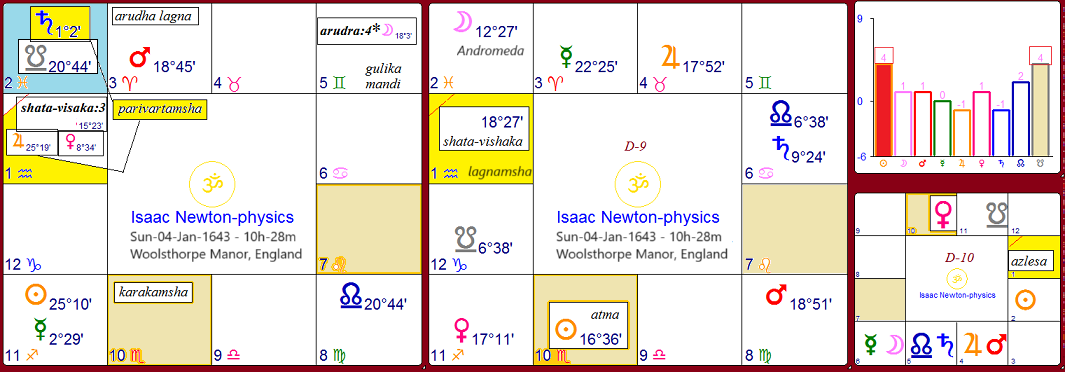
Physicist, philosopher, mathematician + Warden of the Mint
Note the D-1 Shani and D-9 Shani
Shani lagnesha is a defining graha in his nativity.
Professor Newton's legacy has imposed a lasting structure [Shani] upon the scientific [Shani] thinking of the western Academy. He = gay man prone to tumultuous romance (Arudra-Chandra-5) His mentality (3) while inventive (Mesha) was also violent )Kuja) resulting in aggressive feuds with his adversaries (bharani-Kuja-3). Yet, his enduring contribution to western science was highly dignified.
In 1689, Newton was elected to Parliament representing Cambridge (government, Shani) . In 1696, during Budha-Shani bhukti and Saturn return, his age 56,
Newton obtained a royal appointment to the position of Warden of the Mint. This role managed coin-manufacturing and treasury, but it also allowed the appointment-holder to line one's own pockets with bribes and other bonus opportunities.
Newton's D-1 Shani occupies Pūrvābhādra nakshatra, suggesting that his tangible, social-material expression of Shani's strictly lawful, rigidly working character is outputting via the conceptual, theoretical, scientific filter of Guru-ruled, expansive, big-picture Purva-bhadra.
Shani-yuti-Ketu puts Newton on the fringe of mainstream society (Ketu, dissolving edges). In bhava-2, it puts Newton also on the edge of the mainstream scientific discourse (2) of his era, causing periods of social obloquy. Per se, the D-1 character of Shani does not predict either his scientific accomplishments or the social rise that he eventually gained as Warden of the Mint.
Consider then the character of Newton's navamsha Shani.
A significantly different Shani picture emerges from D-9, exposing the antecedent intentions which form the seeds of Newton's unfolding Shani narrative.
- Firstly, d-9 Shani occupies the security-seeking, institutionally positioned, governance-oriented Pushya nakshatra, suggesting that Newton was concerned not only with the laws of physics but also with the governing institutions of his country,
- Secondly, the dispersing D-1 condition of Shani-yuti-Ketu is completely reversed in D-9 with a staunchly unyielding, enduring, opportunistic, corruption-in-service Shani-yuti-Rahu-Pushya-6.
Energy moves from the spiritual dimension, to the mental level, to the astral-emotional level, and only lastly into the material realm. Therefore Newton's inherent expectations and wishes, in their astral imaginary form, show that he intended to achieve a respected but corrupt government position (Pushya Shani).
Rahu-6 is a strong and positive placement for success via toxic, polluted, diseased, corrupt, and criminal environments. For this success to fully manifest, he needed to wait for several decades (Shani delay). However, at the age of 56 during the Shani-return and a Shani bhukti, he got the appointment to Warden of the Mint, and after that his social rank was assured.
Fruits of Dharma
All of the divisional charts show the fruits , attainments, results of life's basic undertakins.
The goals, attainments , fruits of any matter, are seen in the bhava which form a 3/11 angle to bhava-X.
-
11th-from-bhava-X shows HOW THE GOAL IS DEFINED
-
11th-from-bhava-X shows native's COURAGE TO REACH THAT GOAL
The bhava which occupies the 3/11 position from the matter in question can tell us whether a goal is properly set and properly energized to reach manifestation.
The fruits of dharma are shown by 11th-from-dharmasthana = kundali bhava-7.
Therefore, amajor fruit of one's dharma = breadth of one's worldview = one's marriage, and the spouse who along with self creates the marriage emvironment.
Because dharmasthāna-0 is the seed which creates the outcome fruition of marriage-alliance, to know more about the spouse and the marriage environment, it is necessary to inspect the astral-expectations of navamsha varga.
Internal psycho-emotional interactions of marriage environment are the outcome of one's own implicit psycho-emotional expectations. The interactions of marriage create an echo-pattern which evoke often ancient fears, hopes, dreams, wishes, aspirations, from childhood and antecedently from other lifetimes. The immediate conditions of the echo-pattern of marriage stimulus-response emotions is evident in navamsha. Final-final-final outcomes should be read from conditions of Shukra and samatā-pati within the Shastyamsha D-60.
Dharma and non-material, higher dimensional consciousness via D-9
The psycho-emotional = astral truth of bhava-9 reveals the seeds of this dharma-fruit of marriage.
The seeds display the true origins of marriage interactions, as these psycho-sexual dynamics arise first IN THE MIND.
Dharma = non-altered seeing, things as they are, phenomena, truth without added attributes.
The religious implications of dharma = "accurate teachings " = "accurate behavior " result from a neutral, non-reactive viewpoint, seeing things as they are without social conformity, moral judgment or punishment anxiety [Shani] .
The seeds (bija) = repeating psycho-emotional patterns of any bhava, which are stored in the treasury of accrued past-life influences, are seen in the portions = amsha of that bhava. Amsha = storage containers.
The amsha = the private, intimate seeds that eventually create the public, visible fruit = marriage = NAVAMSHA.
of course, the seeds of dharma have a major effect on one's spiritual consciousness, children, and the breadth of perspective signified by the overall D-9 influences one's ability to recognize one's fortune.
Everyone is blessed but rarely does everyone realize their blessings. D-9 indicates whether there is a working link between
- the aspirations, dreams, higher beliefs, intuitions, clairsentience and claircognizance, psychic certainties, and other non-rational realities (D-9)
- with
- the tangible, materially measurable, three-dimensional, public consensus-reality (D-10)
The navamsha lagna = Svamsha = very important in Jyotishavidya because D-9 lagna (particularly its nakshatra) shows the higher path of conscious awareness. There are infinite dimensions of truth. The nature of a person's conscious awareness of layers of reality beyond the D-1 social-material consensus is not easily seen in the D-1. Varga are important for the purpose of identifying meta-awareness.
Q:
Most Jyotishi say that the D-1 and the D-9 must be interpreted"equally
" .
Why?
They are two different charts.
How can they be"equally " predictive? A:
Like most 3-4-5 density graha, earth is composed of two mirror images. One side of the sphere can be referred to as time-space = astral plane. The other side can be referred to as space-time, i.e. The material plane.
In the present civilization, the attention of the incarnated human = generally allocated on an 8/8/8 pattern.
- 8 hours of sleep-dream-meditation (attention focused on astral plane)
- followed by two phases of muscular movement (attention focused on material plane).
In English, the 16-hour material-plane attention phase is humorously known as being awake.
After death and before rebirth, the consciousness is centered entirely in Earth's astral plane.
During the astral phase of sleep (and optionally, of meditation) all final decisions are take n in regard to what will happen during the next day.
In general, the Jyotiṣika must inspect the D-9 just as carefully as the D-1 because the D-9 represents the intentions and broadly pre-established ranges of expectation and decision which can substantially narrow, expand, or alter the expected outcomes seen in D-1.
The life experience = a series of projected ideas. The ideas originate in the treasury of memory-mind (conscious or unconscious = usually unconscious).
Each idea forms a picture. As the subject-mind projects the ideas out of memory onto the mirror of object-external-reality, astream of pictures flashes back at us. A sequence of Gazillions of pictures. Each picture has an emotional tag attached to it.
The Core Reality of human experience is * not* the pictures. We are actually quite neutral to the pictures themselves. Watching the projections fly by is a strictly non-reactive mental event just like watching a movie, reading a book, or playing a video game.
The core reality of human experience is the * feeling* that we get when we experience the pictures.
-
D-1 = social-material reality = the pictures
-
D-9 = the psycho-spiritual experience = the tags
My birth time is fairly accurate but I've often had a doubt about the accuracy of my navamsha lagna.
How can I determine the correct rashi of my navamsha lagna?
A:
With your own knowledge of Jyotishavidya, you might want to do some simple and often very accurate assessments of 10th navamsha = career that can expose the correct navamsha lagna.
The easiest method is to input your birth data into a quality Jyotisha software package, for example Shri Jyoti Star . Then use the software to move the birth time up and down, by one minute increments. When you get skillful, change the D-1 + D-9 snapshots via 15-second increments or the traditional water-clock unit = ghati.
The lord of the 10th navamsha is a reliable indicator of career so make sure there is a fit between
-
what you do for a living
-
the nature of the rashi upon the 10th bhava in the D-9
-
the behavior of the lord of the 10th navamsha as that lord operates in the radix.
-
BTW even if you've done a variety of "jobs " there can be a consistent theme.
-
If the Lord of the 10th navamsha = ashtangata in D-1 or an uncomfortable bhava-pati (e.g. Guru for the Tula D-1 lagna or Budha for the Mesha D-1 lagna) then there won't be too much notoriety in career even if that bhava-pati is in a hospitable rashi in D-1.
-
However, if there is ANY graha in the 10th navamsha varga, the career may be well-defined and publicly recognized. (See George Bush-43 for a huge Simha D-9 10th bhava.)
To establish the nakshatra portion = rising navamsha portion, look at the table of nakshatra-navamsha correspondences = Pushkara Navamsha.
You can also check the marriage behaviors. Your spouse-partner may have (usually) notable characteristics of the rashi upon the 7th navamsha. (About 20% of cases however evoke the qualities of the navamsha varga lagna in the spousal profile.)
if you want really fine tuning, there should be a match between your core attitude and behaviors in marriage and the lord of the rising nakshatra. Of course settling this question requires more neutral objective self-observation than settling the career question, but it can be decided accurately upon guilt-free, should -free meditative introspection.
D-9 = Field of Psychic Expectation for Matters of
Marriage, Unions, intimate psychological and emotional bargains, core relationship of the human being with the Divine Presence -- manifest via Learner's lifepartner
-
Fruits (11) of Faith (9) = gain of alliances, partners, mates, and agreements based in the accrued life wisdom and faith in Divine providence
Practice Issues
Jyotishavidya predictions must consider the Navamsha
One of the first routine assessments = visual scan of the navamsha varga = D-9.
If navamsha Graha are concentrated in only a few rashi, then the radix lords of those high-traffic D-9 rashi may be major players in the lifetime.
Why is the 7th amsha articulated in the 9th harmonic?
And the 5th amsha in the D-7?
Because marriage and human relationship behavior is considered to be the most prominent result of religious development in parallel lives .
The spouse(s) we marry in the current life have been the spiritual partners in parallel lives . If we developed compassion and understanding for others in parallel lives , all should go well indeed. If not...
-
Navamsha is an exceptionally valuable varga for the key questions of life, which all devolve upon how much and what kind of wisdom has been acquired in parallel lives .
-
Generally matters signified by Svamsha = navamsha lagna = and the bhava which Svamsha rules in radix = easier to accomplish in this life due to past-life build-up of skill and wisdom in those matters. (Not necessarily morally pure or profitable or approved ... just easy! If Svamsha has criminal tendencies there may be an easy life of crime.)
-
Navamsha gives a richly detailed micro-view ones' disembodied life conducted through psycho-mental projections. Navamsha represents the psychic field of perception, including hidden assumptions and expectations.
What one profoundly expects to happen, will happen!
(Not what one wishes or hopes or calculates, but subconsciously deeply expects.)
Navamsha shows a great many things but pre-eminently is profiles the marriage partner behavior and shows the path of one's own spiritual evolution via the discipline of steady commitment to marriage. In every case the marriage partner fulfills the subconscious expectations of thrills and disappointments in marriage, and usually also we can see the replay of the parents' marriage in one's own navamsha. Luckily one can re-set the defaults via meditation and intentional therapeutic change, although this does require considerable self-knowledger.
Particularly we live vicariously through the life of the Spouse. Predictions for Marriage, development of psycho-spiritual awareness, developments in intentional religious education, moral consciousness, and (following from spiritual intentionality) happiness in general are read through the navamsha.
The joy and also the unresolved conflict of one's marriage situation is founded upon the physical, electro-magnetic emotional, social, and spiritual consciousness which obtained in parallel life (and which usually continues unconsciously into the present life).
A smooth and prosperous navamsha indicates committed spiritual work in previous lives. If you have reflected the divine in others so will others reflect the divine in you.
Meaningful events trigger reactive feelings.
Ideally, these reactive feelings can serve as signals of the underlying trauma to egoic-mind membrane development, which can in turn help the conscious person to accept and heal childhood and past-life trauma.
but unfortunately the default is simply to experience the feelings on schedule, and maintain a cycle of continuous, unconscious action/reaction and continuous seeking of someone else to blame..
(Let us pray for conscious intervention!)
D-1 Graha may indicate material manifestation of people and events. However, navamsha determines the psychic valence of an experience. As things happen "to " one and around one, the mind constantly reacts emotionally and infuse actions with personal meaning.
-
Exempli gratia, having a chronically late partner may be neutral fact [Shani] for one person but a continuing crisis of rejection and abandonment [Ketu] for another.
-
The deepest psycho-emotional programming is carried forward from trauma embedded over many lifetimes. This trauma-triggered programming is acted out within relationships. The more intimate the relationship, the more psycho-electro-magnetic emotionally intense the reactions.
Navamsha can be dramatically determinative because the psycho-emotional reactions to a material person or event can be much more intense than the normal five-senses perception.
Predicting the tangible effects of Vimshottari dasha periods = three-step process
-
D-1: examine the bhukti-pati in detail within kundali, including His character, all drishti He receives, all yoga in which He participates
-
D-9: find the bhukti-pati's position in navamsha.
-
Back to D-1: find the ruler the bhukti-pat's navamsha in D-1. The D-1 character of the lord of the bhukti-pat's navamsha will reveal the material effects triggered by the psycho-emotional trauma underlying the material events.
The life experience = a series of projected ideas. The ideas originate in the treasury of memory-mind (conscious or unconscious = usually unconscious).
Each idea forms a"picture " . As the subject-mind projects the ideas out of memory onto the mirror of object-external-reality, astream of pictures flashes back at us. A sequence of Gazillions of pictures. Each picture has an emotional tag attached to it.
-
D-1 = social-material reality = the pictures
-
D-9 = the psycho-spiritual meaning of those pictures = the tags
For humans, events have value only when they have meaning! Psycho-emotionally charged events such as major public validation through marriage, childbirth, professional awards, (or invalidation through divorce, dematerialization, firings et-cetera.) are only importance because of the emotional meanings invested in those events.
Navamsha shows the psycho-emotional experiences in a person's life, initiated through relationships, which interpenetrate and color events on the material plane. The psycho-emotional qualities of a Vimshottari can be extremely vivid and even cause material decisions, especially if navamsha lords of the bhukti-pat are stronger than its radix lords. Therefore we always consider navamsha effects.
All of life's truly meaningful events - whether these Learnings are fast or require repetitions = trauma-triggered through the navamsha.
Marriage and emotionally privileged relationships
The main setting for education and skills practice in the present life is of course the constant egoic-mind pounding interaction of human-to-human relationships. The most powerful thoughts and emotions arise in connection with emotionally privileged, psychically interactive relationships.
Marriage-unions are first and foremost signification of the D-9, but also other privileged relationships are encompassed in the 'field of expectations for relationships' including employee-boss (check also D-10 ), sibling-sibling (check also D-3 ), parent-child (check also D-12 ) student-teacher (check also D-20 and D-24 ).
-
Future life conditions are based significantly upon present-life experience. Future happiness depends on whether one can accept the reality of the Other, inclusive of its many attributes, as sacred (if mysterious) expressions of the Divine will.
-
Or whether one remains stuck in the pre-incarnationally planned punishment cycle, emotionally reactive from ignorance, judging and rejecting the Other's attributes as unacceptable, wrong, inferior, immoral et-cetera.
-
One's psycho-mental response to the behavior of others as indicated in navamsha will to a large extent determine one's limits and opportunities in the next life.
Present Life behavior of Learner's lifepartner
The D-9 script projects the (largely subconscious) expectation of Other, that which is "not me". Thus the D-9 defines the way in which one encounters the spouse, the way in which one apprehends the spouse's material personality.
Other people might encounter one's spouse-partner quite differently. I'm sure you've heard divorcing couples complain about some atrocious behavior of their Other which no one else has even remotely noticed.
-
A Learner mentioned that during her divorce process, she claimed that her ex-husband had said and done some truly criminal things to her and her children. Because of the criminal accusations, indictments, the ex-husband's divorce attorney solicited character reference depositions from the ex-husband's parents (who thought him a living angel), his previous bosses (who described a respectful, reliable, productive, model employee) and even old friends and neighbors (who found him to be a great guy, handy with the barbeque, liked to fish, shared his tools et-cetera = the ideal neighbor). Even old professors said this man = diligent student, honest and disciplined, pleasure to teach.
-
What happened? Was this woman insane? No, she was telling the truth. Her navamsha shows that the programming for marriage is subject to prolonged repetition of the key structural elements of the learning pathway-gifts based partly on her contractual relationship with her father. The D-9 seed-pattern was surging with negative expectations of oppression and, ultimately, attack. Apsychiatrist and several police reports were able to confirm that her description of her husband's violence (in the deteriorating days of their long marriage) was accurate.
-
It was the unique matching of their nativities which allowed her to evoke this particular drama in him. Socially she was criticized for instigating his harmful behavior. However, according to Jyotisha she was simply acting out a historic programme, and this man had the perfect set of triggers that allowed her to "push his buttons ".
Learner's lifepartner enacts one's own subconscious unrecognized programming. The extent that one is aware of one's own expectations - perhaps as a result of meditation, psychological inquiry, prayerful reflection, or Jyotisha study - Learners may not be entirely surprised when a new drama emerges in the intimate relationship. Perhaps no one else even sees it.
Yet, the experience of the seeds of expectation rather suddenly sprouting into drama is quite authentic within one's own reality.
Emotionally privileged partners serve as the material mirror of one's own beliefs and expectations.
Present life conditions
Navamsha shows the Learner 's astral personality, which could be called the field of psycho-emotional expectation.
Previous to material manifestation of any event, there is a very long chain of build-up. Signals originate on the spiritual plane. If not directly apprehended in their spiritual nature (which is rare few people are skilled enough to see things "as they are")
-
D-1 shows the main patterns of materialization in one's own life. D-1 is the result of [akashiic memory] which has already passed the gateway from the astral particle shape into the material particle shape. D-1 patterns are destined to manifest in the sense-data world of physical and social reality.
-
The D-1 reality is a tangible world of experiences that can be described by a vocabulary that most people would recognize as the shared human frame of reference.It is rarely so vague and psychologically intuitive rather than rational as the D-9 can be.
-
The D-1 describes ideas and expectations which have not been halted at higher levels of consciousness. D-1 patterns are barreling down the path of materialization and are difficult to retract. (Not impossible, but difficult. )
-
Generally, it is recommended to adopt an attitude of neutrality toward the characteristics of the D-1, since they are controlled by physical-plane and social-plane laws [Shani] which operate in a very slow, rigid, regulated, time-enslaved fashion.
-
Matters of the D-9 are more ephemeral. Although matters of the D-9 are harder to detect because of their subtle particulate constitution, d-9 patterns are also easier to change if one is able to grasp these ghostly seeds before they blossom.
-
The D-9 has a significant role in determining the outcome of the present-time manifestation pattern for the Learner , via one's reaction to the behavior of others. The vast majority of the creative life force is engaged in reacting to other people.
Present life psycho-spiritual agenda
Things only develop on a material level if there is either (1)significant ignorance of the astral and causal seeds so that one is unable to control the unfoldment of experience (2) the astral-causal motive is strong and purposefully focused on a specific materialization for the benefit of others.
-
Generally, it is less beneficial for astral imagery to materialize because material experiences are so gross and cumbersome and hard to change once the pattern reaches the material plane. It's so much easier to work in the magic (imagery) realms where ideas and electro-magnetic emotions are fluid and fast-changing.
-
The navamsha = useful place to look, in order to see what is getting ready to blossom on the astral plane. What are one's (usually unconscious) beliefs and expectations? The first level of materialization, before one's script manifests in the material world = to dramatize in the spouse.
-
Learners may be tightly matched with a partner who has the central characteristics of D-9's seventh rashi and in addition all of the other characteristics of the D-9 will eventually manifest -- e.g., partner's profession, partner's family, partner's mental health.
Psychic Projection creates the Other
Try to remember that Learner's lifepartner = a projection of one's own unacknowledged interior field of expectations. At the root of truth, Learner's lifepartner is not really a separate person. You two share a level of delusion, that's all.
-
When there is a need for adjustment in the marriage, one rarely (without meditative awareness) says 'I want to be the origin of this marriage adjustment'. More normally, one says, 'I want my spouse to change their behavior'.
-
Many men in cultures around the world rely on women to act out their emotions many women similarly rely on men to make their social, professional, and financial decisions.
-
Rather than say, 'I want to feel differently in this partnership', the typical masculine-valenced-nativity may say, 'I want my partner to treat me better'. And the typical feminine-valenced-nativity may say, 'I want my male partner to be more financially powerful or more professionally ambitious'.
-
of course the lines of division of responsibility by gender are changing in modern societies but the projection syndrome remains the same. Partnerships are without exception the result of matching energy.
-
Learner's lifepartner can only do what one expects Learner's lifepartner to do. Albeit that awareness of the expectations maybe deeply buried under generations of heavy [akashiic memory patterns] of blaming and victim-mind. The D-9 may reveal it.
Spiritual practice points
Learner's lifepartner is not ultimately to blame for whatever happens in the marriage. If Learner's lifepartner does socially criminal actions, then social law will punish the criminal.
-
Within an intimate relationship However, there is much more involved than simple actions. Actions on the material plane are always the result of higher-up patterns the material plane is never the cause of anything. Material level = the last stop on the tagged-image projection route, the dumping grounds for unacknowledged akashiic-memory pattern. ("The buck stops here, on the material plane!")
-
of course, if marriage or other privileged relationship (even with one's government) has become violent or terribly unsatisfying or oppressive in some unbearable way, it can be highly desirable to end an extremely negative mirroring relationship. Learners may be completely unable to handle the violence or abusiveness of one's own projections.
-
In that case: take a break, and do some spiritual strengthening, before heading back into intensive-projection interactions again! However, it is critically important to remember that the evil-doer, no matter how vile, is mirroring back one's own unacknowledged script for privileged relationship.
-
Negative experience in privileged emotional relationship should appear as a fairly obvious feature of the D-9. If one is able to detect the negative expectations (and positive ones too!) in D-9 one can gain a tremendous advantage in understanding and predicting the course of life.
The Learner's own past-life and early childhood of the present life
Most of the [akashiic memory patterns] which appear to be karma-reinforcing (not akashiic-memory pattern-releasing) relationship reactivity of the present lifetime is attributable to the way in which one was raised by the parents.
-
The Learner's adult marriage assumptions, principles, reactions, and other behaviors by default repeat the assumptions, reactions, et-cetera. behaviors of one's parents or primary adult role models from childhood.
-
Modern psychology asserts that the deep wheel-ruts of the largely unconscious relationship patterns of one's parents (and other adult pairings such as grandparent sets, close aunt-uncles) will have an over-determining influence upon one's own marriage choices and expectations.
-
As the student of Jyotishavidya becomes more skillful in comparing various nativities, it becomes increasingly obvious how much matching there is between the nativities of one's parents and oneself.
D-9 and Family Patterns
Within a family there is always a predominant pattern = "family culture " .
Once the Jyotisha pattern-recognition skills are sharpened, one can detect the path along which the parents' unrecognized blaming [akashiic memory patterns] has simply transmitted to the next generation.
-
At this level of analysis it is recognized that one's partner (husband, wife, s.O.) has nothing at all to do with one's experience of the privileged union. Learners may be simply carrying forward an ancient family lineage, reacting to a partner in the prescribed fashion which is the heritage custom.
-
The carry-forward of family relationship patterns into marriage is one of the reasons that arranged marriages within a uniform cultural group are often easier. Not perhaps as fertile with potential for enlightenment as a truly incompatible cross-cultural marriage, but indeed easier...
-
BTW it matters naught whether the Learner was bio-born or adopted or anything in between. We are take n into the fold of those who have matching psychic expectation patterns, so that we can materialize the akashiic-memory pattern of expectation manifesting into tangible material reality. The Learner could be raised by wolves so long as the wolves had the proper pre-incarnationally planned signature (just joking, animals are not complex enough to parent humans).
Q:
Namaste Barbara,
I am getting confused about whether to expect navamsha results to demonstrate my wife's behavior or my own.
Some astrologers say that the navamsha graha in D-9 can correct problems with the root graha in D-1. Other astrologers say that the navamsha is a spiritual chart with no material meaning. Others say that the navamsha is only useful to predict the actions of the marriage partner. Which of these is true?
How should I read the navamsha?
My navamsha does have a few similar items to my wife's D-1, but many (most) of the graha are placed differently, so if I try to read my navamsha as the"map " to my wife it contradicts the"map " from her own kundali. ??
Maybe I am making problems by seeing too many equal possibilities? Some possibilities are factored out in some contexts?
Thanks for your guidance.
A:
You are right about all of the options for interpreting the navamsha and there are additional meanings too.
D-9 = a rich treasury of information.
The process of interpreting D-9 patterns versus D-1 patterns can seem contradictory, tautological, or re-iterative, as in"which comes first the chicken or the egg? "
It is a bit complex."Navamsha studies "can be approached from several different angles. Let's approach the"past-life, future-life"angle first.
Immediate Future Life
In terms of lifetimes, d-9 indicates the 'default' attributes of one's next life, in detail. The D-9 shows the direction in which one's thoughts and electro-magnetic emotions are already flowing, toward that next life.
As you know, we are all working on building the next life / alternate life even now, during the current life. The " next " life is not really next since all lifetimes are occurring in the identical same NOW. However, there is a viable Earth-based perspective applying a linear sequencing to events, and through that linear time filter it is viable to assert that each " subsequent " lifetime sets where the"closing set " of thoughts and emotions (which one has been developing during the present lifetime) leaves off. There is considerable multi-use of resources across incarnations and what happens in one of them consistently interacts with all of them.
To ensure a pleasant rebirth experience, it is important to be in the clearest, most neutral state of mind at the time of Earthen-body death in those incarnations that involve fleshbodies.
How can the D-9 show both the spouse's current patterns and the Learner 's future patterns?
-
First the navamsha manifests in the spousal behavior and then in the next life it will manifest in the Learner 's material behavior. Thus it is said that Learners may become one's spouse in the next life. It's true.
Seeds * Bija
-
Yes the direction and content can be altered. However, it is not common for people to adjust the seed-qualities of one's navamsha. It's not that hard with sufficient consciousness. The main tool for release of negative seeds (expectations) is forgiveness, which is a super-powerful [akashiic memory pattern] cleaner that can set in motion a nice clean program for liberation in the next life. Sadly, however, most people are sleepwalking and they just go with the flow of blaming others for one's own mistakes and feeling upset with the conditions of one's own life.
Earth-Time is Circular
Thus the starting point for the next life is not much different than the starting point for the current life. It might be infinitesimally advanced by a brief awakening, but the awakening should be intact at the time of dematerializstion in order to establish an awakened foundation for the so-called / next life. /
The starting point for the next life, presuming that it won't be altered via exceptional consciousness of the present life, is the present-life navamsha. It is quite a reliable next-life blueprint for the sleepwalkers, and a powerful to-do work program for anyone who is trying to wake up.
Reading the D-9 for a variety of purposes
Read the D-9 with savvy style.
It forecasts the spousal character and events that are motivated and contextualized by one's reactions to other humans (which is to say, the vast majority of events in life).
The navamsha will not show things like earthquakes, floods, and fires which are absolutely material but it will show how one interacts and reacts with other humans in those emergency, life-threatening situations.
-
D-9 predicts one's own outcome within the ocean of emotion of privileged relationships and eventually as the manifest physical and social reality of one's future life.
-
For example a man with [nīcha-Budha] in radix but [uchcha-Budha] in navamsha could be said to be moving out communicative fogginess of [nīcha] Budha and he is on the way (not there yet) to an uttama expression of mental narrative. In the meantime he will attract a sharp-witted and categorically analytical mentalized wife. She will act out his logical-argumentation process first before he gets full manifestation.
-
Chandra-Mangala yoga in D-9 says fortune for Learner's lifepartner in financial well-being from matters of Guru and the birth lineagevia Svamsha in one's present life, the Guru Meena portfolio which operates on the bridge between material and astral reality, the bridge between the waking state and the dream or death state, this bridge wisdom about sounds and images (the vehicles of astral communication)is getting better developed for you but it's really the spouse who will enact the stronger purchase on the wisdom in this present life. For you this divinatory Meena discourse only is meaningful in spiritual or mystical terms. For the spouse, the sound-bridge is already manifest and wealth-bringing.
Things don't just manifest once in life and then we're done with that experience. There is a constant recycling of particulate matter from it's highest most subtle spiritual state, percolating down into its slightly less subtle slightly more gross mental-causal state, then further percolating down to its slighter less subtle than mental but more gross that physical astra l state, then finally if nothing is done about it on those higher planes, the sense data will materialize on the physical and social share-human-experience planes.
It's much more efficient to make changes in one's expectations and assumptions while those seeds are in their astral state. Examine the D-9 to see the reactive patterns vis-a-vis other humans, and make changes as desired.
Links between native's D-1 and partner's D-9
Almost always there is a powerful connection between one's D-1 graha and the spouse's D-9 graha - and of course, vice-versa. That is because the D-9 shows "recessive " traits, knowledge and awareness which have been waiting for this particular person to mirror them to oneself as clearly as possible. When that person is located, Learners may feel more whole.
Generally, married people realize that getting along with the spouse requires being honest, and being honest requires and getting along with one's self. If it = love marriage, Learners may remember the feeling of falling in love, and if the marriage was arranged there is also a feeling of certainty and a bond is formed.
The higher reason for the bond = each partner intends to learn to become more like the other , or at least to become maximally aware of one's own knowledge by hitting the boundary of the other person, and more consciously then operating in one's own space.
Dishonest marriages are painful affairs seething with anger and guilt, victimization [being sacrificially eaten] and blaming. Honest marriages are exercises in developing consciousness. It seems terribly ironic but also is brutally logical to understand that in fact, in the next or parallel life, one is or will"be " the spouse.
Just as the student becomes the teacher, so the husband becomes the wife and the wife becomes the husband. The dormant traits will -- through that spouse's evocative role-modeling -- become manifest. Learners may, oh yes, become exactly the opposite of the present self-concept, which self-concept has been juxtaposed against this inscrutable Other. Learners may indeed and must via the march of consciousness become precisely those traits which seem impossible, bizarre preposterous or undesirable today. The cycle of incarnations continues until the full ranger of experiences and relationships and transformations is complete.
To see spouse(s)-partner(s) in navamsha
to profile the first lifepartner, Look to the 1/7 axis in navamsha varga .
traditionally Jyotishavidya reads the rashi = 7th navamsha-varga bhava as lagna for the first spouse.
-
Exempli gratia, to see the first spouse's values/wealth, consider the 2nd-from-7th in navamsha which is D-9's 8th amsha (and its lord) within the D-9.
-
To see the first spouse's mother, consider 10th-from-7th, or bandhu bhava in the navamsha (and its lord) within the D-9.
Keep in mind a peculiarity that is sometimes called the"80/20 rule " : 1st partner may be profiled from either 7th navamsha (most common) or 1st navamsha.
First, try to match 7th navamsha = spouse's character and known events, such as 10th-from-7th-navamsha should = partner's profession.
However, if 7th-navamsha cannot be successfully matched to the character and events of Learner's lifepartner, consider the"20% " possibility that the first spouse and all of their relationships - parents, children, previous spouses, et-cetera. - may be more accurately read from the D-9 first bhava, when the D-9 seventh bhava fails to match.
-
It may also be the case that the second spouse/life-partner's lagna would = 8th navamsha, and second spouse's mother would = 4th-from-8th or the 12th navamsha. et-cetera.
If there have already been several marriages, it can be easier to test the profiles of previous spouses against the D-9 first bhava vs. The D-9's 7th bhava to see which offers a more accurate match to historic reality.
In fact, it may be that there is a correlation between folks who have multiple marriages and their navamsha patterns, which must be read"spouse-wise " from the D-9 lagna rather than the D-9's 7th house.
If the birth time is correct and 7th-navamsha doesn't work, then testing for a better match using 1st navamsha as spousal lagna = warranted.
In Light on Relationships, the respected Jyotiṣika-team deFouw and Svoboda discuss this "80/20 rule " D-9 lagna-as-spouse-lagna option.
The choice between using the navamsha lagnesha-1 or ruler of navamsha-7 as lagna for the first spouse is not a big problem, because all 12 rashi-signs are "yoked " into six yoga-pairs. For example, simha must be understood never in isolation but always as the solar half of the Simha-Kumbha polarity. (There is no king without commoners there is no politics without privilege.)
Best method to find the core character of the spouse
This link represents the aspect of their reality which keeps you linked to him or her. This link when articulated can explain what the Learner is trying to become (or un-become) in the marriage:
Here is single most valuable technique for finding the point of matching energy which serves to attract the spouse. This matching energy maintains the work roster within the marriage until at least one of the parties has completed the transformation from ignorance into wisdom in regard to the contents of the link.
This small set of core characteristics forms the matching energy link that is being used to create consciousness of the own preconceptions, presumptions, and unconscious reactionary behavior.
The vehicle of marriage (including bhakti devotional marriages to a deity) provides the ongoing psychic laboratory for self-knowledge.
Want to see what you are working on and why?
-
find ruler of bhava-7 = planetary lord of radix seventh house
-
locate ruler of bhava-7 within the navamsha.
-
determine the ruler of this navamsha sign
-
Then find this lord, who rules the navamsha of the samatā-pati-7, back in the radix chart
-
study this planet carefully. Study its character, rashi influence, drishti by sign and house, everything about it. T his is the matching energy point.
-
Your experience of the spouse is grounded in this point. If samatā-pati-7's navamsha lord is a genial, wise planet in kundali, the marriage relationship will be delightful. The celibate religious often have exquisite marriage planets! However, if this graha is in a rough spot, so will be the spouse.
-
The point is to take responsibility for the connection, the ongoing psychic tug-of-war with the Other. All those traits that Learners may have projected upon the spouse, are indeed the unrecognized or unacknowledged characteristics of one's own behavior.
D-9 lagna and its lord: Basic Attitudes toward Marriage
When the lord of D-9 lagna, significator of one's own behavior in marriage, falls into a dusthamsha (6, 8, 12), there are negative implications for marriage.
-
6 (Budha-ruled) = jealous and overtly warlike, with the likelihood of chronic animosity.
-
8 (Kuja-ruled) = secretive and conniving, with the prospect of catastrophic upheaval.
-
12 (Guru-ruled) = not conflicted but tends to become disconnected. The marriage energy gets dissolved by spiritual concerns.
When the lord of D-9 occupies kundali indriya-lagna , one's personality dominates the marriage.
If the D-9 lord becomes strong and dominating, such as hot uttama or svakshetra graha, spousal concerns must take a back seat to the Learner 's personality development
Spouse-partner must often"take it or leave it " having little power to negotiate for accommodation or change which might conflict with the direct interests of the Learner 's personality growth.
The navamsha can define the soulmate (or soulmates)
.... If soulmate can be defined as
.... The person(s) with whom one is etherically, astrally scheduled to yoke in this lifetime, according to pre-incarnational plan.
In other words, the soulmate shares with oneself the recognition that you-two are both engaged in a profound agreement, contract, obligation, attraction * ākarṣaṇa *, and work plan to participate in an extended, sustaining balancing yoga.
Can the nature of these partners and their entrance into the life-theatre be seen via Jyotisha? Yes. Do these soul-partners look beautiful, act sweet, and add instant material pleasure? Rarely.
Perhaps the single most important misunderstanding of this soulmate concept, as popularized in modern discourse, is the idea that soulmates must share the material space, that they are natural marriage partners, or that they even have flesh bodies.
Soulmate is an astral identity. It has no inherent material value. Many people in fact find that their soulmate(s) lives primarily in the astral or causal realm.
-
Navamsha shows the profile of one's partner(s) with whom one has agreed to partner - long before the current birth - for the purpose of advancing one's spiritual development.
The disjunct between the modern western concept of soulmate versus the profile of spouse in navamsha = the soulmate concept has been commercially marketed.
Unfortunately, the modern western concept of soulmate tends to be immature, sugar-coated, and materialistic.
-
Look to the 7th navamsha for dominant pattern of expectations of the spouse. Learner's lifepartner whose Chandra matches one's 1-7 navamsha axis (or one's navamsha nodal axis) is that soul-mate, meant to be. Not easy - just properly matched!
By contrast, authentic Marriage is one of the most difficult spiritual practices available.
As d. Phil says,
-
" Marriage is not a long date.
-
It's a partnership.
-
Partnerships involve give-and-take and sacrifice.
-
Men are really bad about understanding this."
If one's concept of soulmate " can mature into the full expression of committed partnership, with all the egoic-mind stress and material difficulty that long-term commitment enforces, then Learners may discover that the navamsha of one's own nativity gives a very accurate picture of one's soulmate .
[QUOTATION] -- d. Phil writing on Soulmates - Ladies' Home Journal magazine, January 2006
d. Phil, the television psychologist, speaking on the "Soulmate "
concept:
Interviewer:
-
Many people say that when it comes to marriage, they're seeking nothing less than a soul mate. Is that asking too much?
d. Phil:
What's a soul mate?
It's just a term somebody made up, and with it comes some pretty mystical expectations.
I've long believed that if you're looking for that perfect partner, you're making a big mistake .
If you can find an 80 percent fit and hope that you'll grow together on the other 20 percent, you'll find happiness a lot quicker.
You wait for a 100 percent partner and you're going to be looking a long time, maybe forever.
but if you're okay on the core issues -- children, careers, division of labor, religion, handling in-laws -- then you jump in and handle the other things as they come along.
I 've been told that the navamsha represents the second half of life ?
Also, does the navamsha have something to do with marriage? Can you tell me what
the navamsha is, and how to read it, and what I should be looking for to
indicate ups
and downs? I think my marriage is excellent but I want to be
realistic about what to expect. My parents had their struggles
and I imagine
hubby and I will too : )
I think I can use the radix pretty well, tracking the Vimshottari Dasha and
the major transits but the navamsha I'm just not sure how to use it as a
separate chart or an extension of the radix??
A: Navamsha for marriage evaluation and prediction
The navamsha varga
[D-9] is equally important to the radix birth chart (kundali). The Navamsha reveals the psycho-spiritual path whereas the radix reveals the material-social manifestation of events.
Because the navamsha indicates the spiritual orientation, and because marriage is the primary spiritual practice for most people -- including people who are married to their ishta-devata such as celibate monks and nuns -- the navamsha is the primary indicator of the behavior of the spouse and one's psycho-spiritual response to that behavior
The spouse-mate is not a separate person the spouse is a projected extension of the self. Remember this mate can easily be using the angelic astral body or even the conceptual mental body. The mate need not use a bio-body. (And if the mate is not using that protector-shell of the bio-body, it is much easier to recognize that this being is a part of oneself not separate.)
Implicitly in all readings whether for radix placements or navamsha placements we assume that one is creating one's own reality on a minute to minute basis.
Therefore, when events are predicted based on the radix chart or when the spouse's behavior is predicted based on the navamsha chart the origin of all phenomena whether psychic, psychological, material, social, emotional, mental, financial, or political is always one's own subconscious.
Although few people have the skills to enter their own subconscious and make adjustments to the originating thoughts, some people can make changes while in meditation and some can use clairsentient psychic healing or other devices to consciously alter the projection.
Most people However, simply sleep-walk through the prewritten script believing that things happen"to " them. Nothing could be farther from the truth, but that is what the sleeping mind asserts. In fact, the navamsha like any other varga shows the plan which one's spirit has designed for spiritual progress via the means of marriage, and other intimate interactions with others.
Spouse as spiritual helper and Guru
The spouse shows what we are becoming, the spouse reflects back the pieces of the personality that have been hidden in the subconscious but are just now emerging into the field of awareness.
The spouse is a spiritual helper who shows one the parts of oneself - good, bad, and neutral - which need to be known and acknowledged so that one can proceed along the spiritual path toward merger with the divine.
The spouse is a great spiritual helper and the spouse should be appreciated even to the point where in some cultures the spouse is actually worshipped.
Spiritually the fact that spouse's show us mysterious and hidden wisdom about one's true behavior not the ego's false ideal is a reason to acknowledge that one's spouse is one's guru. It is really amazingthe amount of information about the self that one's spouse can expose just in daily interaction.
Learners may attract the matching object to the inner expectation image.
This inner psychic image is described in the navamsha.
It is the funny truth that we attract partners who provide us with the missing puzzle pieces about the own personalities.
Partners, especially the long committed partners, reflect back like a mirror the parts of one's own subconscious projection of which one is not yet consciously aware. That is why marriage is such an intense and essential spiritual practice. Learners may come to understand that everything the spouse is doing is nothing more or less than a direct projection of one's own expectations and memories. Once that realization is in place the practice of marriage becomes a matter of"Projection Management " .
However, in the beginning there is the semi-conscious experience of the spouse as being a separate person with their own motive force who imposes conditions upon the Learner and these restrictions can create discomfort as well as support.
Look into the navamsha to see what type of subconscious projection pattern the Learner has designed to be made manifest through the agency of the marriage partner.
- Remember that the marriage partner is merely an agent and that all of the behaviors of the spouse are mirror projections of one's own paradigm of belief.
- [See the navamsha varga for an image of this deeper pre-conscious belief pattern.]
When astrologers say that navamsha varga predicts marriage and also it predicts spiritual characteristics, these patterns are identical. Navamsha rules the pre-incarnational awareness or higher self who is simply a more conscious version of oneself. The preincarnationally planned spouse may be energized to expose one's underlying expectations. The exposure may be welcomed, or not. Learners may be able to recognize what is exposed as having a higher guidance for self-understanding -- or not.
For a navamsha with Karkata svamsha, look to Chandra to shape the profile of one's own expectations for one's own behavior in marriage
-
If Karkata svamsha has no occupying graha, most of the information about how one operates within relationships = especially marriage = is obtained by examining kundali Chandra.
-
Go to the radix to find Chandra and see how one acts within relationships on the material plane.
-
Relationships can be very complex.
-
Start with the planetary ruler of Svamsha At first, inspect only the overall archetypal behaviors, which are according to Chandra's nature both very maternal and parental, protective and lushly sensual in a healing style. Additionally, because Mangala casts drishti upon Chandra in a rashi of Mangala, there may be identified a pattern of aggressive behavior emotionally in marriage, with a need to be in control that is rooted in early childhood trauma.
-
Chandra
= [nīcha] (fallen) condition receiving the outward-propelled drishti of Mangala according to Jyotisha tradition indicates a mother with an invasive, penetrating electro-magnetic emotional style. She may due to her disregard for boundaries plunge past respectful psychic limits and enter the realm of emotional abuse.
All daughters eventually imitate their mothers when their own children are born. Parenting behaviors naturally imitate the treatment one grew up with.
The navamsha suggests that in marriage relationships you have a penetrating, boundary-invading style of emotional bonding with the spouse.
-
To the extent that the spouse has a corresponding set of expectations (which he will) he may enjoy being sheltered, protected, and parented by an electro-magnetic emotionally dominating partner.
-
The spouse welcomes you as one who tries to acquire and maintain more power in the relationship than is ultimately sustainable.
(Chandra is fallen in Vṛścikanot because emotional invasion and manipulative control is morally bad, but because as a pragmatic life strategy it simply fails.)
Most spouses are deeply attracted to each other, so none of this incisive vocabulary is meant as a criticism.
The focus of the observation is the pattern of expectations and how certain behaviors by oneself and by the spouse fulfill the pre-existing expectations which have been part of the life script for many incarnations.
Getting Wise to the Navamsha Mirror-cycle
At some point in their reincarnational cycle, people burn out on marriage. The pre-incarnationally planned completion point occurs when it becomes clear that mating = a mirrors game = one partner reflects back to the other partner the contents of each other's subconscious mind.
At the burn-out or abandonment point [Ketu] a yogi-Learner, monk-Learner, or other celibate-by-choice-Learner may figure out that it is more efficient to work on one's own subconscious without taking the polarizing catalysis to get into high drama interaction with the mirror.
At that point they quit getting married, They arrange to get born conveniently near a monastery or a nice cave, then as soon as marriage time comes around they conveniently disappear into the cloisters...
of course neither you nor I are quite there yet so when reading the navamsha it will help to have a smile and say, oh boy, look what the future may hold.
The parent's marriage replays during one's own marriage. The parents marriage is represented in the perhaps unexamined expectations which are embedded in the sun-moon (father-mother) angle within the navamsha.
making Changes to the Navamsha Script?
Is there a way to alter these expectations whether they are apparently positive or apparently negative? (In reality the expectations are just script, and there is no harm in letting them play out, but of course it is fearful to anticipate events which may seem to have a moral or immoral quality. Really, don't worry.)
YES it is actually quite easy to adjust one's expectations by looking into one's own heart and becoming very clear about precisely what one wants (that is easier) and precisely what one fears (that is scarier) in a relationship.
- Until one is able to perform intensive introspection and re-scripting then the defaults of the navamsha which are carry-overs from triumphs and disappointments of parallel lives , will control the outcome of the projections.
But absolutely yes it is possible if one can resist the urge to judge and react, but rather simply look into the expectations carried over from childhood, then discuss not with Learner's lifepartner but with ONESELF what fears can be released, very major changes are possible.
but that is a big 'if' as most people are buffeted by public opinion, fear of abandonment, fear of non-conformity, fear of freedom, et-cetera. and so the script has a great deal of control and they feel rather like victims of another's actions. That is sad, because they could feel like authors of a great novel! It is all in the consciousness.
Reading the Navamsha as an independent chart
The navamsha is very important in evaluation and assessment of any nativity, and it is especially important for timing the milestone emotional experiences like marriage and the birth of the first child. It can be read as a separate chart which responds to transits and corresponds to the Vimshottari Dasha.
Also transits to the navamsha are significant for major life events.
Marriage nearly always occurs when transiting Rahu-Ketu are traveling across either Svamsha , the navamsha Rahu-Ketu axis, the kundali indriya-lagna or axis, or the axis of the Janma-Chandra.
-
Right now Rahu-Ketu are transiting your 6-12 navamsha, which is not disruptive, but which causes deep inner reflection upon marriage as a spiritual practice and ultimately causes you to think about ultimate realities such as the passage back over the bridge to the astral plane from whence we came and to which we all return.
Navamsha is also important for determination of marital compatibility.
In long-lasting, mutually respecting marriages with high levels of reciprocal emotional recognition (empathy) and long term social compatibility, Janma-Chandra of partner-1 would ideally match the navamsha lagna (Svamsha ) or the navamsha nodal axis of partner-2, and vice versa.
-
One indicator of compatibility for Karkata-Kadaga svamsha ++ R-K Meena -Kanya D- axis would be spouse having Janma-Chandra in Karkata, Makara, Meena , or Kanya rashi.
-
If the spouse's moon is not in one of these four rashi, still Chandra-Vrishabha matches your Vṛścika-indriya-lagna. However ideally spousal Vrishabha-Chandra would be accompanied by more supporting matches to indicate longevity of Learner's lifepartnership.
-
The best spousal matches for Karkata-Kadaga svamsha ++ R-K Meena -Kanya D- axis +++ Shani-ruled Anuradha Chandra in kundali indriya-lagna would be a spouse with Shani-ruled Chandra in Uttarabhadra - Andromeda -- or Shani-ruled Chandra in Pushya - Sidhya
And yes it can be said that navamsha indicates the second half of life because almost all Learners do make amid-life values switch from using a primarily material filter to using a primarily spiritual filter, reflecting an awareness of impending death but also a disappointment with the promised satisfaction of material attainments, somewhere in mid-life depending on the dasha timeline.
Navamsha = who the spouse is now = who is the Learner in next life
-
The spouse shows what the Learner is becoming, the spouse reflects back the pieces of the personality that have been hidden in the subconscious but are just now emerging into the field of awareness.
-
The spouse is a spiritual helper who shows one the parts of one's own elf - good, bad, and neutral - which need to be known and acknowledged so that one can proceed along the spiritual path toward merger with the divine.
Yes it is complicated, requiring many reflections and fine-combing to find patterns which one is conscious enough to acknowledge
Hopefully the above discussion is helpful for your increasing understanding of Jyotisha. Considerable study is required to understand the myriad implications of any nativity. But your study will be rewarded in value of self-knowledge, and the more you reflect on one's own divinity, the most you will be able to use your own interpretive powers to help others who are seeking clarity and release.
Wishing you best success in Jyotisha studies,
Sincerely, bP Lama
Navamsha represents both soul and spouse?
My spouse doesn't seem to "appear " in my D-9. In fact, his behavior is quite the opposite of what I would expect to see in my deepest inner self.
I have a beautiful soul but he is hardly a beautiful person. In fact, he appears quite physically and morally ugly to me.
A:
Namaste,Navamsha is effectively a map of the astral version of oneself. School of Earth is a two-sided coin. In waking hours, one operates within a five-senses consensus reality third-dimensional physics-governed world. In sleeping hours, one operates within a symbolic-communication system in a fourth-dimensional array. Level 3-4 are flip-sides of each other.
the philosophical principle underlying the multiple meanings of the D-9 navamsha varga = lacking a full understanding of the Self, one attracts others who provide essential mirrors to reflect the missing information.
Ideally, the Learner would possess adequate consciousness to appreciate that each behavior of Learner's lifepartner is a spiritual offering of a much-needed mirror that provides information that one cannot detect unaided, at least in the current state of mind.
This is true whether a marriage partner, awork partner, or an Other in any polar arrangement including the Other in the spiritual form of an ishtadevata.
AAccording to this principle of relationships serving as "mirrors ", one of the reasons that some people choose to enter monasteries might be that their ishtadevata, the divine god of their heart, might be sending stronger easier-to-interpret information signals that their human-to-human partners, and these monastics might want to focus primarily on these spiritually characterized signals.
Others might marry someone who appears to act aggressively, disrespectfully, or dismissively toward the Learner . However, according to the mirror principle there is nothing ultimately wrong with getting the missing information in this fashion.
The process of filling in the missing pieces of the Source-Self is like composing a large jigsaw puzzle. All methods for obtaining this missing consciousness are ultimately successful. Various methods are more complex, simple, difficult, easy, resistant, smooth, painful, pleasurable, quick, or time-consuming - However, the y are all ultimately successful.
Sometimes the Mirrored Information is socially approved, or socially disapproved sometimes it is comfortable or uncomfortable sometimes the missing information is exciting or boring, healthy or deadly, vulgar or delightful. Yet, it is always essential to the life progress. Every type of descriptive adjective can be used to describe mirror relationships and the information conveyed within them. The D-9 is fascinating and worth a lifetime of study!
Sometimes a soul may be suffering under layers and layers of fear, abusive shame, judgment, anxiety, self-contempt, and other effects of traumatic egoic-mind injury. Such an egoic-mind injured personality may be so saturated with pain that they might temporarily be unable to accept the mirrored information."Temporarily " may mean for the length of an hour, or lasting through several incarnations.
Others other humans, as well as spiritual personalities, guides, angels. Despite having constructed a detailed plan to partner with this Other personality, when the time comes to mirror-signal each other, one or both parties may have reached a state of injured misery that forces them to interpret the incoming information as dangerous or hostile.
The incoming information may feel toxic, invalidating, or threatening. The Other may be perceived as hateful, evil, intolerable, or horribly wrong. However, even in this miserable condition, some personalities may be able to utilize the mirrored information to add to their conscious Source-completeness in a positive way, by interpreting the offensive signals from the Other as a constructive boundary defining what one is "not " .
So, even in a toxic state, Learners may be able to profit from as clear-headed-as-possible evaluation of the navamsha. If one is suffering from egoic-mind injury, the first egoic-mind defensive instinct may be to project one's own misery into blame of Other.
It is easy and common for the egoic-mind injured to preemptively block unmanageable incoming information as wrong or not me by projecting the abusive shame,, the guilt, the grief, the fear of failure, and other drama of ignorance upon the Other. In this painful, self-defensive state of Mind, the D-9 will not make sense unless it is seen as a neat definition of what I am not.
but even in the polarized mentality, the D-9 is worthy of study. As the pain begins to heal, Learners may begin to see that even an apparently adversarial Other was intentionally placed into the life stream to provide more insight into the phenomenon of psychic polarization in general, and into one's particular personality traits pull s in particular.
Eventually, the dialogue of 'what I am, what I'm not' will mature into a broader understanding that one is ALL of those opposites, and further that the sum is greater than its parts. All of the all is contained in each One of One.
Each and every Other-self in this lifetime is a step on the ladder to self-realization, and the D-9 carefully defines 12 of those steps.
[How Readings Work] = [Sample Sacred Jewels Ratna Recommendation] = [Seva]
 file update =
07-Jun-2026
file update =
07-Jun-2026
Copyright 1994-2094 by Barbara Pijan Lama
[Contact] = [How to Request a Jyotishavidya Reading]
Barbara Pijan Lama Jyotishavidya Vedic Astrology Surya Sun Chandra Moon Mangala Mars Budha Mercury Guru Jupiter Shukra Venus Shani Saturn Rahu Ketu Graha Planets Dasha Timeline Calendar Nakshatra Navamsha Marriage Children Treasury Career Spiritual Wisdom Cycles of re-Death and re-Birth
The information on barbarapijan.com , including all readings and reports, is provided for educational purposes only. Wishing you every happiness and continuing success in studies!
