

Vimshottari Dasha - Rashi - Gochara - Bhava - Graha - Ratna - Nakshatra - Amsha - Karaka - Varga - Bala
नीच nīca
nīcha-amsha
neecha
neeccha / neechcha
[nīcha] dosha
हतौजस् hataujas
क्षाम kṣāma
निरृत nirṛta
Debilitated Portion
see also BPHS Ch-45 Deepta-avastha
उच्च ucca
uchcha-amsha
uchcha
उद्भट udbhaṭa
वृद्ध vṛddha
समुच्छ्रित samucchrita
उदार udāra
समुन्नद्ध samunnaddha
उद्ग्राहित udgrāhita
अनवम anavama
शिरसित śirasita
उद्धूत uddhūta
अध्यूढ adhyūḍha
= Exalted portion
= Utmost sector
QUOTATION from B.V. Raman (1947), Three Hundred Important Combinations
-- in reference to "Kemadruma Yoga"
" Sorrows mean physical as well as mental .
The word neechha is used in the original and this refers to such acts as are prohibited by the religious, moral and social codes and are therefore, held to be disgraceful."
-
[uchcha] amza = uchcha = exaltation = graha character is highly appropriate to the rashi environment
-
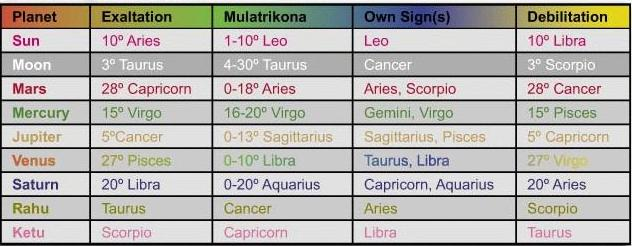
mūlatrikoṇa = root amsha
-
svakshetra = own sign, home rashi
-
[nīcha] dosha * [nīcha] amza * neechcha = debilitation rashi = graha characteristics are inappropriate to the rashi environment
Table quoted from Goravani GJ3
- Shri Yukteswara explains the grand (approximately) 24,000 year rotation of Surya (sun of Earth) around its dual.
- Ultimately, this is why Surya obtains uchcha status (exaltation) in Mesha rashi, while Tula becomes the rashi of Surya's nīcha amsha (debilitation),
QUOTATION from
Holy Science 1855-1936 Shri Yukteswara Giri , Kaivalya Darshanam, p. 7-8
" The sun also has another motion by which it revolves round a grand center called Vishnunabhi, which is the seat of the creative power, brahma, the universal magnetism. Brahma regulates Dharma, the mental virtue of the internal world.
When the sun in its revolution round its dual comes to the place nearest to this grand center, the seat of Brahma (an event which takes place when the Autumnal Equinox comes to the first point of Aries), dharma, the mental virtue, becomes so much developed that man can easily comprehend all, even the mysteries of Spirit.
The Autumnal Equinox will be falling, at the beginning of the twentieth century, among the fixed stars of the Virgo constellation, and in the early part of the Ascending Dwapara Yuga.
After 12,000 years, when the sun goes to the place in its orbit which is farthest from Brahma, the grand center (an event which takes place when the Autumnal Equinox is on the first point of Libra), dharma, the mental virtue, comes to such a reduced state that man cannot grasp anything beyond the gross material creation.
Again, in the same manner, when the sun in its course of revolution begins to advance toward the place nearest to the grand center, dharma, the mental virtue, begins to develop; this growth is gradually completed in another 12,000 years." ~~ quotation from Kaivalya Darshanam, page 7-8
नीच nīca
Graha in Debilitation
Nichha = inappropriate / mismatched to their environment
Rashi immediately following the rashi of Debilitation = Subsequent Rashi = Robust Location
Surya
Vṛścika
yes,
rashi of Great Friend Mangala
Chandra
Dhanus
Mangala
[Karkata - Kadaga]
Simha
yes,
rashi of Great Friend Surya
Budha
Meena - Antya
Mesha - Arya
Guru
Makara
Kumbha - Ghata
Shani
Mesha - Aja
Vrishabha-Urisha
yes,
rashi of Great Friend Shukra
Rahu
Dhanus - Haya
Ketu
Vrishabha - Urisha
नीच nīca
QUOTATION B.V. Raman . (1992, 4th ed.). A Catechism of Astrology . Part I, p. 33
" Q. 39
-
Is Jupiter's aspect in debilitation good?
Ans. Jupiter is primarily a benefic by nature.
-
though he is in debilitation, he still retains his benefic nature and his aspect will be good though weak."
नीच nīca ++ उच्च ucca
QUOTATION B.V. Raman . (1992, 4th ed.). A Catechism of Astrology . Part I, p. 43
" Q 49.
-
What is the effect and strength of planets that are in debilitation in Rasi but exalted in Navamsa ?
Ans.
though Parasara is of the opinion that planets in exaltation but in debilitated Navamsa are not favourable
while those in exalted Navamsa and neechha Rasi do good,
-
we cannot accept it.
Navamsa strength is one of the sources of strength
-
and only from bala-vrinda (sum total of strength) can we know the correct strength
-
and from this, we have to give the effects.
In the stanza referred to, the author has only given the comparative importance of Navamsa in Dasa Vargas."
नीच nīca ++ उच्च ucca
QUOTATION B.V. Raman . (1992, 4th ed.). A Catechism of Astrology . Part II, p. 45
" Q. 53
-
What is the result if a debilitated and an exalted planet are in one house?
Ans. There will be
-
neutralisation of effects, when two such planets combine in one house.
-
If the exalted planet is stronger by proportion, the effect of the exalted planet will prevail ."
Q:
I'm trying to learn as much as I can from your website, and its helping me a lot.I find astrology very very interesting and can see that it is almost purely ''scientific.'' Intuition, however, as you also mention is also very important....
Like this one: What if two graha are located in the same house, where one is exalted and the other debilitated?
E.g. I have a friend (Leo lagna) who has both Jupiter and Mars in his 12th (Cancer) house. So, does the ''goodness " of an exalted guru, cancel the"badness " of the nichhaMars? How does one analyse this?
Your insight will be very much appreciated.
A:
QUOTED below is the commentary of Shri B.V. Raman from p. 45, A Catechism of Astrology
-
" Q. 53 What is the result if a debilitated and an exalted planet are in one house?
-
Ans. There will be neutralisation of effects, when two such planets combine in one house.
-
If the exalted planet is stronger by proportion, the effect of the exalted planet will prevail."
In practice, afrequent pair of [uchcha] nīca = Shukra + Budha, both in Kanya rashi
-
Characteristic of the [uchcha-Budha], such a personality = remarkably intelligent, analytical, articulate, and mentally organized.
-
But also, one may encounter a Learning Pathway populated by women suffering low self-esteem. Often, disappointed expectations in contractual agreements and partnership. Typically, argumentativeness and challenge to locate a point of mutual interest. Commonly,disharmony within relationships.
-
For a feminine nativity = low self-esteem in her own mind, due to repeating self-abuse via criticism [Kanya] of her self-worth [Shukra]
-
for a masculine nativity = a repeating attraction * akarshana * toward women who struggle to recognize their own inherent value. Usually involves the wife and her lady-friends also.
Which effect will be stronger, leading to a definitive characterization of the bhava?
Consider which of the two graha, one uttama and one nīcha, are closer to their own respective ultimate degree of = uttama nichha .
-
Budha peak zenith uttama degree = 04-Kanya
-
Shukra lowest nichha nadir degree = 27-Kanya.
Consider behavioral traits of the graha in their respective rashi
-
in this pair distinctively, budha has an advantage unique to Budha = Budha's mulatrikona is also bantering Budha's svakshetra.
-
Budha gains very considerable strength in Kanya whereas Shukra loses not too much.
-
Shukra in Budha's other rashi Mithuna is fairly happy and definitely enjoys the social art of coupling [Mithuna] .
-
So as always, sensible judgment is required.
Similar judgments can be made for other [nīcha] uchcha pairs:
Surya-yuti-Shani = [uchcha-Surya-Mesha] + [nīcha-Shani-Mesha]
-
POTUS-18 Civil War 1822-1885 Ulysses S. Grant
-
dramatist Uma Thurman
-
POTUS-pair-45 fashion 1970- Melanija Knavs Trump
-
athlete baseball shaming-scandalPete Rose
(1) [uchcha- Guru-Karkata ] exchanges with [potentially nīcha-bhanga] [nicha-Mangala-Karkata]
-
Savitri 1872-1950 revolutionary poet Shri Aurobindo Ghose * freedom fighting yogi
-
Asif Ali Zarda [Bhutto] * political activist
-
NYC-Mayor Rudy Giulani * politician security specialist
-
POTUS-33 Trial and Hope 1884-1972 Harry Truman (1, personality) yogakaraka nicha-bhanga Kuja
(2) [uchcha- Mangala-Makara ] + [nīcha-Guru-Makara]
-
balladeer Sheryl Crow
-
France-Pres 1890-1970 Mémoires de Guerre Charles de Gaulle [uchcha-Kuja-yuti-Guru-nicha] [3, radio-television, instructions, exhortations, announcements, declarations]
-
Opus Dei 1902-1975 St. Josemaria Escriva [nicha-bhanga Guru-yuti-Mangala-uchcha]
-
PlayBoy 1926- publisher Hugh Hefner
-
UK-Queen 1926-2022 Elizabeth-2
[uchcha] Shukra-Meena + [nīcha] Budha-Meena
-
Theory of Relativity 1879-1955 Physics Albert Einstein + [Shani-yuti-Surya]
-
Flowers of Evil 1821-1867 symbolist poet Charles Baudelaire [Surya-yuti-Kuja] + [Guru-yuti-Shani] + [uchcha] Shukra-yuti-Budha [nīcha] (5, poetry)
-
POTUS-07 Indian Removal 1767-1845 Andrew Jackson + Surya [12, under-the-table deals, political bribery]
-
POTUS-18 Civil War 1822-1885 Ulysses S. Grant
-
El Castilo Interior 1515-1582 St. Teresa de Avila
-
USA supreme court justice Elena Kagan
-
social activist philanthropist Ethel Kennedy
-
athlete baseball shaming-scandalPete Rose
-
balladeer Mariah Carey
[nīcha] uchcha pairs do not cancel each others' advantages or handicaps. The nichha graha remain nichha while the uttama graha remain uttama.
[nīcha] uchcha pairs create a particular high-tension yoga which results in a complex personality that succeeds only in very special settings.
-
POTUS-18 Civil War 1822-1885 Ulysses S. Grant= [nīcha] Shani yuti [uchcha] Surya as well as [nīcha] Budha yuti [uchcha] Shukra
Delighted to know you are enjoying - I'll keep working on the site so long as students find it useful.
So the general effects will be a Stronger (Fallen) Mars in Cancer. (?)
A :Namaste,
Yes, general effect stronger for the graha of the higher degree (yuddha) and also the graha which is closer to its peak degree of uttama or nadir [nīcha] amza.
-
[nīcha] Kuja = passive-aggressive rather than direct in action. Mangala = physical energy. Karkata grants an emotional impetus. Harbors resentment, which expresses as control push.
-
[nīcha] Kuja = a guilt-machine. In Karkata, the normally heroic and direct-action Mangala becomes emotionally invasive . If the [nīcha] Kuja is also in Aśleṣa - Naga, 16:40 Karkata to 00:00 Simha, expect to observe the characteristic the penetrating behaviors of squeezing, sneaking, slithering, strangling. Not always physical, often expresses as emotional manipulation, financial extortion (twisting).
-
[nīcha] Kuja may have a genius for massage (muscle penetration, twisting) Speciality skills of protective containment, deep anchoring, or tying-and-lashing may promote success in industries that need an energetic hook-and-keep action, such as fishing to feed the family, or the financial version of fishing such as phishing or loan-sharks.
-
Rather than directly confront its competitors, [nīcha] Kuja insinuates and cajoles . Kuja dosha from bhava-4 becomes especially challenging in partnership. Pushya - Sidhya Guru might have the effect of religious self-justification for this insidious behavior since the [uchcha] Guru in Pushya likes self-righteous demonstrations of piety.
-
Supportive combination for one who works in medical specialty of physical therapy . Excellent placement for emotionally-motivated invasive interventions for drug-alcohol addicts, Likely to be successful in varieties of espionage that require building interpersonal relationships with informants. Great for military stealth. Supports professions where privacy-penetrating behaviors (12) are rewarded as career-positive assets.
-
Militant Mangala can stir the pot, hyperactivating the indoctrination levels of education (4) along with the higher, temple levels of wisdom (9). Trouble for both parents, Yogakaraka bandesha-4 + Dharmesha-9 = nichha in vyaya bhava. Polarizing catalysis through unrest in a foreign land.
-
Energized Potential for moksha = strong papa-graha in dusthamsha! randhresha-8 Guru in 12 with the [nīcha] Kuja suggests death by drowning.
Wishing you every happiness, bPL, Jyotisha
Q: Hi Barbara,
I' ve just read your article on your website, ' Shukra Checklist for easy partnerships' ' . In it you mention the effects of Shukra ' YUTI' ' ketu .
My question is, do these ' yuti' ' effects also apply if Ketu is located in any of Shukra' s houses (Taurus, Libra).
Or, indeed, do Graha give ' yuti' ' effects if they are located in particular houses (eg Mars in Cancer, will it give effects of Mars yuti Moon, because it is in the house of Chandra?
A : Namaste,
Yes, there is a subtle Ketu-yuti effect upon Shukra for Ketu-Tula or Ketu-Urisha.
It is not the distancing and ambivalence toward the life-partner and toward mutually beneficial marriage-and-business partnerships in general such as would be expected when Ketu shares Shukra's bhava.
Rather, chidrakarakaKetu in the rashi of Shukra suggests agency of detachment from wealth and sensual pleasures [Urisha] and from the joys of equity and partnership [Tula] which Shukra brings into the life.
-
When Shukra's functions are reduced by Ketu's presence on one of Shukra's houses, shukra's power to manifest a wife who is pleasuring and invested in the partnership will be reduced. Similar effects for business partnerships in WRT the partner's engagement in building wealth (Vrishabha) and keeping the promises invested in the agreement [Tula].
-
Also you're correct IMO about the understanding that Kuja in Karkata rashi has attributes of Chandra-Mangala yoga. When Kuja is with Soma in the same house, the native is active and ambitious [Kuja] to develop emotional security [Chandra] through financial well-being, thus Chandra-Mangala yoga can be a big money-maker if occurring in houses 1, 2, 5, 9, or 11.
-
The [nīcha] Kuja is emotionally disturbed due to volatile parenting (typically [nīcha] Kuja is raised by someone other than the natural parents). The native typically = quite passive-aggressive in one's methods of trying to achieve emotional attention.
-
Acquisition of affluence , frequently through surreptitious or fraudulent means, = goal of the [nīcha] Kuja who feels wronged, and wants to compensate by taking the hoards of others. [nīcha] Mangala personalities = "sponges " who absorb the product of others' work.
-
The Chandra-Mangala yoga native is also emotionally volatile, but if the yoga occurs in a dhana house then despite their emotional volatility The financial well-being will be generated and one may have a good career due to their personal productivity. The spouse may find such a native difficult to live with at times, but the spouse can also appreciate the engine of productivity and the fruits of profit that this engine can create.
-
The same thing is generally true of [nīcha] Mangala in a bhava concerning cintamani * mani * money , especially in bhava-11: there can be spectacular wealth development due to the native 's intense psychological drive toward security and belongingness, which is commonly (if falsely) believed to be provided by owning properties and storing money. Unfortunately the [nīcha] Kuja's wealth if it does occur may be acquired through parasitic dependence on others, deceptive manipulations, or theft.
-
It is quite reasonable to continue the logic of association between the characteristics of a graha as posited in a rashi, as being similar to the characteristics of that graha when the graha is a co-tenant with the lord of that rashi.
-
Exempli gratia, it is benefical for conceptual learning in Jyotisha studies to consider that Guru-Kumbha is quite similar to Guru + Shani when Shani has the higher degree. Guru's natural abundant expansion will be curbed and limited by fearful, law-abiding Shani; and Brihaspati will need to seek the most conformist, socially uniform channels of expression for obtainment of religious and philosophical wisdom.
Hope this viewpoint is helpful.
Wishing you every happiness, bPL, Jyotisha

[How Readings Work] [Sample Sacred Jewels Ratna Recommendation] [Seva]
 file update =
21-Apr-2024
Copyright © 1994-2024 by Barbara Pijan Lama [Contact]
[How to Request a Jyotishavidya Reading]
file update =
21-Apr-2024
Copyright © 1994-2024 by Barbara Pijan Lama [Contact]
[How to Request a Jyotishavidya Reading]
Barbara Pijan Lama Jyotishavidya Vedic Astrology Surya Sun Chandra Moon Mangala Mars Budha Mercury Guru Jupiter Shukra Venus Shani Saturn Rahu Ketu Graha Planets Dasha Timeline Calendar Nakshatra Navamsha Marriage Children Treasury Career Spiritual Wisdom Cycles of re-Death and re-Birth
The information on barbarapijan.com , including all readings and reports, is provided for educational purposes only. Wishing you every happiness and continuing success in studies!
all that is true, all that is noble,
all that is just and pure,
all that is loveable and gracious,
whatever is excellent and admirable -
fill all your thoughts with these things."
~~ Paul of Tarsus, Epistle to the Philippians 4:8
