
Vimshottari Dasha - Rashi - Gochara - Bhava - Graha - Ratna - Nakshatra - Amsha - karaka - Varga - Bala
Chandra-Tula - comforted by ritual negotiation of agreements = sensitive to balance = needs to trade
Chandra-Tula matched with 12 lagna
- Surya for Tula-born Learners
- Chandra for Tula-born Learners
- Mangala for Tula-born Learners
- Budha for Tula-born Learners
- Brihaspati for Tula-born Learners
- Shukra for Tula-born Learners
- Shani for Tula-born Learners
- Rahu-Ketu for Tula-born Learners
- [Mesha - Aja]
- [Vrishabha - Urisha]
- [Mithuna - Dvamdva]
- [Karkata - Kadaga]
- [Simha - Leya]
- [Kanya - Parthya]
- [Tula - Vanika]
- [Vṛścika - Thriketta]
- [Dhanus - Haya]
- [Makara - Draco]
- [Kumbha - Ghata]
- [Meena - Antya]
9 graha from Tula indriya-lagna
- [Surya-Tula] = [nīcha]
- [Chandra-Tula]
- [Mangala-Tula]
- [Budha-Tula]
- [Guru-Tula]
- [Shukra-Tula]
- [Shani-Tula]
- [Rahu-Tula]
- [Ketu-Tula]
12 bhava from Tula indriya-lagna
Kuja maraka agent of dematerialization
Properties of Tula rashi
Tula indriya-lagna 9 graha = bhava-adhipati = bhava-activators
Observations on Guru, Budha, and Shani bhava activations
dhanapati-2+samatā-pati-7Mangala: Death Outcomes, death Benefits
General Suitability of Sacred Jewels for Tula indriya-lagna
Malefics, sukha-graha, and Neutrals
Tula rashi contains three nakshatra
- Chitra - Spica - Tvastri = pada 3-4
- Svati - Arcturus - Vayu Arcturus = pada 1-2-3-4
- Viśākha - Rādhā - Bishaja = Radha = pada 1-2-3

OM shum Shukra ya namah
OM dram drim draum sah Shukra ya namah
OM sri ram dasrathaye namah
OM tatva niranjnaya tarakaramaya namaha
तुला
Thauli - Thulam
तौलिन् taulin = one who holds the scales
वणिज् vaṇij / baṇij = merchant, trader
वाणिजिक vāṇijika = trader
वणिक्पथ vaṇikpatha = trader's pathway
धट dhata = balance scale
युग्य yugya / जूक juka = yoked, paired [ζυγόν - Zugos]
द्वि dvi = being of two minds, doubt
मानुष mānuṣa = humankind, polarity
पणन paṇana = bartering, purchasing; traffic; sale, selling; betting
The Traders + the Trade Routes
the balance
counterweights
proportion - ratio - symmetry
being equal - homeostasis -
compromise - agreement - settlement
harmonizing, equity, adjustment, accommodation
equal weight, equal value
Fair = Pair = in the Air
Libra - Vesyi - Vahy - Vaga
Zygos ζυγός = yoke
Balanta - Terazi
Moznaim - al-Miizaan
equilibrium
राशि names in numerous languages
mastery is balance
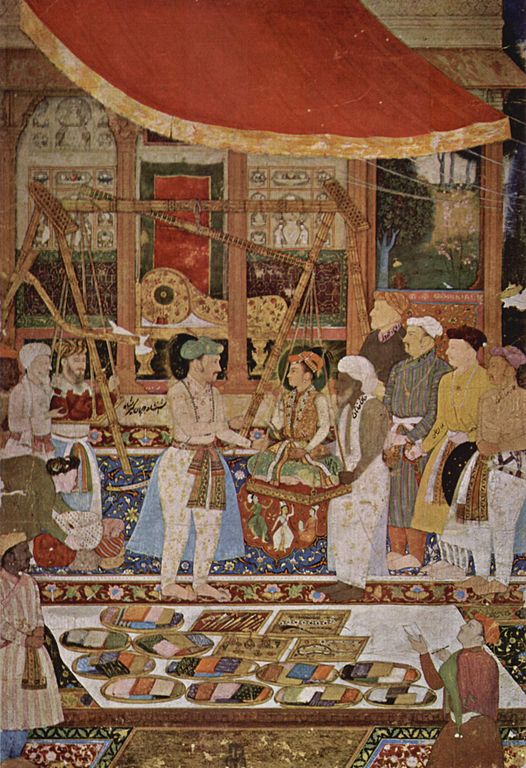
Emperor Jahangir weighing his son Prince Khurram
Featuring young Shah Jahan in gold in 1607
from Tuzk-e-Jahangiri (Jahangirnama) by Manohar circa 1615 CE
"But let justice roll down like waters, and righteousness like an everflowing stream."
Regional Names for Tula
- see also: Rashi names multilingual
-
Greek = yugos, yoke
- Tula = Tulya = Tulha = Thula
- Tauli = Thauli
- Dhata
- Vaanija = Vanikpatha = Vanik (trader)
-
Yugya = Juuka
-
Zigos , Zugos
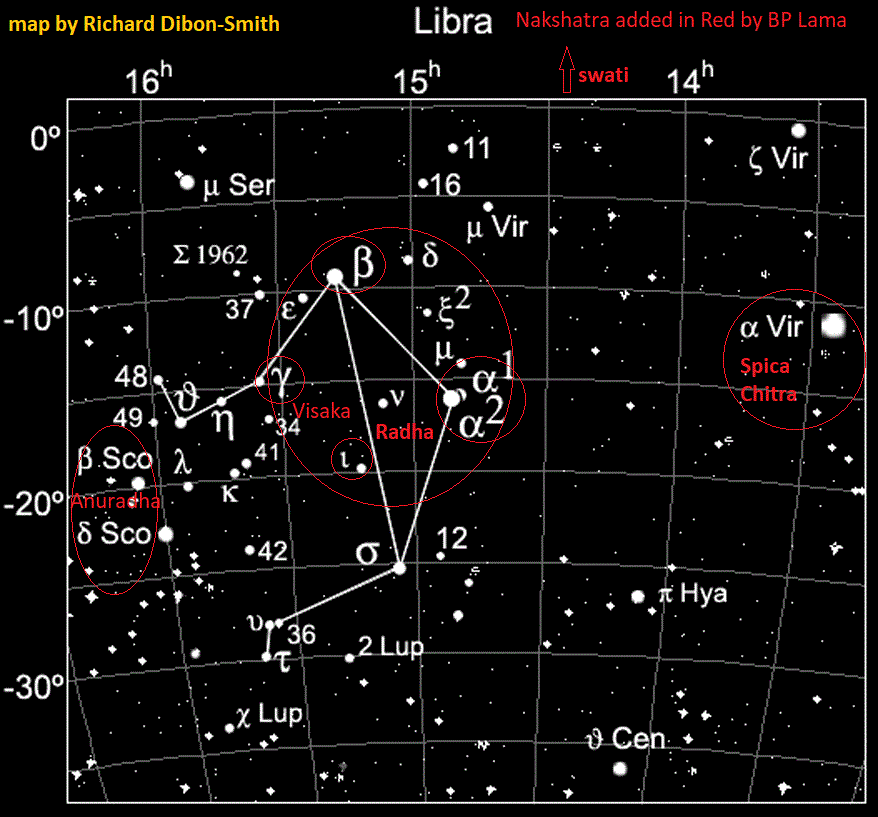
The constellation of Libra from Richard Dibon-Smith - www.dibonsmith.com
nakshatra names in red by BP Lama
Chitra - Spica - Tvastri + Svati - Arcturus + Viśākha - Rādhā
Parashara says:
" [They] grow tall with age and have a well proportioned body.
-
Their limbs are slender but strong.
-
Their appearance is graceful and attractive.
-
They get bald in adult age
-
Their nose is like that of a parrot.
-
the natives of this lagna are level headed .
-
They weigh the merits and demerits of a subject and then express their decision.
-
They are constructive critics.
They are reasonable and just.
-
They are also modest, refined and gentle.
-
They love happy and harmonious life.
They want peace at all costs.
-
They seldom lose their temper.
-
They like changes in their life and environment.
-
They are popular and have a spirit of sacrifice in them.
They have fertile imagination, correct intuition , brilliant intellect and pleasant nature.
-
They are fond of good things and comforts.
-
Their domestic and married life = generally happy.
-
They love their home, family and property. "
[end quotation]
BPHS Sarga 4: 15-16
" Tula is a Seershodaya Rashi , rising with its head
-
Tula is strong in daytime.
-
It is black in complexion and is predominant with Rajo-Guna.
-
It relates to the western direction and resorts to land.
-
It is destructive, or mischievous (‘Dhatin').
-
It represents Shudra, or the 4th Varna.
-
It has a medium build physique and is a biped Rashi.
Its lord is Shukra. "
[end quotation]
EXAMPLES
- Tula = indriya lagna of the kundali (bodily baseline)
- see also: Chandra in Tula
[Tula - Vanika] lagna specializes in partnership and pairings, yoga, equity, balancing, deal-making, match-making, and mutual agreement.
Tula negotiation, bargaining, arrangements, brokerage, diplomacy, partnerships.
Scrupulously polite, as a rule.
-
Chitra - Spica nakshatra marks the eastern horizon. Mangala's influence produces forceful, incisive contract-making. Learners may have an architectural style, aimed toward building of an edifice of alliances. Physicalized.
-
Svati - Arcturus is the rising nakshatra. Rahu's influence produces a passionate expression of feeling in public roles, with a willingness to take risks for potential gain. Zeal for making agreements with those outside one's own group. Risk-rewarding.
-
Viśākha - Rādhā nakshatra forms the Earthen-body birthing indriya-lagna . Shri Guru's influence supports the development of multiple alliances. Often concerned with doctrine and matters of global humanism. May represent numerous and diverse constituencies. Shockingly wide-scope.
Tula portion = Pada-3-4
Mangala's mūlatrikoṇa = Mesha bhava-7
Diplomacy, bargaining, brokerage, deal-making, contracts, design,
arrangements, agreements, exchange,
peerage = paréage, parity, partnership,
equity, equanimity, equability, equation, marriage, balance, grace
[ Chitra pada-3 Tula] [DOUBLE་ TULA]
[negotiating, brokering, adjusting, equity, attorney, advocacy, accommodating, graciously arranging, pleasant, diplomatic, deal-making, trust-building, dithering, compromising, contractual, balancing, fair-deals, trade.]
[Karkata 10th-navamsha] Career Reputation =
tribal, ethno-national, tribal, ethno-national, agricultural, customary, fluctuating, iterative, pulsing, border-defense, wall-builder, farmer, sustains a way-of-life, marine, protective, Caretaking, ritualized. rhythmic/algorithmic, stays in the ancient ruts, building, property-owning, transport ]
-
Oops 1981- music-merchandise Britney Spears [Chitra svamsha] [triple Tula-Chitra lagna = D-1 + D-9 + D-10]
[ Chitra pada-4 Vrischika]
[transformative, identity-changing, mysterious, eruptive, shocking, penetrating, recycling, secret-keeping, revolutionary, healing, disguising, discovering, hidden-power.]
[Simha10th-navamsha] Career Reputation =
political, theatrical, entitled, ceremonial, creative, idealistic, flamboyant, games, genius, romance, artistic performance, fashion-style, solar-energy, central attention-getter, glittering radiance, demonstrating, bright display]
Svati - Arcturus pada 1-2-3-4
regulated by Risk-taking, privilege-seeking Rāhu
Rahu's mūlatrikoṇa = Kumbha bhava-5 = performing arts, theatre, delightful children, literary genius , fashion, politics, celebrity , royalty, romantic idealism, poetry, amusements, charismatic glamour
Svatika = risk-take rs, often found in government diplomacy, politics and drama; religiously or philosophically moralistic albeit with a slightly arrhythmic, slightly unorthodox style of swinging out to form alliances with other traditions [Rahu].
[ Svati pada-1 Dhanus]
[ideological, dogmatic, doctrinal, righteous, convinced, globalist, pontificating, inspirational, optimistic, believing, principled, preachy, patronizing, patriarchal, sacerdotal.]
[Kanya 10th-navamsha] Career Reputation =
ministering, methodical, master of logical argumentation, complex calculations, assistive, accusing, complaining about poverty-crime-disease, analytical, aggrieved of unfair conditions, medicating, military, helping, laboring.]
-
Harmonices Mundi 1571-1630 Johannes Kepler [Purvashadha svamsha] calculation of time cycles, algorithms of planetary movement, theory, celestial mathematics ++ criminal defense of his Mother
-
Calif-Gov-pair 1955- broadcast journalist Maria O. Shriver [Mūla svamsha]
[ Svati pada-2 Makara]
[class-stratified , hierarchical, ranked positioning, timeclock, pyramid, ages-and-stages, sober, architectural, governing, regulator, lawful, structural, stones-and-bones pragmatism.]
[Tula 10th-navamsha] Career Reputation =
brokering, contractual, alliance-building, diplomatic, equalizing, pleasant, musical, harmonizing, partnering, adjudicating, arranging, balancing, match-making, deal-making, advocacy, reciprocity, mutuality in relationships.]
-
POTUS-pair-42 + USA Secy State 1947- Hillary Rodham Clinton [Śrāvaṇa svamsha]
-
Germany Bundeskanzlerin 1954- Angela Merkel [Śrāvaṇa svamsha]
***
-
Walden 1817-1862 abolition Henry David Thoreau [Vaishva svamsha] = maybe Shravana
[ Svati pada-3 Kumbha]
[systematic, gridworked, community-connecting, distributive, interlinked, socio-economic, networking, friendly, associative, goal-achieving. Proletarian sensibilities, pragmatically profitable, mass-marketer. ]
[Vrischika 10th-navamsha] Career Reputation =
undisclosing, dangerous, shocking, healing, penetrating, recycling, , explosive, identity-changing, mysterious, transformative, revitalizing, rejuvenating, evolutionary. May be called to leadership during emergencies, dangers, or threats. ]
-
Egypt-Iran Queen 1921-2013 Fawzia bint Fouad ?
***
- Methodism 1703-1791 preacher John Wesley [Varuna svamsha]
- POTUS-23 National Forests 1833-1901 Benjamin Harrison [Varuna svamsha]
[ Svati pada-4 Meena ]
[visionary, fantasizing, imaginative, conceptual, contemplative, privately guiding, expansive interior worldview, theoretical, diversifying, developing, inclusive, charitable. May be clairsentient.]
[Dhanus 10th-navamsha] Career Reputation =
preachy, pontificating, patronizing, inspirational, globalized, optimistic, expansive exterior worldview, believing, ideological, theological, philosophical, principled, indoctrinating. May be called to leadership in teaching of theory, sermonizing, profession of ultimate convictions, or higher understanding. ]
- Faust 1749-1832 polymath Johann Wolfgang von Goethe [Revatī svamsha] ??
Tula portion = Pada- 1-2-3
Guru's mūlatrikoṇa = Dhanus 3rd counted from Tula
writing , hand-craft, tools, technology, touring, meetings, conferences, printing, photographs, scripts. reports, announcements, advertising, publication, instruction, media-messaging, cinema, work-group, collaboration, conference, entourage, ensemble performance, equipe, commercial business, strategic and tactical planning, frequent travel, tours, promotions, organizers, evangelism
[Rādhā pada-1 Mesha]
[pioneering, dominating, active-aggressive, speedy, forceful, conquesting, competitive, athletic, new, bloody, muscular, innovative, battling, invasive, first-arriver, championship master.]
[Makara 10th-navamsha] Career Reputation =
status-maintaining, hierarchical, institutional, regulatory, governing, directing, legitimizing, ranking, ordering, class-stratified , structuring, lawful, fixed-position, dignified elite. ]
-
Bello Gallico 100-44 BCE Julius Caesar planner + executor of annihilation conquest of European tribes (paga) [Kṛttikā svamsha]
-
POTUS-18 Civil War 1822-1885 Ulysses S. Grant [Kṛttikā svamsha]
[Rādhā pada-2 Urisha]
[finance, face, family, food, tradition, treasures, pleasures, speech, song, language, capitalization, sensual values, historical knowledge, sound, color, taste, touch, beauty, cattle, oil, sugar, sweetness, wine, ornaments, music.]
[Kumbha 10th-navamsha] Career Reputation =
community, fundraising, social-participation, gridworking, gainful, economics, distribution systems, marketplace revenues, associative webs, scientific, futuristic, networking, profitable, collectivist, popular causes, interlinked, friendly.]
-
Italy-Dictator 1883-1945 Fascist Benito Mussolini [Kṛttikā svamsha]
-
POTUS-39 Talking Peace 1924-2024 Jimmy Carter [Kṛttikā svamsha]
-
UK-Princess Royal 1950- equestrienne Anne Windsor Laurence [Kṛttikā svamsha]
[Rādhā pada-3 Mithuna]
[publicizing, explaining, detailing, mercantile, collaborative, communicative, media-messaging, team-working, tallkative, managing, planning, writing, instructional, neighborly.]
[Meena 10th-navamsha] Career Reputation =
privately guiding, intuitive, conceptual, abstract, visionary, symbolic, wholistic, amorphous, privately-guided, vague, charitable, sleepy, imaginative, contemplative, dreamlike].
-
POTUS-pair-04 hostess 1768-1849 Dolley Payne Madison [Punarvasu svamsha]
-
Telepathy 1880-1949 esoterica Alice Bailey [Punarvasu svamsha]
-
VPOTUS-pair Music Censorship 1948- Tipper Gore [Arudra svamsha]
***
- POTUS-26 National Parks 1858-1919 Theodore Roosevelt [Arudra svamsha]
- Superman 1952-2004 tetraplegia Christopher Reeve [Arudra svamsha]??
QUOTATION = Das/ Behari comment on Tula indriya-lagna
" A Libra Ascendant usually bestows a long face, an attractive appearance, tender eyes, and sparsely set teeth.
-
You are generally above average height, lean and thin.
-
Mentally, you are disorganized, emotionally unstable, and socially unbalanced.
-
You are extravagant, generous, helpful and simple at heart.
-
You crave social contact and the assurance that other people need you.
You are also subject to contradictory thoughts and actions;
-
you are fond of justice and law but easily irritated.
Your friends and benefactors tend to be well-placed individuals,
-
but you can also associate with dishonest people who, unfortunately, stick with you for years.
Physically you appear strong and healthy
-
but you may secretly suffer from diseases relating to the loins and kidneys,
-
and should take precaution against urinary tract infections.
You may have a strong desire for artistic achievement but fail to actualize it.
Saturn is a very powerful planet for you.
Jupiter is also very good.
Fond of helping the lowly, and so much so that you may use base acts to achieve your goals.
You respect spiritual leaders because you respect principle centered persons,
but you are often too driven to stick strictly to principles yourself,
but would rather see to it that the objective gets carried out."

General Traits
Tula in kundali indriya-lagna = Chandra in Tula
-
Chandra in Tula - Vanika = affluence from Surya
Tula = chara "initiating" Other-oriented, mutual-benefit, always-bargaining environment which enforces the yogic discipline of availability, awareness and response to Learner's lifepartners.
Career = profession public reputation vocation
Although the 10th navamsha must be considered in any profile of career, it can be said generally that Tula-born Learners tend toward careers that match Karkata themes of security, shelter, stability, schooling, rhythmic undulation , nourishment, rootedness, Caretaking, protection, parenting, and all things maritime.
Also, due to the [yogakaraka] role of bandesha-4 and vidya-pati-5 Shani, acareer in education is empowered, . Shani's bhava and rashi influence the specialization of the type of school, its students, and associated scholarship of the native.
As planetary patron of 4 and 2nd-from-4, Shani contributes expertise in matters of foundation culture (4) and related topics of foundational language, song, speech (2nd-from). In addition Shani confers lineage treasury of the root culture, including linguistic values, moral values, aesthetic values, and financial values. Naturally, professor Shani prefers to confer these culturally-determined, received values in a strict, unchanging manner.
It cannot be overemphasized that the 10th navamsha and the role of the ruler of the 10th navamsha within the radix are also leading predictors. The factors of career must be synthesized to produce a prediction.
Nevertheless, abroad tendency for Tula-born is to establish [Chandra] careers in foundational, grounding, protectionist areas of social order (10).
Careers in Chandra related industry are most probable for the Tula nativity. It is important to assess the rashi-bhava-drishti situation of Professor Chandra to fine-tune any predictions.
Chandra-ruled karma-sthāna may favor careers in schooling from adult to child = with some preference for adolescents (5) adults due to yogakaraka Shani. Tula folk can be influential educational leaders and are often found governing culturally-responsive school hierarchies.
Tula-born also can lead in Chandra-related fields such as housing, real-estate, building construction, transportation of land and sea, shipping and oceans, environmental protection, and the institutional governance of these sectors.
Chandra also concerns all matters of shelter, protection and defense, policing of boundaries, maintenance of the root-culture, agriculture, fishing and farming, and other undertakins of a people in their place of settlement.
-
POTUS-18 Civil War 1822-1885 Ulysses S. Grant = defense of the settled peoples against the enemies of slavery and secession; originally a farmer. Only Tula-Viśākha with its capacity for shock-healing could have succeeded in this horrible task.
The personality often displays a natural affinity for bargaining , arranging, mutually accommodating, deal-making, brokerage, negotiation, seeking balance of weights; parity, diplomacy; design
- Contracts, promises, trust; agreements, alliances; law courts, legal remedies and conflict resolution
-
marriage, partnerships, pairings, equal participation; polarities, sexual relationships; satisfaction, equity; crime-and-punishment, truth-and-consequences; social justice
-
Any type of paired, partnered, fair, equitable, yoked-yoga, balanced phenomenon or activity.
- Pairs of Equal Opposites , polarities, positive-Negative, black-White, self-Other, subjective-Objective, alpha-Omega
see also Tula Chandra
Recommended Jyotisha-ratna for Tula-lagna Learner
- Panna = emerald for wise, imaginative Dharmesha-9 + ruler-of-12 Budha
- Hira= diamond for physical vitality lagnesha-1 + occult randhresha-8 Shukra
- Nilamani = blue sapphire parenting bandesha-4 + creative intelligence vidya-pati-5 [yogakaraka] Shani
Vocabulary for Tula
-
~~ Koeln Digital Sanskrit Lexicon www.sanskrit-lexicon.uni-koeln.de
-
the old // tula // = a unit of mass
Tulā
- the sign Libra
- to hold in or put on a balance, weigh, compare; a balance, weight, measure
- to be in a balance; be equal with
- the balance as an ordeal
- equal measure, equality, resemblance; to become equal to
- to resemble any one or anything
- a kind of beam in the roof of a house
DhaTa
- A balance or the scale of a balance
- ordeal by the balance
- the sign of the zodiac Libra
- old cloth or raiment
- a piece of cloth worn over the privities
Vaanija
- a merchant, trader
- the zodiacal sign Libra
- traffic, commerce
- the submarine fire (supposed to be at the south-pole)
QUOTATION from
T. Subba Row. (1881)."The Twelve Signs of the Zodiac"
in Five Years Of Theosophy. George Robert Snow Mead (ed.). London. (1885, 1894).
" Mystical, philosophical, theosophical, Historical and Scientific Essays, selected from "The Theosophist" .
Available at www.gutenberg.org
" VII. Tula.
When represented by numbers according to the method above alluded to, this word will be converted into 36.
This sign, therefore, is evidently intended to represent the 36 Tatwams.
(The number of Tatwams is different according to the views of different philosophers
-
but by Sakteyas generally and by several of the ancient Rishis, such as Agastya, dvrasa and Parasurama, etc.,
-
the number of Tatwams has been stated to be 36).
Jivatma differs from Paramatma, or to state the same thing in other words,
-
"Baddha" differs from Mukta in being encased as it were within these 36 Tatwams, while the other is free.
This sign prepares the way to earthly Adam to Nara.
As the emblem of Nara it is properly placed as the seventh sign.
(* As the Infinite differs from the Finite and the Unconditioned from the Conditioned.--Ed. Theos.)"
Tula rashi Guna
- rago-guna = rajas , energetic action
Tula rashi Planetary Owner
- Shukra = Venus
Tula rashi manushya group = humane, human-being (group of 3)
-
Mithuna
-
Kanya
-
Tulā
Tula rashi tattva = that-ness; element
-
vayu tattva = air or gassy element
Tula rashi belongs to zirshodaya = shirsho-daya group = head-first =
daya = presentation, delivery, or showing-portion
-
Mithuna
-
Simha
-
Kanya
-
Tulā
-
Vṛścika
-
Kumbha - Ghata
Benefic Malefic
According to B.V. Raman, Three Hundred Important Combinations.
-
(10th ed., delhi, 1991, 1947)."Malefics, sukha-graha, and Neutrals p. 5:
benefic:
-
Mangala (2 + 7),
-
Budha (9 + 12),
-
Shukra (1 + 8),
-
Shani (4 + 5)
malefic:
-
Surya (11),
-
Chandra (10),
-
Guru (3 + 6)
11th-from = Natural Friendship Community-Economy-Sahangha
Tulā befriends Simha-05 types
-
kings and super-stars
-
queens (including 'drama-queens')
-
center-stage personalities
-
the Very Confident (including"cons ")
-
the charming and the charismatic
-
literati and glitterati
-
attention-getters; royalty, celebrities, politicians,
-
who receives acclaim and applause
-
the Entitled
-
Bright Dry Burning Red Ones
-
children
-
persons of genius and creative intelligence,
-
literary genii and performance artists; the glamorous, the fashionable, the brilliant; idealists
-
the dramatically oriented
-
those disconnected (12th-from) service work and medicine [Kanya]
-
leaders (10th-from) of secret empowerment and charismatic agents of sudden, forced-changes [Vṛścika]
If Surya = svakshetra, the Tula-born becomes very selective in the choice of friends and may consider only the truly brilliant ones as suitable company for voluntary association.
General Suitability of Gems for Tula indriya-lagna
Aid to three friends of Shukra
:Recommended Jyotisha-ratna Sacred Gems
- Hira = diamond for lagnesha-1 lagnesha = physical vitality + randhresha-8 ability to"reinvent" the identity = rebalance in response to catastrophic change
- Nilamani = blue sapphire vidya-pati-5 bhagya creative, intelligent, child-generating confidence + bandesha-4 foundational security, shelter. Wear nilam ONLY during Shani bhukti
- Panna = emerald = Dharmesha-9 wise, world-traveling Budha + ruler-of-12 meditation, clairsentience and claircognizance, prayer
-
Surya ratna = generally, no. Surya a natural enemy of lagnesha Shukra = vriddhi-pati-11 . (There are some specific exceptions = see Surya below)
-
Chandra ratna = no, because Chandra = karmesha -10 and does not rules any other house (exceptions may be prescribed for those carrying important leadership responsibilities)
-
Mangala ratna = no, almost always, because maraka Mangala = dhanapati-2 + samatā-pati-7
-
Budha ratna = yes, because Budha = dharmesha -9 + ruler-of-12 (benefits religious intellect)
-
Guru ratna = almost always no, because Professor Guru = bhratru-pati-3 + rogesha-6
-
Shukra ratna = probably yes, because lagnesha Shukra = lagnesha-1 + randhresha-8
-
Shani ratna = Yes, because [yogakaraka] Shani = bandesha-4 + Vidyapati-5
-
Rahu-ratna = unknown, depends on Rahu's ruler
-
Ketu-ratna = unknown, depends on Ketu's lord
There are exceptions to all of these general rules.
Exceptions are caused by the position of Chandra, the active Vimshottari time lords, and one's personal goals inter alia.
Raja Yoga for Tula indriya-lagna = Tula Chandra + Shukra-Karkata
" An exchange of Rashi between Karma's Lord and Lagna-Lord will make the native associated with the king in a great manner."
~~ BPHS, sarga-40, sl. 13
then they form a Raja Yoga.
They will confer high position, reputation and power."
[end quotation]
~~BPHS, sarga-5, shl. 41
natural communities, friendship networks, and sangha
-
wifely-companion Tula-born may have many male friends
Simha
-
befriends those who are in the center of power
-
royalty, celebrities, politicians, persons of genius and creative intelligence,
-
literary genii and performance artists
-
males and father-figures; the father himself is a friend
-
the glamorous, charismatic, fashionable, and brilliant; idealists
-
those less concerned with service work and medicine; children
-
those who take center stage; the dramatically oriented
lagnesha Shukra
Identifies with Partners and Pleasures
Nativity = Tula indriya-lagna or Tula Chandra = strongly identified with peer relationships and fair agreements .
Barring damage to dhana-bhava or to the dhana-pati, most Learners of Vrishabha and Tula become financially privileged and knowledgeable, over time.
Learners may be socially most comfortable in the advocate or peer-adviser role and in company of other match-makers and balancers, and may prefer the social environments of materially elegant, enriched, luxurious cultures.
Tula-born are typically very aesthetic, with an advanced sensitivity to balance in art and design. Ahighly developed Shukra when paired with [uchcha] Shani may become an extraordinary diplomat and agent of social justice .
For Tula indriya-lagna, the character, placement, drishti WRT gracious, acquisitive lagnesha Shukra will determine the conditions of social satisfaction.
Growth-Challenging Vimshottari Dasha calendar periods
for the Tula-born
-
measure from Tula kundali indriya-lagna for social-material effects
-
measure from Tula Chandra lagna for psycho-emotional and spiritual effects
In general, the most growth-challenging life periods for any lagna occur during the Vimshottari dasha lordship of graha which rule no trikona in the nativity.
Easier bhukti-pati = Shukra, Shani, Budha
-
Shukra, Shani, and Budha rule domains 1, 5, 9 respectively.
-
No matter how much challenge from other factors such as difficult transits or the effect of the other non-trine bhava, there is always some positive compensation for the Tula-born during periods of Shukra, Shani, and Budha.
Even when some features of the life experience are growth-challenging due to evocation of the akashiic-memory pattern of their non-trine bhava (8, 4, 12) the effects of their trikona will be rewarding enough that Learners may plod along with reasonable amounts of validation from society and spiritual hope.
Moderate Periods = Chandra, Surya
-
For Tula-born, periods Professor Chandra = karmesha -10 enjoy the special compensation of a distinguished public reputation despite a very heavy leadership workload.
-
Professor Surya Vriddhi-pati-11 while not a trikona pati does facilitate achievement of social-material goals and development of the conceptual and social network.
Difficult Periods = Guru, mangala
-
for Tula-born Learners, the inherently most difficult periods can be expected occur under the auspice of Professor Guru = vikrama-pati+rogesha-6 and maraka Professor Mangala dhanapati-2+samatā-pati-7.
-
Mangala bhukti have a certain compensatory power. dhanapati-2 can energize the Treasury (2) of cintamani = mani = money and knowledge. samatā-pati-7can energize the building of alliances, and connect the native to new advisers such as physicians, attorneys, brokers, etc.
-
Negotiation skills are fueled and sharpened like a fierce warrior's sword. Nevertheless Mangala brings death. In the earlier years Mangala will be the agent of death for the mother, father, and other family members. In the later years, mangala will provide the sharp scissor which cuts that silver cord linking the spirit into the Earthen-body .
One of the reasons that Tula-born = significantly over-represented among the lagna of political leaders and captains of industry = the / personality / graha - Chandra karmesha -10 , Budha Dharmesha-9 , and Shukra lagnesha-1 === all serve as benevolent bhava-pati.
Tula-born are arrangers, negotiators and bargainers; they naturally seek to form alliances.
However, it is the remarkable [yogakaraka] bandesha-4 + vidya-pati-5 Shani who yokes the house of upbringing and schooling (4) to the house of genius and personal intelligence (5).
Tula-born Learners typically = capable students, able to coordinate the old roots, folk customs and established cultural norms of one's own people (4) with the channeled divine intelligence often called 'genius'.
Tula = thus smart at games (5) especially politics(5) and also respectful [yogakaraka Shani]
Workplace leadership issues for the Tula-born
-
karmesha -10 Chandra rules natural bhava of Shani
Strict, punitive, lawful Shani sees tolerant, forgiving, emotional Chandra as an enemy.
-
karmesha -10 Parental Chandra rules karma-bhava
Despite their natural, protective kindness in leadership roles, the Tula-born may become associated with a soft, ineffective, inconsistent or overly feminized [Chandra] leadership style.
-
female Tula leaders face a particular challenge to overcome the public perception that Chandra's natural interest in the welfare of women, children and society's most vulnerable members is not a source of weak ness but rather a source of civilized strength.
-
weak ness when manageable presents opportunities for growth.
Some Tula-born Learners contain powerful corrections to this Tula-lagna leadership disability.
On the plus side, L -10 Chandra = intensely emotionally patriotic. Tula's protection of homeland is perceived as a palpable emotion of devotion to the people and ethnic customs of the homeland = generally a trusted feature of their leadership regime.
Other compensations:
If Chandra is positioned at a favorable angle from karma-bhava, public leadership prospects are improved.
Chandra in bhava that are located 4, 5, 7, 9, 10 from karma-bhava are better suited
, for the Tula-born, Chandra -Tula, Chandra -Vṛścika, Chandra -Makara, Chandra -Meena , and Chandra-Mesha are better suited for leadership roles.
-
[Chandra-Meena] = comforted by ancestral guidance = settled into rhythmic intuition = needs contemplative sanctuary = in 9th-from-10th is better for leadership in academics.
-
Chandra-Mesha is especially strong after age-50 due to Shani = karmesha -10 from Chandra lagna.
there may be improved public appreciation of one's parental style during periods of Chandra in these locations.
However, even with the more favorable placements, tula leaders may struggle to overcome emotional softness in order to appear strictly lawful in their professional social-ordering and regulatory roles.
Crazy-making opposite style workplace communication issues for the Tula-born:
Philosophical vs. Technical
-
vikrama-pati+rogesha-6 Guru rules natural bhava of Budha
-
Dharmesha-9 +ruler-of-12 Budha rules natural bhava of Guru
Wise, inclusive Guru sees argumentative, discriminating Budha as an enemy.
vikrama-pati+rogesha-6 Guru rules 2 natural bhava of Budha.
Guru substitutes philosophical long-view teaching behavior in Budha environments where short-term, superficial, technical collaboration is normally required.
Periods of Guru = problematic for Tula indriya-lagna folk. Learners may become unpopular at work.
The Tula person tends to talk in terms of broad conceptual knowledge [Guru] when it is time to use short-term, pragmatic information [Budha]
The Tula person tends to go into teacher-preacher configuration [Guru] when the workplace situation calls for collaborative, twinning, cooperative behavior [Budha]
The natural worlds of Budha = commercial business, announcements and reports, short-term clinical assessment, accusative litigation, and normal daily exchange of trivial information. In Budha's realms, the Tula-born may give the impression of being a bossy know-it-all, straying off target, and creating mountains out of molehills.
rogesha-6 = the problematizer. Guru rogesha-6 produces a style of problematization (framing and describing a problem) that is often far too religious or moralistic for the mundane clinical environment of bhava-6.
Guru tries to solve daily problems from a higher philosophical perspective. Coworkers may feel that neither the staff nor the patients-clients-customers have time for philosophical rumination nor deep discussions upon the meaning of life.
They want to get in, get the process done, and get out. The Tula-born may be seen as an obstacle to efficient workflow in many cooperative workplace settings.
-
The workplace exception = pastoral counseling or other forms of human services ministry such as social work where it is understood that the client might benefit from a Guru-style compassionate outreach to the deeper meanings of life.
-
Yet, even in these more humanistic environments, there is often a caseload waiting for quick, superficial Budha-style processing. The Tula person who indulges in teaching [Guru] behaviors while employed in a technical [Budha] job may find oneself working a great deal of unpaid overtime.
Dharmesha-9 + ruler-of-12 Budha governs the two natural bhava of Guru.
-
No graha sees Guru as an enemy.
-
Detail-oriented, team-centered, chatty Budha sees broadly wise, teacher-centered, sermon-preacher Guru as neutral.
-
but broadly viewing, inclusive and comprehensive Professor Guru intensely dislikes the quick-witted, superficial young student Budha
Periods of Budha are less difficult overall due to the Kumara's auspice as dharma-pati
-
nevertheless somewhat stressful due to the fact that mentalized Budha has been tasked with revealing the true philosophy (dharma) which results in all the typical frustrations of putting the cart before the horse.
The ceremonially ritualized temple and university environment (9) and the reflectively imaginative and clairsentient private sanctuary environments (12) are NOT places that evoke natural teacher-preacher-believer behaviors.
-
Rather, in these holy places, Budha asserts a critical and analytical method of inquiry.
Budha imposes logical rules of evidence upon matters of religious belief [Guru]. Budha is unable to prima facie accept, without credible explanation , the efficacy of temple discourses nor accept"on faith" the guidance of dreams, imagination, conceptual thought, theory, first principles, research, interiority, hallucination, meditation or clairsentient apprehension.
The two main problematics (endless argumentative loops)
generated by Budha when He encounters Guru's two bhava of religion =
-
unquestioned or unquestionable doctrinal beliefs
-
lack of transparency and accountability in the entitled priesthoods (including the civil religion's priesthood, such as judges)
Often the Tula -born experiences periods of Budha as intellectually frustrating
In matters of dharma-bhava and vyaya-bhava, Budha the Analyzer cannot accept Guru's guidance on faith
Budha wants to instruct, explain, classify, discriminate, and articulate human religious traditions, priestly sacraments, and meditative visions.
Dharmesha-9 +ruler-of-12 Budha the questioner = particularly challenged by attributes of religious culture [Guru] that explicitly forbid or transcend questioning such as dogma, orthodoxy, scriptural 'fundamentalism', priestly empowerment, and assertions of holy mystery based on unaccountable or unexplainable phenomena.
[Tula ]..."Literally means scale. It refers to the seventh sign of the zodiac also known as Libra. Tula also means one's position or stance, which is similar to one's weight on a scale.
The word 'Tula' is used throughout Indian languages to mean one's position.
-
For example, in the Earthen-West if someone is known as a "heavyweight" , or "a major player" , such references are in regard to one's 'Tula', position or stance in relation to others.
This process of judgment can be likened to the balance of a scale."~~ Das Goravani Writing

In classical Greek, the seventh sign = // yugos // the yoke //
Sometimes spelled / zugos / or / zygos /
Yugos = a balance, scales, ayoke, or a slave bound to a master. Yugos = a common term in the koine Greek of the Christian scriptures 'New Testament'r.

[How Readings Work] = [Sample Sacred Jewels Ratna Recommendation] = [Seva]
 file update =
07-Jun-2026
[Copyright © 1994-2034 by Barbara Pijan Lama]
= [Contact]
= [How to Request a Jyotishavidya Reading]
file update =
07-Jun-2026
[Copyright © 1994-2034 by Barbara Pijan Lama]
= [Contact]
= [How to Request a Jyotishavidya Reading]
Barbara Pijan Lama Jyotishavidya Vedic Astrology Surya Sun Chandra Moon Mangala Mars Budha Mercury Guru Jupiter Shukra Venus Shani Saturn Rahu Ketu Graha Planets Dasha Timeline Calendar Nakshatra Navamsha Marriage Children Treasury Career Spiritual Wisdom Cycles of re-Death and re-Birth
The information on barbarapijan.com , including all readings and reports, is provided for educational purposes only. Wishing you every happiness and continuing success in studies!
