
Vimshottari Dasha - Rashi - Gochara - Bhava - Graha - Ratna - Nakshatra - Amsha - karaka - Varga - Bala
Vṛścika rashi contains three nakshatra
-
Viśākha - Rādhā = pada-4
-
Anuradha - Maitreya = pada 1-2-3-4
-
Jyeṣṭha - Antares = pada 1-2-3-4

OM kram krim kraum sah bhaumaya namah
OM Naraya Namah = OM Narayanaya Namah
OM Nayanaya surasihaya namaha
वृश्चिक vṛścika
Vrishchika
वृश्चन vṛścana = scorpion
वस्कराटिका vaskarāṭikā = scorpion
कालक kālaka = scorpion
आलि āli = scorpion, bee, swarm
नक्र nakra = swarm of bees or wasps
कीट kīṭa = insect, stinger
kita - ketta - kalaka
kaurpi - korpi - cike
vrushik - vrizcika - vrizcikarazi - vrizcikeza
ralicha
the perfect sacrifice
Scorpionis
Skorpjon - Skorpija - Escorpi
Isidis
'arkav - al-'
rab -
rep
राशि names in numerous languages
Vṛścika is co-ruled by BOTH Mangala AND Ketu
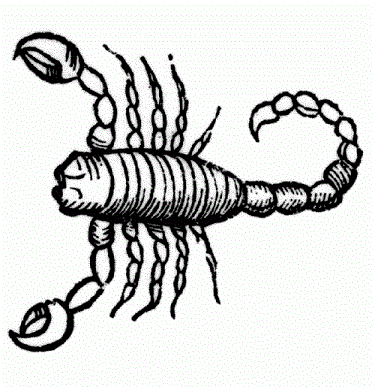
woodcut from Liber Astronomiae
by Fra. Guido Bonatti, c. 1277
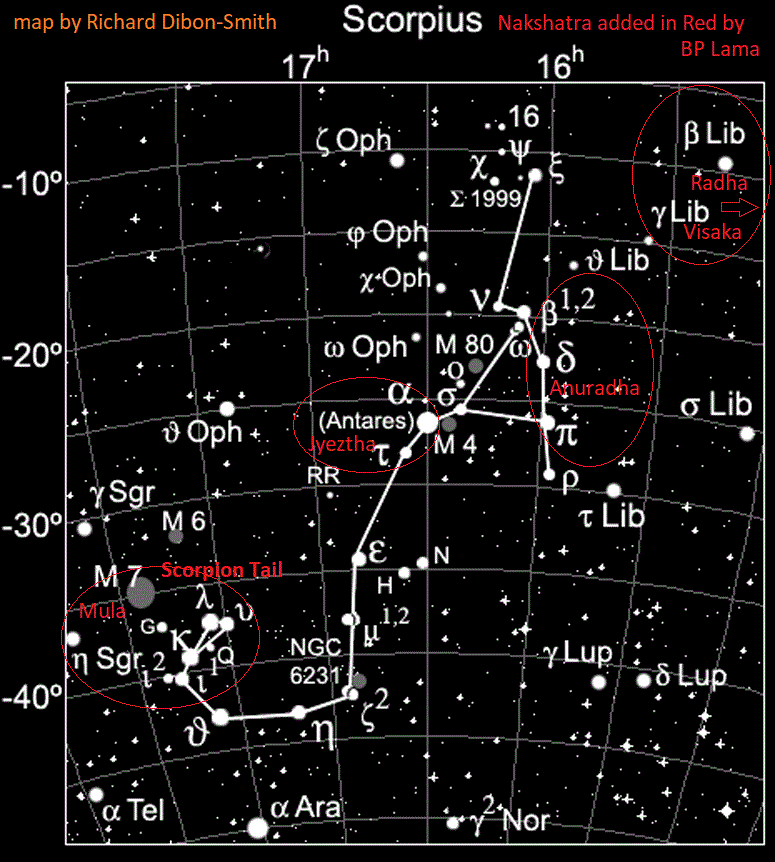
The constellation of Scorpio from Richard Dibon-Smith - www.dibonsmith.com/sco_con.gif
nakshatra names in red by BP Lama Viśākha - Rādhā ++ Anuradha - Maitreya ++ Jyeṣṭha - Antares
General Suitability of Remedial Ratna for Vṛścika Learners
9 graha rulers for Vṛścika indriya-lagna
12 bhava measured from Chandra-Vṛścika
12 bhava counted from Vṛścika indriya-lagna
Nodal Bhava Pair for Vṛścika indriya-lagna
Parivartamsha Yoga for Vṛścika indriya-lagna
Hidden Geothermal Power
fiery nervous system of the animal-chassis of the human
sudden unexpected forceful movement = the Sting
eruption = Breaking the old form = recycling energy
abrupt = interrupt = corrupt = disrupt = erupt = rupture
new identity emerges from within
Names for Vṛścika
- see also: Rashi names multilingual
-
Hindi : Vrishak, Vrushik
- Greek : ekorpios, #931;κoρπιός
Ali
Kaurpi = Kourpya
Kita
Nakra
eScorpionis
Vrishak= Vrushik = Vrizcika = Vrizcikaraazi = Vrizcikeza
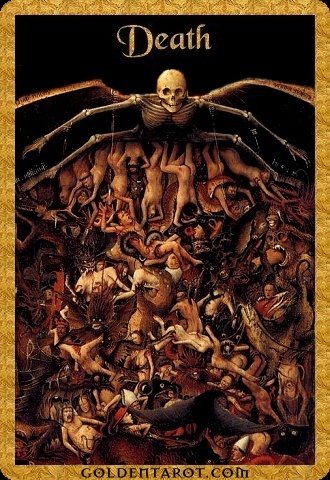
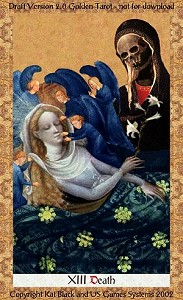
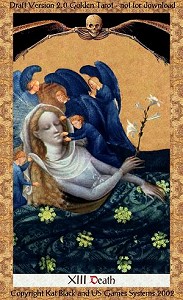
imagery from the exquisite medieval and early renaissance Northern European art collages of the Golden Tarot deck composed by Kat Black
typical of Vṛścika imagery, there is a psychologically adaptive evolution from Old versions of the Arka-typos into Newer versions. Same life force expression, moving into new containers.
the images from this beautiful deck are copyright US Games Systems and Kat Black
BPHS Sarga 4: 15-16.5
" Vṛścika has a slender physique and is a centipede rashi.
-
It denotes Brahmins and resides in holes.
-
Its direction is North and it is strong in daytime.
-
It is reddish-brown and resorts to water and land.
-
It has a hairy physique and is very sharp (or passionate).
-
Mangala is its ruler." [end quote]
QUOTATION - BPHS
The body of the native of this lagna is well proportioned.
-
Hands are generally long.
-
The stature is above average.
-
Face is broad with commanding appearance.
-
Such natives have generally a good personality.
-
[He is] a particularly determined individual.
He will crush the obstacles before him and move forward .
-
He has a fertile imagination and sharp intelligence.
-
He is emotional but possesses remarkable intuitive power.
-
He has self assertion, courage , resolution, independence and forcefulness .
-
He is highly sexy and has relations with many women.
A good Vṛścika native evinces great interest in occult science s and spiritual experiments.
-
the natives of this lagna have a harsh tongue .
-
they are revengeful and vindictive .
-
they love to criticize Others and establish their superiority .
The domestic life of a person with this lagna can be happy
-
only if every member of the family is submissive to him." [end quote]
EXAMPLES
-
Vṛścika = indriya-lagna
-
see also: janma lagna = Chandra in Vṛścika
Vṛścika - Thriketta specializes in recycling, renewal, rejuvenation, death-and-rebirth.
-
If Guru-ruled Viśākha - Rādhā pada-4 nakshatra marks the eastern horizon at the time of birth, aspecial understanding of lineage values-fulfillment and cycles of death-and-rebirth confers a capacity for catastrophe and large-scale rebirth. Often a shakti-healer via rather shocking methods.
-
When Shani-ruled Anuradha - Maitra ms the rising nakshatra, suddenly emerging, eruptive change can be contained within lawful structures. Often an agent of shock-recovery who restores the social order after upheavals and disasters, such as governance officials, military, physicians and emergency-response professionals.
-
Budha-ruled Jyeṣṭha -Kita indicates a messenger of transformative destruction and renewal, whose instructional signal is vigorously conveyed. Often an announcer, reporter, channeler, prophet, instructor, writer, spin-doctor, actor, spokesperson who can make shocking statements.
Viśākha - Rādhā [Karkata pada-4]
ruled by Guru humanism expansion = roots and shoots
Guru mūlatrikoṇa - Dhanus bhava-2 = treasuries of language and history, collections of value, history-stories-storage, genetics, knowledge, family of origin, voice-song-mouth-eyes-hair; pleasure from wisdom, internationalism, doctrine, ideologies
Military general-commanders , transformative agents, tolerance for traumatic evolutionary upheavals but typically sustains household stability, patriotic citizenship, and education
- Calif-Gov 1938- Moonbeam Jerry Brown [Pushya svamsha]
[Rādhā pada-4 Karkata]
[defensive, nationalistic, rhythmic-algorithmic, worshipping, protective, customary, ritualized, routinized, rutting, tidal, moody, habitual, parental, cultural-agricultural, householding.]
[Mesha 10th-navamsha] Career Reputation =
championship, engineering, first-arriving, invasive, weaponizing, fighter, pioneering, muscular, dynamic, energetic, pushy, conquesting, innovative, fiery, new-birth .]
-
POTUS-pair-44 Let's Move 1964- Michelle Robinson Obama [Punarvasu svamsha]
***
-
Spiritual Exercises 1491-1556 Jesuits St. Ignatius Loyola
-
New Atlantis 1561-1626 Sir Francis Bacon
-
France-Emperor 1769-1821 Wars Napoleon Bonaparte [Aśleṣā svamsha] = boundary defense
-
POTUS-09 Tecumseh 1773-1841 William Henry Harrison [Aśleṣā svamsha] invasive destruction of native hunter peoples due to Euro-American farmer settlement [= boundary defense]
-
POTUS-19 Railroad Strike 1822-1893 Rutherford B. Hayes [Pushya svamsha]
-
POTUS-22-24 Interstate Commerce 1837-1908 Grover Cleveland [Pushya svamsha]
-
Satyagraha 1869-1948 Mahatma Mohandas Gandhi [Pushya svamsha]
-
POTUS-36 Great Society 1908-1973 Lyndon Baines Johnson [Aśleṣā svamsha] known for arm-twisting, squeezing, tight-grasping
-
POTUS-41 All the Best 1924-2018 George H.W. Bush [Aśleṣā svamsha]
-
USA Black Power 1925-1965 Nation of Islam Malcolm X [Aśleṣā svamsha]
Anuradha - Maitra
pada 1-2-3-4 = ruled by Shani social governance
* Shani mūlatrikoṇa = Kumbha 4th from Vṛścika = Schooling, housing, fences, boundaries, real-estate- vehicles-transportation, security, parenting, patriotism , homeland, home-craft, housekeeping, republicanism, citizenship,
foundations of a nation, agriculture, care of elderly, folkways, ancient roots, way of life, established patterns, predictable cycles, protection of the homeland, Habitual Rhythms of Life, "end of things" . Loyal to the Mother.
[Anuradha pada-1 Simha]
[demonstrating, displaying, creative, artistic, glittering, showy, ceremonial, brightly intelligent, confident, narcissistic, splendidly dramatic, gaming, romantic, political, entitled.]
[Urisha 10th-navamsha] Career Reputation =
treasures, pleasures, wines, music, visual arts, beauty, luxury, face-eyes-mouth, finance, capitalization, evaluation, assessment, pricing, hoarding, storytelling, genetics, breeding, cattle, memory, sonorous words knowledge, speech-song, tradition, ornaments, storage, food.]
- POTUS-14-pair 1806-1863 Temperance Jane Appleton Pierce [Magha svamsha]
-
Nepal 1945-2001 The Last Hindu King Birendra Bir Bikram Shah [Pūrvaphalgunī svamsha] art collector, entreasured
-
Lipstick 1954-1996 drama-model Margaux Hemingway [Pūrvaphalgunī svamsha]
[Anuradha pada-2 helping-calculating Kanya]
[Logistical, analytical, strategic, calculating, ministering, helpful, tactical, assisting, medicating, arguing, complaining, litigious, human services, seva, scandal.]
[Mithuna 10th-navamsha] Career Reputation =
Solar genius for mercantile, process-product manufacturing, sales, scripted, administrative, project-managing, media-messaging, announcing, writing-publishing, information delivery, radio, television, cinema, internet, advertising, data processing, ensemble production, manual skills, teamwork]
-
POTUS-pair-37 Watergate 1912-1993 Pat Ryan Nixon [Hasta svamsha]
-
Iran-Shah 1919-1980 Aryamehr Mohamed Reza Pahlavi [Uttaraphalguni svamsha]
-
49th Nizari Ismaili Imam 1936-2025 Agha Khan-4 Karim al-Husseini [Aryaman svamsha]
-
POTUS-46 Pandemic 1942- Joe Biden [Uttaraphalguni svamsha]
[Anuradha pada-3 Tula]
[negotiating, brokering, adjusting, equity, attorney, advocacy, accommodating, graciously arranging, pleasant, diplomatic, deal-making, trust-building, dithering, compromising, contractual, balancing, fair-deals, trade.]
[Karkata 10th-navamsha] Career Reputation =
tribal, ethno-national, agricultural, customary, fluctuating, iterative, pulsing, border-defense, wall-builder, farmer, sustains a way-of-life, marine, protective, Caretaking, ritualized. rhythmic/algorithmic, stays in the ancient ruts, building, property-owning, transport ]
[Anuradha pada-4 Vrischika]
[transformative, identity-changing, mysterious, eruptive, shocking, penetrating, recycling, secret-keeping, revolutionary, healing, disguising, discovering, hidden-power.]
[Simha10th-navamsha] Career Reputation =
political, theatrical, entitled, ceremonial, creative, idealistic, flamboyant, games, genius, romance, artistic performance, fashion-style, solar-energy, central attention-getter, glittering radiance, demonstrating, bright display]
pada 1-2-3-4 = ruled by Budha message-prophecy
bantering Budha's mūlatrikoṇa Kanya = 11th counted from Vṛścika
communities, goals, connectivity, economies and ecologies, distributive and associative networks , connections, nexus, knot-net-knit, income, gainfulness, material achievements, marketplace activism, large gatherings, social progress activism, opportunities for economic participation, fan-clubs
[Jyeṣṭha pada-1 Dhanus]
[ideological, dogmatic, doctrinal, righteous, convinced, globalist, pontificating, inspirational, optimistic, believing, principled, preachy, patronizing, patriarchal, sacerdotal.]
[Kanya 10th-navamsha] Career Reputation =
ministering, methodical, master of logical argumentation, complex calculations, assistive, accusing, complaining about poverty-crime-disease, analytical, aggrieved of unfair conditions, medicating, military, helping, laboring.]
-
England-Queen 1533-1603 Armada Elizabeth-1-Tudor [Mūla svamsha]
-
Second Sex 1908-1986 social theory Simone de Beauvoir [Mūla svamsha]
***
-
Puttarpathy 1926-2011 Sathya Sai Baba [Mūla svamsha] magician
-
Iran-Pres 1956- traffic engineer Mahmoud Ahmadinejad [Mūla svamsha]
-
Wikileaks1971- Julian Assange [Mūla svamsha]
[Jyeṣṭha pada-2 Makara]
[class-stratified , hierarchical, ranked positioning, timeclock, pyramid, ages-and-stages, sober, architectural, governing, regulator, lawful, structural, stones-and-bones pragmatism.]
[Tula 10th-navamsha] Career Reputation =
brokering, contractual, alliance-building, diplomatic, equalizing, remediating , pleasant, musical, harmonizing, partnering, adjudicating, arranging, balancing, match-making, deal-making, advocacy, reciprocity, mutuality in relationships.]
-
La Pucelle d'Orléans 1412-1431 St. Jeanne d'Arc [Dhaniṣṭha svamsha]
-
POTUS-pair-16 Illinois 1818-1882 Mary Todd Lincoln [Dhaniṣṭha svamsha]
-
UK-PM Path to Power 1925-2013 Margaret Thatcher [Vaishva svamsha]
-
"O" 1954- multimedia Oprah Winfrey [Vaishva svamsha]
-
UK-Princess 1961-1997 Diana Spencer [Dhaniṣṭha svamsha]
***
-
POTUS-05 Monroe Doctrine 1758-1831 James Monroe [Vaishva svamsha]
-
Ave Maria 1935-2007 tenor Luciano Pavarotti [Vaishva svamsha] ??
-
France-Pres 1955- public finance Nicolas Sarkozy [Dhaniṣṭha svamsha]
[Jyeṣṭha pada-3 Kumbha]
[systematic, gridworked, community-connecting, distributive, interlinked, socio-economic, networking, friendly, associative, goal-achieving.]
[Vrischika 10th-navamsha] Career Reputation =
undisclosing, dangerous, shocking, healing, penetrating, recycling, , explosive, identity-changing, mysterious, transformative, revitalizing, rejuvenating, evolutionary. May be called to leadership during emergencies, dangers, or threats. ]
-
France-Pres 1890-1970 Mémoires de Guerre Charles de Gaulle [Varuna svamsha]
-
Egypt-Sudan King 1920-1965 Faruq al-Awwal [Dhaniṣṭha svamsha]
-
USA-Sen-Tenn VPOTUS Climate Change 1948- Al Gore [Varuna svamsha]
-
UK-Prince 2013- George Wales [Pūrvābhādra svamsha]
[Jyeṣṭha pada-4 Meena ]
[visionary, fantasizing, imaginative, conceptual, contemplative, privately guiding, expansive interior worldview, theoretical, diversifying, developing, inclusive, charitable. May be clairsentient.]
[Dhanus 10th-navamsha] Career Reputation =
preachy, pontificating, patronizing, inspirational, globalized, optimistic, expansive exterior worldview, believing, ideological, theological, philosophical, principled, indoctrinating. May be called to leadership in teaching of theory, sermonizing, profession of ultimate convictions, or higher understanding. ]
-
Ms. Magazine 1934- women's rights Gloria Steinem [Pūrvābhādra svamsha] social philosopher
-
Two Women 1934- eyeglasses Sophia Loren [Revati svamsha]
***
-
Protestant Reformation 1483-1549 hymns Martin Luther [Revatī svamsha] legendary singer, wrote many hundreds of devotional hymns
-
Totem and Taboo 1856-1939 psychoanalysis Sigmund Freud [Pūrvābhādra svamsha] ??
-
POTUS-27 Dollar Diplomacy 1857-1930 William Howard Taft [Andromeda svamsha]
-
Syriana 1961- drama-activist George Clooney [Revatī svamsha]
Vocabulary for Vṛścika
-
QUOTATION from ~~ Koeln Digital Sanskrit Lexicon www.sanskrit-lexicon.uni-koeln.de
Vṛścika - Thriketta
]
vRzcika]
=
- a scorpion; a female scorpion
- the zodiacal sign Scorpio
- the month when the sun is in Scorpio
- a kind of caterpillar covered with bristles
- a sort of beetle found in cow-dung
- a centipede
- various plants (Boerhavia Procumbens)
- an ornament for the toes
Ali =
- " possessed of a sting"
- a (large black) bee
- a scorpion
- a crow
- the Indian cuckoo
- spirituous liquor
- enemy
- Scorpionis in the zodiac
- a woman's female friend
- a row, range, continuous line, aswarm
- a ridge or mound of earth crossing ditches or dividing fields
- a dike
- a ditch
- a line, race, family
- useless, idle, unmeaning
- pure, honest, secure
- to come close to;
- to settle down upon; to stoop, crouch
kita =
- insect
nakra =
- crocodile, alligator
- the sign of the zodiac Scorpionis
- a swarm of bees or wasps
- the nose
- the upper timber of a door-frame
- a kind of aquatic animal
Properties of Vṛścika Rashi = General Traits of Vṛścika indriya-lagna = Chandra in Vṛścika
-
rago-guna = rajas, energetic action
tattva ( = " that -ness ", element)
-
jala tattva = water element
Rashi Co-Owners
- Professor Mangala and Professor Ketu = Mars and the Cauda Draconis
zirshodaya = shirsho-daya group
= head-first =
daya = presentation, delivery, or showing-portion
- Mithuna
- Simha
- Kanya
- Tulā
- Vṛścika
- Kumbha
QUOTATION Role of Mangala = lagnesha + rogesha-6
-
B.V. Raman . (1992, 4th ed.). A Catechism of Astrology . Part I, p. 28
"Q. 33
" For persons born in Scorpio lagna, mars is bad and will kill the native if ill disposed," says Jataka Chandrika .
" Mars is not a malefic for persons born in Scorpio," says Parashara .
How do you reconcile these?"
" Ans.
Here we have no contradiction.
For persons born in Scorpio, mars is the lord of both 1 and 6. As such, he may exercise any one of these powers, or both.
According to Mantreswara , he will exercise the lordship of 6, since the Mulathrikona for Mars is Aries which is the 6th house.
Anyhow, he will exercise his power as the 6th lord if he is ill-disposed .
If he happens to be strong, well-posited, and otherwise favourable, he will exercise his powers as ruler of 1 which is always good."
QUOTATION
T. Subba Row. (1881)."The Twelve Signs of the Zodiac" in Five Years Of Theosophy. George Robert Snow Mead (ed.). London. (1885, 1894).
" Mystical, philosophical, theosophical, Historical and Scientific Essays Selected from The Theosophist. Available at www.gutenberg.org
" VIII. Vṛścika.
It is stated by ancient philosophers that the sun when located in this Rasi or sign is called by the name of Vishnu (see the 12th Skandha of Bhagavata).
-
This sign is intended to represent Vishnu.
-
Vishnu literally means -- expanded as Viswam or Universe.
That which is expanded
Properly speaking, Viswam itself is Vishnu (see Sankaracharya's commentary on Vishnusahasranamam).I have already intimated that Vishnu represents the Swapnavastha or the Dreaming State. The sign in question properly signifies the universe in thought or the universe in the divine conception.
It is properly placed as the sign opposite to Vrishabham or Pranava. Analysis from Pranava downwards leads to the Universe of Thought, and synthesis from the latter upwards leads to Pranava (Aum).We have now arrived at the ideal state of the universe previous to its coming into material existencer.
The expansion of the Vija or primitive germ into the universe is only possible when the 36 "Tatwams " are interposed between the Maya and Jivatma.
-
The dreaming state is induced through the instrumentality of these "Tatwams."
-
It is the existence of these Tatwams that brings Ham to existence.
-
The elimination of these Tatwams marks the beginning of the synthesis towards Pranava and Brahmam and converts Hamsa into Soham .
As it is intended to represent the different stages of evolution from Brahmam downwards to the material universe, the three signs Kanya, tula, and Vṛścika are placed in the order in which they now stand as three separate signs."

Corvus Negrus = the Black Crow
11th-from = Natural Friendship Community-Economy = Sahangha
befriends Kanya-types
the mother's relatives,
the service-oriented, the ministering, the helping, the laboring
the disproportionate
the toxic, the polluted
the unbalanced, ill and the argumentative;
the young and unmarried; the easily exploited, who has no equality no contract
the litigious and accusatory;
criminals and victims;
those who break promises;
the clinical physicians and human services ministers;
the exploited and disenfranchised;
one's servants and animals;
the conflict-oriented
those detached (12th-from) diplomacy and alliances
leaders (10th-from) in humanistic thought and teaching
Vṛścika forms a network of friendships with service-providers, and often makes voluntary friendship with one's own servants or employees.
-
Surya ratna = no, because Surya = karmesha -10 . (Certain exceptions regarding intention to enhance professional recognition, see below.)
-
Chandra ratna = yes! because Chandra = Dharmesha-9
-
Mangala ratna = possibly, with caution for health effects - because Mangala = lagnesha and rogesha-6 (will depend on position of Chandra)
-
Budha ratna = no, because Budha = randhresha-8 and vriddhi-pati-11
-
Guru ratna = yes, unless the person is near death, because Guru = vidya-pati-5 and dhanapati-2
-
Shukra ratna = no, because Shukra = samatā-pati-7and ruler-of-12
-
Shani ratna = possibly, with caution - because Shani = bhratru-pati-3 and bandesha-4 (will depend on position of Chandra)
-
Rahu-ratna = unknown, depends on Rahu's ruler
-
Ketu-ratna = unknown, depends on Ketu's lord.
There are exceptions to all of these general rules which are caused by the position of Chandra, the active Vimshottari time lords, and the Learner 's personal goals, inter alia.
For example if Vṛścika-native is positively sure that one wants to gain cintamani = mani = money no matter the consequence, Budha ratna will stimulate randhresha-8 for secret sources of funds and Vriddhi-pati-11 for marketplace earnings.
The consequences of activating the randhresha-8 can be quite shocking, including a life lived in clouds of suspicion and mistrust, being hunted by predators, minute-to-minute consciousness of the pending circumstances of death, etc. but yes indeed Learners may get income.
Sane people will walk away from this opportunity as a rule . Yet if Chandra occupies Mithuna and there are other compelling reasons, it is possible to prescribe a panna even for Vṛścika indriya-lagna.
The Nodal Bhava Pair for Vṛścika indriya-lagna : bhava-1 and bhava-4
The nodal bhava pair = the two domains which are afflicted by association with the challenger-trinity : Rahu-Ketu and Shani and Mangala.
These are the two domains which are controlled by Vṛścika - Thriketta - Mangala co-ruler with Ketu = and Kumbha - Ghata = Shani co-ruler with Rahu = respectively.
Vṛścika and Vitality
dematerialization is not the end
Vṛścika = re-birth = that (largely) invisible, psychic, soul-based transformation of the container of the vital energy which all sentient creatures continuously endure.
-
In Kuja's capacity as natural governor of randhra-bhava-8, mangala can enforce numerous transformations of the container for an individual vital being (virtual rebirths) within any apparently fleshly lifetime.
-
For example major surgery, deep therapeutic healing, emergence from catastrophic change, tantrik magic, can all effect a vital rebirth.
-
Mangala is the natural regulator of bhava-8. bhava-8 determines conditions of dematerialization. However, it is important to understand that death is a VITAL PROCESs and it certainly is not the "end" of anything.
dematerialization = a material point upon a cycle of continuous movement of vital energy from form to form This energy-cycle is directed by Professor Mangala.
For Urisha indriya-lagna and Vṛścika indriya-lagna
Budha-Ketu bhukti
Potential Divorce signification
Vimshottari dasha each Budha bhukti is always followed by a bhukti of Ketu.
-
Budha = dhanapati-2 for Vrishabha and randhresha-8 for Vṛścika. Thus lord of 2 or 8, which is a divorce trigger, is followed by influence of"surrender" Ketu.
-
Should the marriage be on shaky grounds before the Budha bhukti begins, and if other factors are present such as Budha ruling or located in an argumentative position,
-
then marital disintegration may start in a Budha bhukti to be followed by abandonment and an exclamation of"I give up" during the immediately subsequent Ketu period.
-
During certain long mahadasha (Shukra, Budha, rahu, Shani) the Budha and Ketu periods are proportionally quite long also, therefore, the script of argument [Budha] followed by apathy, despair of improvement, and ultimately abandonment, is given a long playing time in the script.
Raja Yoga for Vṛścika indriya-lagna
Mangala + Surya
-
Mark Twain = parivartamsha yoga
natural communities, friendship networks, and sangha
[Kanya - Parthya] befriends
-
the mother's relatives ,
-
the unbalanced, ill and the argumentative
-
the young and unmarried
-
the litigious and accusatory
-
criminals and victims;
-
those who break promises
-
those less concerned with promise-keeping, trust, diplomacy and alliances
-
the clinical physicians and human services ministers
-
the exploited and disenfranchised; one's servants and animals; the conflict-oriented
PARENTS
Only for Vṛścika indriya- lagna, Surya becomes karmesha while Chandra becomes dharmesha. Therefore, the Vrischika born are generally provided with favorable parents, who in their own characteristic ways do prepare the child for
- adult leadership duties [Surya]
- understanding of human life principles [Chandra].
Health for Vṛścika indriya-lagna
rogesha-6 = Kuja
Tendency toward overweight conditions
Vṛścika indriya-lagna is more likely to have physically-based health puzzles.
-
The physical manifestations of illness are not too mysterious. They tend toward the obvious fleshly wounding of the Mesha warrior aggressive actions: bruises, brain concussion, fevers from infection, cuts and gashes, breaks from collision or fall, blood disease.
-
The origin of Vṛścika's ailment = usually explicitly physical, and often traceable to sport or competitive contests with the brothers [Mangala], male peers [Mangala], soldiers, police, or animals (e.g. hunting injuries).
-
rogesha-6 = the contract-dissolver. In contractual relationships, during the period of rogesha-6 , the Learner will struggle with impulsiveness and a tendency to break promises (6). If other factors suggest impending dissolution of marriage, mangala bhukti may signal divorce.
-
However physical health will be robust
If rogesha-6 Kuja also occupies the Vṛścika kundali indriya-lagna ,
-
the Learner 's life = fraught with physical conflict. The individual is exceptionally competitive to the point of chronic, often destructive, aggressiveness.
-
However, this is not an uncomfortable situation because Kuja = lagnesha
-
The physical frustration inherent in this configuration often drives the Learner to careers military or police service. If Shani is involved with Kuja (yuti or drishti or parivartamsha) the aggression can be channeled into corporate career"climbing" up the status hierarchy, often yielding material and social success.
Power of Parivartamsha Yoga involving Kuja, for Vṛścika indriya-lagna
-
Four parivartamsha yoga possibilities for Kuja lagnesha
Mangala-maraka + Shani in Vṛścika - this yoga is the best for material gain because:
-
Professor Shani is the gainful 11th-from his tenant Kuja,
-
while lagnesha Kuja is self-made-wealth 3rd-from his tenant Shani.
Mangala-Kumbha + Shani in Vṛścika - this yoga is the best for public status , respect, and professional recognition because:
-
Professor Shani is the respectful 10th-from his tenant Kuja,
-
while Professor Kuja is the social-emotional security 4th-from his tenant Shani.
Mangala-maraka + Shani-Mesha
this yoga also benefits public status and professional recognition because the same 4/10 yoga obtains.
-
= [nīcha] Shani occupies the maha-dusthamsha , obliging the person to handle the suffering of the masses - poverty, disease-discomfort, hatred
-
yet Shani emerges through the parivartamsha into the very powerful [nīcha-bhaṅga] status,
-
causing the person to rise very high in organizations which serve the suffering.
-
There may be much combat in this life
-
but the person has undeniable business skills from the uttama lagnesha Kuja
-
Kuja will give increasingly obvious results after age 28.
-
Superior performance in military settings.
Mangala-Kumbha + Shani-Mesha =
Professor Shani is self-made-wealth 3rd from his tenant Kuja,
while Professor Kuja occupies the gainful 11th from his tenant Shani.
Wealth may be gained via unscrupulous means involving exploitation,
and there may be profound emotional turmoil ( with an abstract, philosophical calm in the eye of the hurricane)
but the person gains tremendous worldly power
-
= emotional need to be in control
-
needs a degree of secrecy and hidden psychological values in sexual relationships
-
needs to pursue the forbidden and the unknown
-
affinity for shocking revelations, especially in -Viśākha
-
Often emotionally traumatized in childhood
-
hides money
-
the mother may be exceptionally invasive , controlling and prone to live in a state of constant emotional emergency
-
may be a"crisis junkie" wants things to be a in state of upheaval, disaster, threat to life, and will create an emergency even when there is none, in order to feel needed emotionally
-
at the highest levels of consciousness, may be tantrik yogi and healing facilitator of intentional cycles of self-destruction and rebirth
-
Parental, sensitive and intuitive when in the presence of death .
-
Can be a deeply healing figure at times of catastrophic change.
Counting From indriya-lagnalagna, moon-Sun always = the auspicious 9th and 10th lords
Chandra = matrikaraka and Surya = pitrikaraka
Chandra-Surya working as a team jointly rule dharma-bhava-9 and karma-bhava-10.
Due to the background influence of the personalities of the mother [Chandra] and the father [Surya]Vṛścika Learners typically = predisposed to assume responsibilities for both philosophical teaching (9) and public leadership (10).
The self-concept shaped by both parents contains a high level of certainty regarding one's inherent capabilities.
When the Scorpio lagna person looks in the mirror, s/he sees one destined to guide the people.
The details of how they guide their people depend largely on the house and sign position of Surya and Chandra, drishti to the luminaries, and other adjustments to the general truth that when Ravi is 10th lord the person is born to rule, and when Chandra is 9th lord the moral and religious intuition is highly developed.
For example, Vṛścika-lagna containing; Surya-yuti-Chandra-Mesha-bhava-6 may lead his people via trade and financial services. This combination = Black Moon of course, so often the cintamani = mani = money rules him rather than him ruling the money!
By contrast Vṛścika-lagna with Surya powerful in Simha-bhava-10 while Soma occupies Meena -bhava-5 = more likely to express her leadership empowerments (10) via professional education and the literary arts. The Surya-Chandra relationship suffers from an awkward 6/8 angle (indicating a childhood imbalance-seeking-a-remedy between the mother and the father). This yoga of imbalance-seeking-a-remedy is less amenable to a friendly expression of leadership intelligence. Although Learners may be respected for her bright public visibility due to the powerful position of Surya-Simha-10, Learners may feel the emotional pull of individual creativity from Chandra-Meena -5 and act in an autocratic fashion. The end result could be a political personality which is not entirely trustworthy by the electorate which seeks a leader who is both consistently reliable and radiantly bright. Learners may be accused of contradictory behaviors due to inner and outer self being not fully coordinated = the 6/8 angle.;
Another arrangement might be Surya-Kanya-11 while Chandra occupies Meena -5. Chandra as dharma-pati brings much intelligence via vidya-bhava-5 and when Surya occupies the 7th from Chandra, the White Moon (full moon) obtains, giving smooth coordination of inner and outer self-concepts in the world. Professional expression is sensible to the public. Material gains and honors via Surya-11; are granted for work of creativity via Sauma-5 and advising relationships are supported via 7/7 yoga Sun-Moon.

[How Readings Work] = [Sample Sacred Jewels Ratna Recommendation] = [Seva]
 file update =
07-Jun-2026
file update =
07-Jun-2026
[Copyright © 1994-2034 by Barbara Pijan Lama] = [Contact] = [How to Request a Jyotishavidya Reading]
Barbara Pijan Lama Jyotishavidya Vedic Astrology Surya Sun Chandra Moon Mangala Mars Budha Mercury Guru Jupiter Shukra Venus Shani Saturn Rahu Ketu Graha Planets Dasha Timeline Calendar Nakshatra Navamsha Marriage Children Treasury Career Spiritual Wisdom Cycles of re-Death and re-Birth
The information on barbarapijan.com , including all readings and reports, is provided for educational purposes only. Wishing you every happiness and continuing success in studies!
