

AUM som somaya namah
AUM hreem shreem chandraya namah
OM shram sreem shraum sah chandraya namah
Learning Pathway 4
rhythms and roots
Bhava-4
सुख
sukha-daya = contentment
बन्धु bandhu =
bandhu-sthāna
बन्धुजन bandhujana= kinfolk
रसातल rasātala
हिबुक ὑπόγειον hibuka = [Greek] vault, crypt, burial
= 4th-from-any-lagna
= [4th-from-Chandra]
Vimshottari Periods of the Rulers of Bhava-1-to-12
bhava-4: angles from the 12-sthāna
Regional Names for Bhava-4
- Ambu
- Hibuka
- Paataala
- Sukha
- Surid - Suhrida
- Griha * house, household
- Matripadma
- rasAtala
- vezman

svabhava of Chandra
Rashi - Gochara - Bhava - Graha - Ratna - Nakshatra - Amsha - Varga
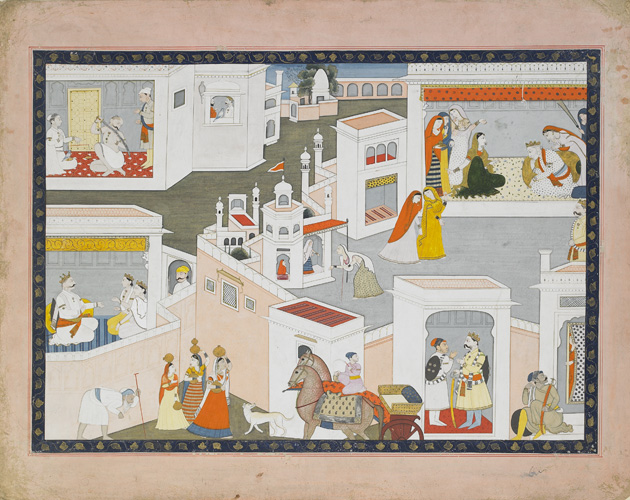
Court Scene from a Bhagavata Purana * ca. 1820
Opaque watercolor on paper; Kangra, punjab Hills, India
Smithsonian Institution Collections: www.asia.si.edu
learning classroom of Professor Chandra
THE PAST
ancestry
all things ancient
ethnicity
THE HOUSEHOLD
dwellings, buildings, settlement
cultural stability
griha/garha the home within the village
Establishment, stability, Security
Shells, shelter
Nourishment, cultivation, agriculture, farms, Gardens
fence-defense
deeds-and-land-holdings
MOTHER - matristhāna
Place,
parenting,
protection,
patriotisam
Rates,
roots,
routes,
ruts,
routine,
rhythm
Walls,
morality,
customs,
boundaries,
belonging
Schooling
Road,
pathway,
walkway,
ports,
trail,
tracks,
wagons,
boats, Vehicles
householders,
citizens,
parishioners,
people of the settlement
RHYTHMS,
rITUALS,
and ROUTINES
familiar calendar of the liturgical year
habitual rites of worship seasonal flow of the folkways
THE WATERS
and the LANDs
oscillating patterns,
tides,
ocean, estuary
Waterways
inside-and-outside the body
shipping geology, earthly environment,
fundament shores,
beaches
THE BEGINNING and THE END
Groundwork, Underground
Burial,
basis,
basement
Retirement
Foundation,
finality
Conclusion of Cycle
the End of Things
" The care of the root of a thing - this is the usage of experienced men.
If the root is sound, the juices, which implement the maturing of the fruit, will be protected."
~~ Ramayana, Kishkindha Kanda, sarga-65
QUOTATION ~~ Phaladeepika , Sarga-1, shloka-11-12
"House property, land and agricultural fields,
maternal uncle, asister's son, relatives,
friends, conveyance (vehicular), mother,
cattle wealth,
scents and perfumes, dress material and garments, jewelry,
happiness (sukha), the nadir,
Hibuka, water, bridge and river are the names to indicate the 4th house."
QUOTATION from Ecclesiasticus (Sirach) 38: 24 - 34 [Revised Standard Version]
38:24 The wisdom of the scribe depends on the opportunity of leisure; and he who has little business may become wise.
38:25 How can he become wise who handles the plow, and who glories in the shaft of a goad, who drives oxen and is occupied with their work, and whose talk is about bulls?
38:26 He sets his heart on plowing furrows, and he is careful about fodder for the heifers.
38:27 So too is every craftsman and master workman who labors by night as well as by day; those who cut the signets of seals, each is diligent in making a great variety; he sets his heart on painting a lifelike image, and he is careful to finish his work.
38:28 So too is the smith sitting by the anvil, intent upon his handiwork in iron; the breath of the fire melts his flesh, and he wastes away in the heat of the furnace; he inclines his ear to the sound of the hammer, and his eyes are on the pattern of the object. He sets his heart on finishing his handiwork, and he is careful to complete its decoration.
38:29 So too is the potter sitting at his work and turning the wheel with his feet; he is always deeply concerned over his work, and all his output is by number.
38:30 He moulds the clay with his arm and makes it pliable with his feet; he sets his heart to finish the glazing, and he is careful to clean the furnace.
38:31 All these rely upon their hands, and each is skilful in his own work.
38:32 Without them a city cannot be established, and men can neither sojourn nor live there.
38:33 Yet they are not sought out for the council of the people, naor do they attain eminence in the public assembly. They do not sit in the judge's seat, naor do they understand the sentence of judgment; they cannot expound discipline or judgment, and they are not found using proverbs.
38:34 But they keep stable the fabric of the world, and their prayer is in the practice of their trade. [end quote]
BPHS Sarga 11:5
" Conveyances,
relatives, mother,
happiness,
treasure,
lands and buildings
are to be consulted through Bandhu Bhava."
" Whatever results are to be known from Bandhu ... should also be known from the 4th of Chandra. .."
" From the fourth house know the mother, conveyance, relatives, state Protection, house, friend, and armaments."

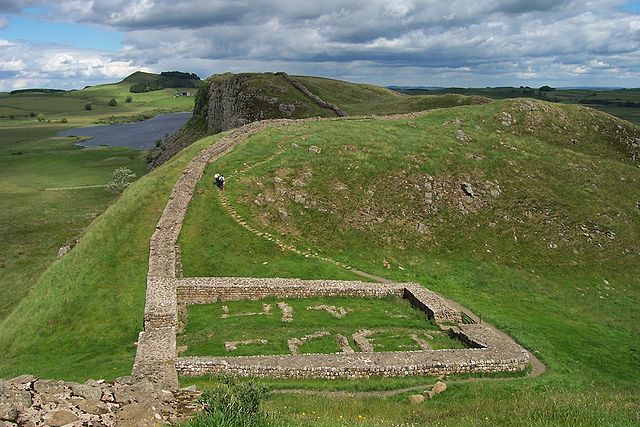
Milecastle 39 within Hadrian's Wall - built in the era of Vallum Hadriani Romae
photo by Adam Cuerden
-
4-household, parents, security, habitual patterns, foundational schooling
bhava-4 characteristics can indicate the longevity of the biofather = 8th-from-9th
Guardians of Land and Country, Protectors of the Customary Ways
-
bhava-4 rules the oceans, estuaries and sea-coasts:
-
sea-shelters and customary folkways of the sea = boats, fishing, seafoods
-
Home and Garden; school and shelter; roof and Roots
-
Local Roads, Local Transportation, local infrastructure
-
" Ethos" the established within-the-walls customs of a settled people
-
ethnos people, naation, class, caste, tribe; a number of people accustomed to live together
-
Local folkways, ancient customs, and established cultural norms: Folk religion
-
Sheltering, sustaining, Securing, Socializing, settling
-
Protection, parents, patriotism, property ownership-stewardship , foundations, fortifications, buildings, protective vehicles upon land and water, that which surrounds and protects
-
Early Childhood Home, fundamentals, stability, Establishment; common law, customary morality
-
Burials (griha), things under-ground, gravesites, housing foundations basements, bhava-foundations, groundworks, the lowest level of anything, basso-profundo
-
soil, ashes-to-Ashes, Earth-core, burial, The End of Things
-
Diplomas and Licenses, passing of examinations, Land Deed
-
Comfort, Custody, National Borders, folkways, ancient customs, and established cultural norms and culture of a People, the ethnic Nation-State,
-
Grounding, root Stock, Planting, Gardening, care of a place and stewardship of the land
-
Ruins and Remains of Buried Civilizations; vestigial remnants; archeology, old roots
-
4-schoolteaching, property ownership-stewardship , patriotism
Topics of Bandhu-Bhava-4
bound, band, binding, bundles
Nation * Foundation
Habitual Rhythms, rituals and Routines
Undergirding, bolstering, lowest stratum, foundation, basis
" Old School"
homeland, farms, schools, houses, and cars
Bound to Earth - bandhi
rhythms, rituals, ruts, routines
social security and continuation of the presence of a people in their place; roots
Held together, protected,"sur-round-ings "
bandhi, bundles: Fasces, fasci, fascisti, fascio, ]
in The earthen body : faschia; in architecture: the doorframe binding fascia ; "fascia" "housing" (for example the removable exterior housing that surrounds the interior electronic device
Security, roots, home, shelter mother, kitchen, landed property, farms, vehicles,
basic formal emotional security, heart.
Fourth marriage. Burials * griha
in Roman-Rite vestments, afascia (binding) is a wrapping like a scarf, usually worn to surround the waist or neck
One's Customary Place : Shelters upon Land and Sea
Safety, Hearth and Home, folkways , the Land, place of belonging
security, ethnicity , vehicles, homes, real estate, landed properties, foundational schooling, folkways, local folkways, ancient customs, and established cultural norms, laying the groundwork, rhythms, rituals, habits * dedication to parents and homeland; protection sheltering safeguarding caretaking of the weak and the vulnerable
4 household, mother, parents, caretakers, familiar rhythms, foundational schooling, gardens, waterways, transportation, housing, social security, sense of place, belonging, ethnic basis, ethnoreligion, patriotism, real-estate, farming, land-ownership, childhood home, owned-stewarded properties, boundaries, deeds of title, ethno-nationalism, tribalism
-
parents
-
Dwashamsha = 12 portions of bhava-4
-
Education within bhava-4= transmission of folkways, ancient customs, and long-embedded cultural norms = via Foundational Schooling in established truths and practices (as distinguished via the 6/8 adversarial angle toward the university-level theoretical discourse of bhava-9)
-
matrikaraka Chandra vs. judging Mother via bhava-4
-
4th house and bandesha-4
-
4th navamsha
-
4th-from Chandra
-
Schooling and property ownership-stewardship : D-4 Varga Chaturamsha
-
Schooling: 4th from Mercury (Budha = Karaka for writing, skills-training)
-
4th-from-4th= Yuvati bhava
-
Vehicles: D-16 Shodashamamsha -10
-
Mother: Chandra and graha yuti Chandra
-
Mother: Moon within navamsha
-
Radix (D-1) graha in Karkata rashi
-
placement of radix bandesha-4 within navamsha
-
Radix bandesha-4 within D-4 chaturamsha
-
4th house within D-4 and Moon in D-4

California freeway with feeder roads and service roads
by Joan Halifax Buddha's Daughters: Teachings from Women Who Are Shaping Buddhism in the West, p.118
"The true nature of mountains is that they are mountains. They practice both stillness holding their place and moving with change.
Men and women can be reborn through mountains. Ancestors abide in mountains. And mountains disappear the closer you are to them.
As Dogen wrote in the Shobogenzo:
"They passed aeons living alone in the mountains and forests; only then did they unite with the Way and use mountains and rivers for words, raise the wind and rain for a tongue, and explain the great void."
Realizing fully the true nature of place is to talk its language and hold its silence. "
QUOTATION Vocabulary for Bandhu Bhava-4
-
Koeln Digital Sanskrit Lexicon www.sanskrit-lexicon.uni-koeln.de
IE root = [ -
bhendh] =
English
bind,
bondage,
bound,
band
Bandh
- To bind , tie, fix, fasten, chain, fetter; to bind round, put on
- To bind together
- To catch, take or hold captive, met
- To attach to world or to sin
- To fix, direct, fasten, rivet (eyes, ears or mind) on
- To arrest, hold back, restrain, suppress, stop, shut, close
- To bind a sacrificial victim (in order to offer sacrifice of the deity to whom it is presented)
- e.g. fold (the hands), clench (the fist), knit or bend (the eyebrows),
- arrange, assume (a posture), set up (a limit), construct (a dam or a bridge),
- span, bridge over (a river),
- conceive or contract (friendship or enmity),
- compose, construct (a poem or verse)
To entertain, cherish, show, exhibit, betray (joy, resolution etc.)
To be bound; to be bound by the fetters of existence or evil,
sin again
To be affected
To cause to bind or catch or capture, imprison To cause to be built or constructed To cause to be embanked or dammed up
Patala
- A roof, thatch
- A veil, cover
- A basket, chest, box
- A heap, mass, multitude (esp. in comp. with a word denoting"cloud" ')
- An enclosing or surrounding skin or membrane (esp. of the eyes), afilm over the eyes, cataract
- A chip, piece, portion
- A section or chapter of a book
- Train, retinue
- A (sectarian or ornamental) mark on the forehead or other parts of the body with sandal-wood
- A tree or a stalk
- pale red, pink, pallid; a pale red hue, rose colour
- saffron
- red Lodhra
- made of the Patali or forming a part of it
-
Bignonia Suaveolens(the tree bearing the trumpet-flower)
- A species of rice ripening in the rains
-
Rottleria Tinctoria
- A kind of fresh water fish
- a form of Durga Tantras
- One of the 7 regions under the earth and abode of the Nagas or serpents and demons;
- a town in the serpent-world
- submarine fire
- An excavation, hole in the earth
- (in astrol.) the fourth house
- (in astron.) name of Jupiter's year of 361 days
- (in music) a kind of measure
hibuka
- name of the fourth Lagna or astrological sign, fourth astrological house
- An assistant, servant
- A house, habitation, home
- " house of earth" , grave
- " the lower world"
-
with names of gods,"a temple"
- A house as containing several rooms
- the inhabitants of a house, family; a householde
- A sign of the zodiac
- An astrological mansion
- name of the 4th astrological mansion
suhRd [suhrid]
- good-hearted, kindhearted, well-disposed
- A friend, ally (also said of planets as friends)
- The fourth astrol. Mansion
- A female friend
- fond of, liking or devoted to
- very similar to, closely resembling
stabilizing, ethnic-religion, habitual, rhythmic, patriotic
A loving atmosphere in your home is the foundation for your life.
bhava-4 represents the landing place where Ur folk descended and planted their genetic seeds
In modern times the conditions of the Jyotishavidya nativity
bhava-4 can indicate how comfortable or not the person may feel living"in the Earth"
some nativities are comfortably grounded into housing, shelter, roots in the place of settlement, rhythms of the childhood home, growing of crops and fishing
others are fundamentally uncomfortable and struggling to adjust to the Ur density for the duration of the incarnation
when conditions in bhava-4 are exceptionally challenging, look for other indications of an early exit
Security
Bandhu Bhava = Security = spiritual, mental, social, emotional, and physical security.
The first analytical step toward determination of the native 's intuitive sense of belonging to a people and a place, and one's specific social practice of security-enhancing behaviors may be found via the lagna.
Lagna = either Chandra lagna or kundali indriya-lagna . Chandra lagna has more emotional and intuitive value. Rashi upon the 4th bhava indicates one's style of security-defensive-belongingness-roots behaviors +source of one's most stable foundations at a personal, family, and national level
-
As always+ bandesha-4 in 3 indicates eventual dissolution of property holdings
-
whereas bandesha-4 in 11 indicates profit via the property marketplace (residential, commercial, vehicular)
" Venus is in 9
or Venus is in 11
or the lord of the 4 is in 9
or the lord of the 4 is in 11"
" Venus or the Lord of the fourth house are somewhat blessed due to their presence in the auspicious ninth or gainful eleventh house.
- Depending on various other factors in the chart, this combination tends to have a positive effect on the number and quality of conveyances or properties."
matrikaraka Chandra = Karaka for Mother vs. Mother = bhava-4
- According to BPHS Sarga-32, shloka-18-21, as a constant karakatva, matrikaraka Chandra always represents the Mother and Mother Figures.
-
According to BPHS Sarga-32, shloka-31 - 33 , each of the 12 bhava also represent a social-material environment that has a reliable association with the kinship figures.
Chandra represents one's emotional Self.
In the present lifetime, the emotional Self is re-generated primarily through one's relationship to one's caretakers.
The default caretaker is one's mother; However, in varying life circumstances the primary caretaker may be a grandmother, aunt, sister, naun, naurse, or even a feminine deity.
However, even if the primary parent is one's father, the father and male persons are not signified by Chandra; men are signified by Surya. If the father is the primary caretaker, likely the Jyotisha relationship between Surya and Chandra is very strong.
Therefore Chandra is a karaka for emotion in general; and in particular Chandra is karaka for one's childhood process of building a coherent emotional Self from repeated emotional Learning Pathway experiences.
-
Typically, mother = agent and referee of those core emotional experiences
-
Mother and Self are very closely aligned.
-
Tthe bond of this core survival relationship = so intense and absolute that one may not be able to distinguish oneself from one's mother until age seven or later.
-
bhava-4 = childhood home . Because Mother is normally the absolute determiner of conditions in one's childhood home, bhava-4 in effect also represents the Mother or primary caregivers who function in the Mother role.
-
But more accurately, bhava-4 represents the mother's affairs , conditions in the early childhood home, family lands and property, and all The mother's estate.
-
Whether mother is queen over a few tin pots or a vast field of financial wealth , mother's estate, and her child's experience of forming its own Self in that estate, is seen in bhava-4.
The Wisdom of No Escape and the Path of Loving-Kindness by Pema Chödrön, p. 77–78
" Ritual is about joining vision and practicality, heaven and earth, samsara and nirvana. When things are properly understood, one's whole life is like a ritual or a ceremony. This is what's behind ritual, these formalized things that get carried down in the religions of different cultures.
Ritual, when it's heartfelt, is like a time capsule. It's as if thousands of years ago somebody had a clear, unobstructed view of magic, power, and sacredness, and realized that if he went out each morning and greeted the sun in a very stylized way, perhaps by doing a special chant and making offerings and perhaps by bowing, that it connected him to that richness.
Therefore, he taught his children to do that, and the children taught their children, and so on. So thousands of years later, people are still doing it and connecting with exactly the same feeling.
All the rituals that get handed down are like that. Someone can have an insight, and rather than its being lost, it can stay alive through ritual."
bhava-4 rules the oceans , estuaries and sea-coasts as well as the lifestyles based in these marine environments
- fishing, boats, sailing
- transoceanic voyage
- under-sea drilling (Mangala in 4 in wet rashi)
- ocean-freight shipping; ocean-going trade [Budha]
- military navy and national defense by water (Mangala, shani)
bhava-4 rules the childhood home, the parents, shelters and shields on mental, physical, emotional, and spiritual levels; for example the physical protection afforded by buildings and vehicles, or the social protection afforded by education.
Bandhu = bindings and bondage
-
Bandhu bhava binds via cultural roots , usually more strongly through the mother's birth culture; through patriotism and the homeland; through childhood schooling and indoctrination into the cultural manners of one's people
-
Bandhu binds to the land through entitlements of ownership or stewardship; such as deeds of title to landed properties and vehicles.
-
Bandhu binds to society through licensing and qualifying examinations, diplomas, licenses, proof of schooling.
Politics of Patriotism and Protectionism
-
Most politicians have strength in either bhava-4, 4th-from-Chandra, or graha in Karkata rashi.
-
The more of these patriotic factors that are present, the stronger is the need, conviction, and rhetoric about homeland roots, security, possession of properties, and boundary defense .
Gore Vidal
"We only have one political party in the U.S.,
-
and that is the property party, which has two right wings."
Stability, foundation, seat; Vehicles
-
Parents, caretakers, and school-teachers provide one's foundations in life
-
bhava-4 rules vehicles which provide protected movement using a shell, afoundation, and a seat (the vehicle's shell may be very basic such as a barge raft, but the shell still provides a minimal protection from the surrounding air, water, fire, earth etc.)
-
Lymph system of The earthen body
-
Hormone-producing glandular system
-
chest
-
breasts
-
the Sheltering, protective, Holding behaviors of the body which involve chest, arms and hands in their nurturing function
-
movements = binding, surrounding, holding, stabilizing
(in their communicative function, arms/hands belong to Mithuna;
The pumping heart which is the seat of the Divine in The earthen body actually belongs to Simha/5, although Naturally, there are very strong associations between the emotional, place-loving heart as the root of being and bandhu bhava. However, the 5-4 relationship between heart and chest is similar to the 5-4 relationship between intelligence and education; )
If the Jyotishavidya nativity
features a strong bandhu-sthāna, expect the fourth chakra region of The earthen body to function well.
Conversely, malefic planets affecting bandhu-bhava may lead to dis-ease in the chest region.
Personal Stability
Habitual, seasonal, and monthly movements of a person may be seen through conditions of bandhu bhava, and also via Chandra.
less benevolent graha in bhava-4 (such as Kuja or Rahu) disturb the foundational cycles of human life.
At the material level,
-
bandhu bhava = real-estate, buildings, shelters, vehicles, schools.
At the social level,
-
it is parents, teachers, examiners.
At the emotional level
-
it is "roots " connection to the homeland and the ethnic people.
At the mental level
-
it is folkways education; licensing and permission to practice a skill within the tribe; the ability to receive [Chandra] the transmission of the folkways, ancient customs, and established cultural norms of the people as those customs define their relationship to land and sea.
On the spiritual level
-
it is the Root going back to the center of our galaxy; our most ancient mother (Moon) and the Earth into which we return at death.
Bhava-4 = also tribal boundaries, schooling and school-teaching, parenting, environmental stewardship, vehicles including cars, boats, airplanes; one's own elderly parents, all things underground, and the "end of things " such as the funeral celebration as well as the place of one's birth and school examinations. For example when people ask whether they will pass the medical board exam and receive their M.D. license, look to the effects of bandhu-4, the bondage to the land and the folkways, ancient customs, and established cultural norms of one's people (including the custom of licensing different types of professional practice).
Mother and Emotional Security
Most basic of all roots in human life is connection to mother. Bandhu bhava along with Moon profiles the mother in radix. (Check Dwadashamamsha -10 Moon or 4th house for additional details on mother.) Also in bandhu sthāna, see mothering, care-taking, stewardship, and nurturing roles of all kinds.
Effect of the Mother seen via the child's chart:
-
Bandhu bhava and bandesha-4
-
Dwadashamamsha -10 D-12: 4th-from-lagna - or - [4th-from-Chandra] [whichever is stronger]
Mother provides the core emotional security, the fundamental sense of being good and valuable, and having a place, belonging.
If things are going well in the bandhusthāna and easy with the Moon, one may have effective emotional and psychic grounding along with a flowing emotional experience, which is the basis of all happiness in human life.
Stepfather = Bonus-father
Usually the step-father or Bonus-father is also the mother's second husband, but there can be other arrangements.
In whichever way, this man has gained the Bonus-father position, the next-dad is indicated by several profile elements, including
-
8th-from-Surya. Check this ruler's role in both radix and navamsha.
-
8th-from-9th, bhava-4
Mother's divorce and mother's second marriage = 2nd-from-Chandra
-
ruler of 8th-from-Surya in Dwadashamamsha -10 can give confirmation of Bonus-father relationship in the native 's life
-
If 8th-from-Surya = strong or receiving strong drishti, the step-father may have a strong personality. Involvement of Kuja or a dusthamsha lord can be overbearing or combative.
-
If 8th-from-Surya = a dusthamsha, the Bonus-father may be a problematic agent for the unfolding of the native's Learning Pathway.
-
Even if 8th-from-Surya = a dusthamsha, benefics in 8th-from-Surya may = benefits coming to native through agency of the Bonus-father.
Home, Land, buildings, Properties
Most questions about property ownership-stewardship , roots in the land, inherited lands, stewardship of the land, buildings, structures, the roof over one's own head (or lack thereof), and the fate of nations, can be answered by examining the fourth house and its attributes.
-
Most permanent possessions such as furniture are included in bandhu, as is hidden treasure.
-
One of the best yoga for treasury is to have the family values grounded in the land ownership house:
Canines
Creatures of the Land

White Wolf and friend Raven
~~ BPHS Sarga-34, shloka-16
" If Dhana's lord is in Bandhu Bhava,
the native will acquire all kinds of wealth ."
Security in society, socialization via schooling
It is said that the two great emotional instincts of human nature are the urge to mate and the urge to conform to a group ethos.
-
Dhana bhava profiles the family's values. Dhana controls the individual's basic moral education, knowledge of tribal history, and education through the oral tradition.
-
By contrast, Bandhu bhava profiles the basic, foundational, formal induction into the customary behaviors of a people which are provided by the larger society.
-
Bandhu also confers the social security gained through conforming to established standards.
-
Bandhu bhava rules basic formal education. Bhava-4 well supported signifies that the individual may complete the basic schooling required to hold a government job. In some nations, that means 10th class; in other nations, that means a university diploma; but in all cases, if bandhu is weak, there is a shortfall in formal education which deprives the person of full security in society.
Because it profiles the fundamental emotional nature which is determined through the relationship with one's mother, bandhu is known as the"source of all ambitions."

Roots that Bind
Bandhu bhava = 4th house = the root =foundation = "basement" basis of the entire kundali.
Although Chandra and the indriya-lagna = ascendant = describe the native 's physical body, Moon and Bandhu bhava = foundational life-support provided by schooling, nourishment, mother and the childhood home
Karkata = Cancer = natural fourth rashi = bondage.
Bondage = positive bonding = unconditional supportive relationship with parents, especially mom. Bondage = positive boundaries = owning a house with lands, farming cultivated fields, caring for the weak, defending the ethnic food-producing lands and the customary habits of a people, or just feeling patriotic.
Cancer
At a dysfunctional body level, the disease called cancer results from The earthen body 's obsessive clinging to waste cells that were scheduled for release but do not get released. Cancer = never letting go, never forgiving. These sticky waste cells bond to each other to form tumors. Most healers acknowledge that the emotional pattern of clinging to the past accompanies the cellular 'bondage' disease.
Layers of protective Shelter
Other vital forms of shelter and protection include clothing and the moving-shelter = vehicles.
-
Bandhu profiles the quality and quantity of one's personal wardrobe, as well as all details of one's road vehicle whether one rides on a donkey, elephant, palanquin, apublic bus, or a racing Ferrari.
-
(For trade in textiles see domains of transaction-Budha = Sahaja Bhava commerce and Ari bhava sale of home-crafts = 3rd from 4th)
-
Road accidents are determined by examining Mangala and Shukra, and any malefic effects on bandhu bhava. Shodashamamsha -10 = D-16 = a confirmation of information from bandhu bhava specially regarding matters of vehicles. D-16 = assessment of whether the vehicle would be damaged or not, or whether passengers can be protected.

Kande Ela Reservoir
in the Central Highlands of Sri Lanka
If your divination skill-set includes the method of Tarot cards,
notice a correspondence between the energy state of Bandhu sthāna and Ten of Pentacles.
Profession and Public Reputation of spouse/partner
-
7th-from-10th = stability of the partnerships which support one's social dignity and public standing. If bandhusthāna is strong, the peer-to-peer contracts such as marriage-union and business partnerships = respectable. Partners support each other via properly balanced terms of agreement. Naturally, relationship skills whether personal or professional are learned in childhood from observing the cooperative understanding of the parents.
-
10th-from-7th = social rank, reputation, and professional status of the primary partnerships.
Favorable conditions in bandhu bhava =
-
first spouse = auspicious public reputation.Check 4th and 10th navamsha also.
-
from blessings in patala-bhava-4, see stability and emotionally nourishing conditions present in the rhythms of school, home-shelter, use of vehicles
-
Polarizing catalysis in 4, triggered by temporarily uncomfortable bhukti or transits, can affect the spouse's or business partner's public reputation, dignity, or professional status. The partner may suffer indignities which sends a ripple of instability through your home. These effects are temporary and may be met with calm acceptance of the cycles of Nature [Chandra].
A steadily rhythmic but low-status bandhu bhava owned and/or aspected by Shani, = regular work habits of the partner.
-
Often such a spouse is a farmer , caretaker of lands, protector of weak elderly and infants. Such a home-based incarnation is very deeply tied to the land and the getting of nourishment; usually a great patriot and loyal citizen of the nation.
-
Such a partner will serve with unbroken daily routine in a potentially grueling [Shani] manual labor position, and feels he must carry the world upon his shoulders. He maintains established civilization although he does not direct its forward movement.
A leading indicator of the Profile of the career of second spouse = 10th-from-2nd = labhasthāna
A leading indicator of the element of the Profile of the career of Third spouse = 10th-from-9th = satkona
A leading indicator of the element of the Profile of the career of Fourth spouse = 10th from 4th = tanu
If yuvati bhava and the 7th navamsha suggest multiple marriages, then part of the profile of the 4th spouse = Bandhu Bhava .
-
4th spouse's wealth = 2nd-from-4th = putra bhava
-
4th spouse's sibling-cohort group = 3rd-from-4th = ari bhava
-
4th spouse's childhood home and mother = 4th-from-4th = yuvati bhava
Like the nature of Bandhu sthāna itself, the fourth marriage is all about roots . If Bandhu is stable, the 4th marriage partner (when indicated) resembles one's mother. The fourth partner hails from a similar cultural background.
of course if Rahu or Saturn aspect or occupy Bandhu, the fourth partner could be lower class than native, foreigner, etc. according to occupying malefic. Remember to check 4th navamsha!
-
Ceteris paribus, the fourth marriage is secure, emotionally cyclical, prefers a hearth-based or kitchen-based lifestyle, focused on property, roots, and belonging to a place. Often deeply involved with the cycle of natural seasons and the tides, particularly coastal lands where the ocean borders the human habitation.
-
If Chandra is strong in a watery sign, may be grounded in a water-based lifestyle such as living on a boat. Typical implications = stronger if radix bandesha-4 = Saturn or Moon.
The fourth marriage might not be too interesting, overly lively, or a sexual hothouse (unless Rahu is with the bandesha-4 or Rahu in 4). Unless there are disruptive, counter-cyclical graha in 4, the fourth marriage = grounded in the ethnic practice particularly the folkways, ancient customs, and established cultural norms of the mother's people, and protection of the land.

Tenzing Gyatso (2012) From Here to Enlightenment: An Introduction to Tsong-kha-pa s Classic Text The Great Treatise on the Stages of the Path to Enlightenment, p. 35 - 36 .
"If your engagement with others is tainted by strong attachment, craving, aversion, anger, and so forth, then that form of grasping is undesirable.
But on the other hand,
when you are interacting with other living beings and become aware of their needs or suffering or pain,
then you need to fully engage with that and be compassionate.

- So there can be positive attachment in this sense of active engagement.
Buddhist masters have long used the term attachment to describe the quality of compassion for others.
For example, averse from Haribhadra Clear Meaning Commentary refers to compassion that is attached to other living beings.
And as we have seen, naagarjuna teaches that attachment for other living beings will arise spontaneously in the person who realizes emptiness."
QUOTATION from Tenzing Gyatso, trans. Thupten Jinpa. The Union of Bliss and Emptiness: Teachings on the Practice of Guru Yoga
" Going for Refuge: Seeking Protection:
-
" What is meant by going for refuge is that you are seeking refuge from some fear.
Causal refuge
-
All the objects [Buddha, lama, guru, etc.] in front of you are what is known as the causal refuge, because they serve as the cause for bringing about the resultant refuge within you.
-
You should entrust yourself to these objects from the depth of your heart, and you should see the objects as protectors.
Resultant refuge
The resultant state of your own future realizations, becoming an arya being and attaining buddhahood -- which depends on your own actualization of the path -- is called the resultant refuge.
Someone in difficulty seeking the assistance of a high official is analogous to someone seeking refuge in the causal refuge.
-
But depending upon others' protection forever is not a courageous way of life; therefore, one has to try to achieve a state where one is no longer dependent upon such a refuge, and this is likened to taking refuge in the resultant buddha, dharma, and sangha .
-
That is the process of taking refuge by a person of high faculty and courage.
-
This practice should be done not for the sake of oneself alone but rather for the sake of all other sentient beings.
When you cultivate such an aspiration focused toward the achievement of the omniscient state, it is very much like the generation of the bodhichitta mind."
[end quote]


[How Readings Work] [Sample Sacred Jewels Ratna Recommendation] [Seva]
 file update:
21-Apr-2024
file update:
21-Apr-2024
[Copyright © 1994-2024 by Barbara Pijan Lama] [Contact] [How to Request a Jyotishavidya Reading]
Barbara Pijan Lama Jyotishavidya Vedic Astrology Surya Sun Chandra Moon Mangala Mars Budha Mercury Guru Jupiter Shukra Venus Shani Saturn Rahu Ketu Graha Planets Dasha Timeline Calendar Nakshatra Navamsha Marriage Children Treasury Career Spiritual Wisdom Cycles of re-Death and re-Birth The information on barbarapijan.com , including all readings and reports, is provided for educational purposes only. Wishing you every happiness and continuing success in studies!