
Vimshottari Dasha - Rashi - Gochara - Bhava - Graha - Ratna - Nakshatra - Amsha - Karaka - Varga - Bala
Rahu-Ketu Main Page
- BPHS MahaDasha of Rahu
-
BP Lama commentary Rahu Mahadasha
-
Traditional Jyotishavidya Sacred Jewels Ratna for Rahu
-
Risk-rewarding Rahu reaches maturity = age 48
-
Gochara Rahu Transits 1900-2099-CE
Rahu samchara * transit bhava-4
- [Rahu in bhava-1]
- [Rahu in bhava-2]
- [Rahu in bhava-3]
- [Rahu in bhava-4]
- [Rahu in bhava-5]
- [Rahu in bhava-6]
- [Rahu in bhava-7]
- [Rahu in bhava-8]
- [Rahu in bhava-9]
- [Rahu in bhava-10]
- [Rahu in bhava-11]
- [Rahu in bhava-12]
- [Rahu-Mesha-Aja]
- [Rahu-Urisha] = [uchcha]
- [Rahu-Mithuna]
- [Rahu-Karkata]
- [Rahu-Singha] = [nīcha]
- [Rahu-Parthya]
- [Rahu-Tula]
- [Rahu-Vṛścika]
- [Rahu-Dhanus]
- [Rahu-Makara-Draco]
- [Rahu-Kumbha] = [svakshetra]
- [Rahu-Meena]
- [Surya-yuti-Rahu]
- [Chandra-yuti-Rahu]
- [Kuja-yuti-Rahu]
- [Budha-yuti-Rahu]
- [Guru-yuti-Rahu]
- [Shukra-yuti-Rahu]
- [Shani-yuti-Rahu]

AUM ram ravahe namah

√ रभ् rabh = grab, seize, take-hold
राहु rāhu
Professor Rāhu
अर्करिपु arka-ripu = enemy of Arka
चन्द्रारि Chandra -ari = enemy of Chandra
अर्कशशिशत्रु arka-śaśi-śatru =
enemy (shatru) of sun (arka) and moon (shashi)
चाण्डाल cāṇḍāla chandala =
outcast, outside the boundary, pariah, worst, lowest
भुजङ्गम bhujaṅgama = serpent-demon
खेट khe-ṭa = air-moving, cavity, hollow, aperture
पिच्छल कारक picchala-kāraka = slippery-maker
resides in
बन्धुस्थान bandhu-sthāna
= place of belonging, staying bound
सुखदाय su-kha-dāya
= easy, comfortable area
रसातल rasā-tala
= earth, ground, subterranean lower realms
गृहस्थान griha-sthāna
= grave, house-of-earth, burial, lower-world
Caput Draconis
Head of the Dragon - North Node
yati
Anabibazon
occupies
the fourth house
genitor = domus
see also: Rahu occupies 4th-from-Chandra
see also: Rahu in the defensive, culturally-rooted, seasonal-calendar, routinized, patriotic, ethno-nationalistic, comfort-seeking, home-loving, foundational, property-owning 4th-from-Chandra
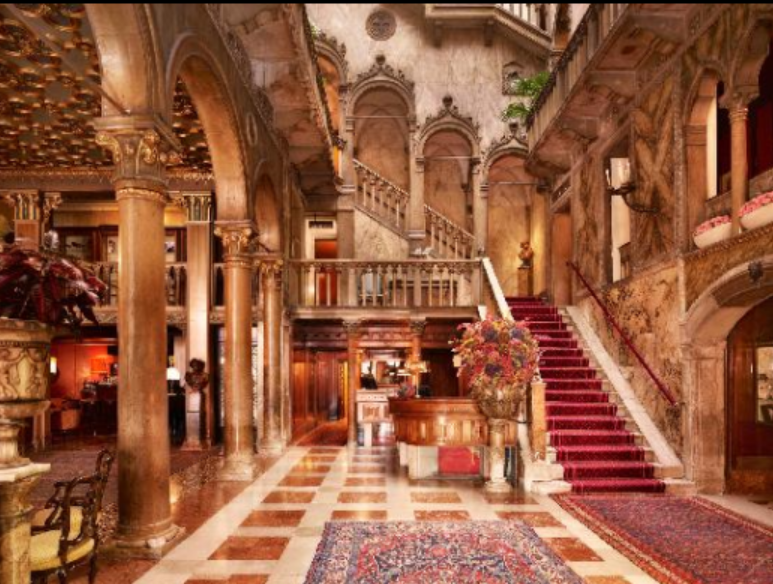
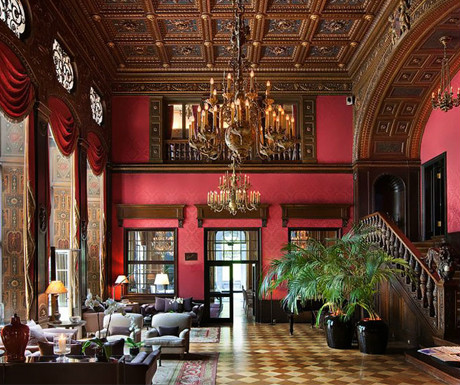
Palazzo Dandolo , Venezi Italia = en.wikipedia.org/wiki/Hotel_Danieli
" As long as you have certain desires about how it ought to be, you can't see how it is."
~~ Ram Dass

Professor Rahu seeks Importance via matters of protectionism and boundaries,
He enjoys the Thrill of Passing via Mixed-Culture privilege, across culture-separating fences, limits, borders, barriers
EXAMPLES
[for Makara - Draco indriya-lagna]
[Rahu-4 casts passionately property-owning habitual drishti into 8-10-12]
-
check Kuja + Kuja-drishti to source Rahu's apparently conquering, mesmerizingly dynamic, mirage of fiery energy
[challenges conventional parenting habits] [passion to mimic first-arrival glamorous appearance of supremacist homelife] [pretentious social mobility of over-reaching competitive local denizens]
[hungers for pioneering educational accomplishment often without normal licenses or diplomas] [cultural foundations may supply championship opportunities]
[ambitiously energetic parents may fraudulently or fabulously exaggerate superb engineering of real-estate or vehicles] [may have excellent irregular parentage]
[wants forward-pushing prestigious athleticly physicalized mixed-culture environments] [craves dynamicly active lifestyle with privileged citizenship]
[artificially vigorous illusion of warriorlike patriotism] [may covet unusual propulsive transportation] [may use amplified weaponized boundary-fencing or aggressive dwelling defense]
-
France-Pres-pair 1967-singer Carla Bruni Sarkozy [pioneering-innovative Aśvini-1] = [vargottamsha]
[Rahu-Urisha] = [uchcha]
[for Kumbha indriya-lagna]
[Rahu-4 casts passionately property-owning habitual drishti into 8-10-12]
-
check Shukra + Shukra-drishti to source Rahu's apparently musical, entrancingly enriching, shimmering sensuality
[passion to mimic the glamorous appearance of luxurious homelife] [pretentious opulence of over-reaching local denizens] [hungers for acquisition of costly licenses and valuable diplomas]
[cultural foundations supply precious opportunities] [ambitiously entreasured parents may fraudulently or fabulously exaggerate their real-estate or vehicles] [wants financially prestigious pleasurable mixed-culture environments]
[craves sumptuous lifestyle with privileged citizenship] [artificially-sweet pretension of cherished patriotism] [may covet expensive unusual transportation] [may over-value boundary-fencing or dwelling price]
[for Meena indriya-lagna]
-
check Budha + Budha-drishti to source Rahu's apparently explanatory, entrancingly detailed, shimmering mirage of communicative flair
[Rahu-4 casts passionately property-owning habitual drishti into 8-10-12]
[fascinating descriptions of landed property] [passionate presentations of fashionably prestige locations] [excitingly unorthodox household conversational rhythms]
[opportunistic advertising of intriguing vehicles]
[for Mesha indriya-lagna]
[Rahu-4 casts passionately property-owning habitual drishti into 8-10-12]
-
check Chandra + Chandra-drishti to source Rahu's apparently familiar, entrancingly rhythmic, exotic defense
-
Esoteric Astrology 1925-2005 Jyotiṣika Bepin Behari [governing-hierarchical Aśleṣā-2] + [Aśleṣā-Rahu-yuti-Soma-Aśleṣā]
-
India-PM 1944-1991 Rajivaratna Gandhi [ancestral-undulating Punarvasu-4] = [vargottamsha]
***
-
UK-Duchess 1981- Meghan Markle [ministering-logistical Pushya-2] + + [Pushya-Rahu-yuti-Surya-Aśleṣa] + [Pushya-Rahu-yuti-Budha-Pushya]
-
basketball champion Michael Jordan - famed for his enormous homes and fleet of remarkable cars + Mangala
[Rahu-Singha] [nicha]
[for Urisha indriya-lagna]
[Rahu-4 casts passionately property-owning habitual drishti into 8-10-12]
-
check Surya + Surya-drishti to source Rahu's apparently ingenious, entrancingly dramatic, brilliant mirage of celebrity
passion for royal-celebrity entitlement
-
France-Queen 1755-1793 Madame Deficit Marie Antoinette [dogmatic-principled Uttaraphalgunī-1]
[for Mithuna indriya-lagna]
[Rahu-4 casts passionately property-owning habitual drishti into 8-10-12]
-
check Budha + Budha-drishti to source Rahu's apparently accurate over-reach, aggrieved ambitions, illusion of articulate argumentation
opportunism in logical argumentation
-
War and Peace 1828-1910 Leo Tolstoy [complaining-logical Chitra-2]
-
UK Princess 2015- Charlotte Wales [fantasizing-conceptual Uttaraphalgunī-4] + [Chitra-Somana-yuti-Rahu-Aryaman]
[Karkata indriya-lagna]
[Rahu-4 casts passionately property-owning habitual drishti into 8-10-12]
-
check Shukra + Shukra-drishti to source Rahu's apparently fair, shimmering mirage of contractual equity
[passion for justice in maritime and land-use law] [ambition to trade in real-estate and watercraft] [opportunistic negotiated arrangements for transport and housing]
[desires to bargain for prestige real-properties] [thrilled by contractual environmental protection of pathways, waterways, airways] [over-reaching pleasantly patriotic ostentatious parents]
-
UK-Duke-Edinburgh 1921-2021 Consort Philip Mountbatten [bargaining-brokering Chitra-3] = [vargottamsha]
[for Simha indriya-lagna]
-
check Mangala for defining source of Rahu's thrillingly transformative innovations, astounding evolutionary energy, mesmerizing eruptions of healing power
[Rahu-4 casts passionately property-owning habitual drishti into 8-10-12]
[passion to mimic the glamorous appearance of camouflaged ancestry] [pretentiously over-reachin mystification of cultural foundations] [expediently obtained licenses and undisclosed diplomas]
[guardian-protectors may supply hidden opportunities] [ambitiously secretive parents may fraudulently or fabulously exaggerate their real-estate or vehicles]
[wants identity-transforming prestigious mixed-culture educational environments] [craves taboo-challenging lifestyle with privileged housing] [thrilled by dangerous threats to habitual patriotism]
[revolutionary initiatives in schoolteaching and border protection] [may make exciting sudden changes of citizenship or dwellings]
[for Kanya indriya-lagna]
-
check Guru + Guru-drishti to source Rahu's apparently generous, fascinatingly wise, shimmering mirage of philosophical conviction
[Rahu-4 casts passionately property-oingwning habitual drishti into 8-10-12]
[passion to mimic the glamorous appearance of principled homelife] [pretentious righteousness of over-reaching local denizens] [hungers for sacerdotal empowerments via philosophical licenses and diplomas]
[cultural foundations supply global opportunities] [ambitious indoctrinated parents may exaggerate their faith in real-estate or vehicles]
[wants boundaried prestigious inspirational mixed-culture environments for sacred understanding] [may be obsessed with developing builded shelters to advance a priestly purpose]
[craves international lifestyle with privileged citizenship] [sermonizing pretensions of preachy patriotism] [may patronize unusual styles of transport]
[may believe that protection provided by fabulous boundary-fencing or astonishing dwelling walls]
- Easy Rider 1936-2010 art-collections Dennis Lee Hopper [defensive-customary Mūla-4]
[for Tulā indriya-lagna]
Rahu-Ketu for Tula-born Learners
[Rahu-4 casts passionately property-owning habitual drishti into 8-10-12]
- check Shani + Shani-drishti to source Rahu's apparently lawful, mirage of regulatory ordering
[passion to mimic the glamorous appearance of conventional homelife] [pretentious formality of over-reaching local denizens] [hungers for local protection via legal licensing and approved diplomas]
[fixed structure of the cultural foundations supplies the illusion of regularized opportunities] [ambitious class-stratified parents may fraudulently or fabulously exaggerate their real-estate or vehicles]
[wants socially prestigious normalized mixed-culture environments] [craving for opulent socially admired boundary-challenging forms of transportation]
[maintains the pretension of exemplary mainstream patriotism] [using public transit pathways, nevertheless craves unusual forms of carriage] [may bureaucraticly over-ride orthodox rules for fencing land-use]
[Rahu-Kumbha] = [svakshetra]
[for Vṛścika indriya-lagna]
[Rahu-4 casts passionately property-owning habitual drishti into 8-10-12]
-
check Shani + Shani-drishti to source Rahu's apparently systematic, shimmeringly structured gainfulness, mimicking ordered connectivity
-
La Pucelle d'Orléans 1412-1431 St. Jeanne d'Arc [champion-pioneer Pūrvābhādra-1]
[for Dhanus - Haya indriya-lagna]
[Rahu-4 casts passionately property-owning culturally habitual drishti into 8-10-12]
- check Guru + Guru-drishti to source Rahu's apparently dreamy contemplation, over-reaching esperant fantasy mirage of imaginative intuition
-
Tantra 1931-1990 professor Osho Rajneesh [ministering-strategic Andromeda-2]
-
Archbishop of Canterbury 1950- poet Rowan Williams [arranging-brokering Uttarabhādra-3] [4, ritual worship, cultural foundations]
***
-
Lights Out singer 1968-2023 Graceland Lisa Marie Presley [imaginative-conceptual Revatī-4] = [vargottamsha] + [Revatī-Rahu-yuti-Shani-Uttarabhādra]
 Fascinating RAHU in BANDHU-STHANA
Renegade Rahu in Bhava 4
[4, mother, parenting, cultural foundations, Founders, security. routines]
In all things Rahu, even the most fantastic upward trajectory tends to end with a sudden ejection from the artificially high, exotically obtained elite level of privilege.
Think of Pretender Professor Rahu 's beheading and fall from the world of the deities. When the period of false entitlement is over, it's over big.
Yet, risk-rewarding Rahu = never fully defeated, His perpetual ambition never withers .
He may fail once or a hundred times. Nevertheless, when the next Rahu bhukti empowers His Fascinating Passions, Shri Rahu will try again
kama-karaka = doer of desires
Uncharacteristically for this normally gentle group, Rahu over-stimulates the taboo-breaking ambitions of
- householders, denizens, citizens, parishioners
-
parents, schoolteachers, caretakers, dwellers in the settlement
-
police, environmentalists, defenders of the land
-
priests of the ancient liturgies, ritualists, pujari, blessers of burials
-
patriots, localists, guardians of the folkways
Rahu's Reach can be greatly amplified when Rahu-4-yuti-Other-Graha
- especially Rahu's Over-reach = empowered when Rahu yuti Mangala, Guru, or Shani
Parenting, property ownership-stewardship , ancestral lands
Conditions of parenting and property ownership-stewardship are often unusual, exotic, ambitious, and overleap conventional boundaries. Learners may serve as a substitute or surrogate parent while posing as the authentic parent. Often a great desire to parent, but the circumstances of the parent role are unconventional or pretentious, surrounded by a smoky aura of not-quite-legitimately entitled to make the claims that the Rahu-4 parent is asserting. Rahu-4 does not affect the conventionality of the children (that would be Rahu-5) rather it affects the social credentials of the parent.
- For example, perhaps the mother's lover who has Rahu-4 presumes to act in the role of the father of her children, or perhaps the mother is really a stepmother yet pretends to be the bio-mother, or perhaps the person is not really a parent but rather a schoolteacher or other protector who does a typical Rahu over-reaching and pretends to have parental authority. There are many possible iterations of the ambitious, gain-intending, alternative-patternings of Rahu-4 parenting.
With property ownership-stewardship , boundaries, and defense of the land, Rahu-4 may be passionate but irregular defender of a parcel of land or an entire nation. Rahu-4 may be found, upon inquiry, to lack legitimate claim to own, protect, defend, land about which Rahu boasts so vehemently.
Here may be found a mercenary warrior defending the entitlements of a foreign monarch, or a false claimant to properties using a ruse such as ancestral rights which lack authenticity.
Irregular settlements - unusual land-use
Seeks privilege via upward social class-mobility via real-estate, construction of buildings, establishment of schools and ancient ethnic teachings, vehicles of land and sea.
- Professor Rahu teaching in classroom-4 often finds His preferred launching-platform in property and vehicle entitlements.
-
May appropriate the properties of others, claiming entitlement to fence and develop the irregularly settled land.
-
Devious, slithering, law-avoiding practices and misrepresentation of credentials in the world of "deeds and titles".
-
Professor Rahu teaching in classroom-4 may be an agent of excitement on topics of property ownership-stewardship and Defense and Protection of the Old Ways in matters of homeland, house, vehicles, school, and farm.
Irregular behaviors related to Lands and Houses
Squatters.
-
Risk-loving Rahu can inhabit (4) the land owned by others (government land, religious land, tribal land, etc.) He can build a home, start a farm, or business on that land, then claims homesteader rights.
Real-estate Speculators.
-
Professor Rahu teaching in classroom-4 would offer a course entitled How to Make a Million in Real Estate - Overnight. Professor Rahu teaching in classroom-4 finds self-elevating opportunity in real-estate and vehicle ownership schemes such as foreclosed properties; flipping; liar-loans (falsification of qualifying income to achieve a larger loan).
-
Professor Rahu teaching in classroom-4 craves important dwellings such as houses, warehouses, commercial buildings, school buildings, construction development, trucks, cars, trailers, caravans, boats large and small.
-
Typically, vehicles and landed properties of Professor Rahu teaching in classroom-4 appear to be a considerable stretch past one' actual social-financial position.
-
Professor Rahu teaching in classroom-4's self-elevating methods may involve bank fraud, wire fraud and mail fraud. Nevertheless Rogue Rahu = master of fraud and the Learner = rarely prosecuted.
Rahu-style home and vehicles
Nowhere is Thorstein Veblen's concept of conspicuous consumption more evident than in the entitled holdings of Rahu in classroom-4.
Since Rahu's class-mobility aspirations are focused upon the lands, vehicles, and home, professor Rahu teaching in classroom-4 may transport, locate and decorate in a conspicuously "showcase" style.
-
Regardless of how outsiders might evaluate the place, professor Rahu teaching in classroom-4's location is perceived by the native as "exclusive" . Furnishings are "classy" and vehicles should connote membership in the Leisure Class. The ambitions of Professor Rahu teaching in classroom-4 would be as obvious in ancient Rome or the old Sarasvati culture as in modern cities.
Rahu occupies the property-owning 4th bhava, which suggests an intensive engagement with real-estate, interiors, housing, shelter, citadel-protection, foundational schooling (especially the school buildings) vehicles and transportation, and a passion for prestigious cars and homes.
Rahu-4 is often a fervent environmentalist, who finds opportunity in the acts of protection and guarding boundaries.
hungry quest for empowering recognition as a legitimate, credible holder of status-rank in the class of beings =
-
Earth Guardians, caretakers, home-owners, property-keepers , watchmen and bouncers, stewards and custodians of the land,
-
environmentalists and real-estate deed-holders, parents and schoolteachers, nurturers, owners of vehicles and shelters, housekeepers, naesters
-
educated, licensed, having passed examinations, belonging here, rooted, bound, homelanders, citizens, folk
-
protectors, mariners, mothers, those who live by cycles of the Earthen-Moon
If candescent Chandra or bandesha-4 = strong, professor Rahu may take whatever risks are necessary to achieve membership in this class of beings.

interpretation of the style of Klimt
TRANSPORT, VEHICLES, DWELLINGS
A Tale of Two Professor Rahu teaching in classroom-4
I remember being invited into the working-class suburban American home of two salary-workers. The living room (salon, parlor) was stuffed with imitation "Louis- XV" furniture. Two sparkling new cars and a pricey sport-fishing boat consumed the smooth new concrete driveway.
The couple expressed pride in having built a brand-new home in this "quality" suburb of a rust-belt industrial city. They explained happily that by illegal conspiracy of the land-selling agents, racially "inferior" persons were not allowed to buy homes in this exclusive area.
I asked these folks how all of this high-status accouterment was funded. (4 = foundations, funding.) They explained that rather than pay property taxes to the municipality (4) they instead paid a bribe to a corrupt local official. They were proud of this clever [Rahu] strategy and smiled knowingly saying "that's how it works in this neck of the woods". In addition, even though the Wifely-companion's three children did not share their home and were not financially supported by the Conspicuous Couple, they claimed her three kids as dependents for a major tax credit. Last year, tax refund had financed their new boat.
From a Jyotisha perspective, this American Midwest couple provide a splendid example of Rahu's quest for social mobility and privilege via legal loopholes and "dark systems". Fraudulent parenting, pretentious home furnishings, showcase vehicles, and illicitly exclusive properties. It turns out that BOTH partners had empowered Rahu in bhava-4!
Arrhythmic parenting.
Ambitious desire to be socially recognized for the exceptional qualities of one's parental status.
-
Professor Rahu teaching in classroom-4 may claim entitlement rights toward parental figures or ancestry"roots " which are not precisely one's own.
-
Expedient claims toward tribal affiliation, including fraudulent ancestral entitlement to lands.
-
Devious practice and misrepresentation of credentials in the world of parental status.
Irregular Professor Rahu teaching in classroom-4 may falsely claim to be the legal parent regarding child(ren) that belong to others. Anti-Shani lawless Professor Rahu teaching in classroom-4 may deceptively mask one's legal parenting status quite convincingly, so that others come to believe that Learners may be the 'natural' parent (4) or the primary legally responsible [Shani] parent.
SCHOOLING [4]
Rahu's Reach can be greatly amplified when Rahu-yuti-Other-Graha
- especially Rahu's Over-reach = empowered when Rahu yuti Mangala, Guru, or Shani
Over-reaching claims about prestige of diploma, license, exam-pass
Devious devising Rahu may self-promote via misrepresentation of credentials in the world of educational certification, diploma, license.
Rahu-4 prefers to tout prestige diploma, license, or professional certification.
Boasting Schoolteacher, parent-figure, protector
Also Professor Rahu teaching in classroom-4 may over-state His importance as a primary teacher, especially in regard to a former student who has gained socially privilegedrrecognition. Rahu-4 may over-claim, "I taught him everything he knows."
Typically, purported student has learned from many teachers, throughout their schooling. Yet, Rahu-4 suggests that the foundational teachers may share a pattern of self-important boasting.
Foundational Familiar Insinuation [unprovable] regarding Ethnic Qualities
- For example, culturally foundational schooling received by a Rahu-4 birth may feature insinuated indirect implied truths, overt or covert, claiming that a certain ethnic group is naturally equipped to govern, or to succeed in business, due to their inherently superior traits. Having been steeped in this over-reaching insinuation throughout their socializing education, one would tend to accept the claims as normal and obvious.
Upon logical inspection most Rahu-4 illusory claims about inherent qualities of any ethnicity or ethnoreligion [4] tend to be unprovable.
But unless critical thinking is brought to bear against such fundamentally yet indirectly insinuated, instilled claims, Learner may honor those foundational teachers by passing these implicit, indirectly presumed cultural folkways to the next generation.
PROPERTY OWNERSHIP or STEWARDSHIP
- Rahu-4 may over-emphasize the cultural importance of
-
property ownership [4] farms, coastal inhabitation
-
marine environments [4]
-
having unusual, extraordinary parents [4]
-
transport, vehicles, and shipping [4].
naturally, one having chosen a birth with Rahu-4 is already prepared to experience ambitious desire in these local, protective, defensive, anchoring, ethnic topics of bandhusthana.
It can also be that Professor Rahu teaching in classroom-4 may obtain educational credentials in an exotic land. Such diploma(s) may be legitimate in their original context, yet their content is exaggerated or inflated in the homeland.
Expedient patriotism.
Ambition to be socially recognized for intensity of His desire to defend and protect the homeland. Yet, irregular or exotic in nationalistic behaviors.
-
UK-Duke-Edinburgh 1921-2021 Consort Philip Mountbatten was born as a prince of Denmark and Greece, educated in France and Germany, then joined the British Navy to defend Britain during the Second World War. Three of his brothers-in-law however fought for Germany, including two with Nazi ties. The British people were naturally a bit leery of Philip's claim to British citizenship.
Professor Rahu teaching in classroom-4 seeks entitlement via His apparent passion for cultivating the Old Ways , while also subverting the stability of the settlement.
Elevation through rhythmic, habitual foundations
Rahu in Bhava-4 = privilege gained via land ownership, vehicles, schooling, and ancient customs of a settled people.
Often a dramatic rise from the station of birth via extraordinary or exotic patriotism, ancestral properties, or cultural protectionism
-
Unusual circumstances regarding the mother, house, lands, or vehicles
Quest for higher recognition via
-
parenting, school-teaching, vehicles, shelters, landed properties, patriotic defense of the Old Ways.
Desire-driven strong property-owning instincts aimed toward self-elevation through risk in areas of real-estate, vehicles, schooling, and marine or coastal affairs. However, full scope of effects depends upon which graha occupy bhava 8, 10, and 12.
Rahu the Naga demi-god is an ambitious trickster.
Rahu has not yet completed the necessary austerities [Shani] and thus Rahu has not yet earned the rank of True Deity.
-
Rahuva craves Deity-level privilege.
To Rahu the Deceiver's advantage, sattva (quiet purity) and tamas (lethargic toxicity) often appear identical on the outside surface (Rahu appear).
Rahu tried to slither into the assembly of the true deities by mimicking their appearance, but His poseur fraud was detected by Shri Vishnu [Surya] and Rahu was thrown out!
Thus Rahu = traditionally a demonic influence = rakshasa = outcast or lower cast = dark, oily, smoky, moves quickly, not established, not legitimate.
-
quickly ascending, unusual, or unstable conditions in the early childhood home; parents unpredictable; disrupted or foreign education
Rahu the Disrupter = an unwelcome guest in the house of stabilizing Chandra
Rahu is considered to provide reasonably good or effective social-material results in domains 3, 6, 10, and 11. These are the svabhava of Budha and Shani; their portfolios include commerce, medicine, government laws, and economic laws.
By contrast, Rahu the Quick Uncoiler who springs forward suddenly at opportune moments = a bitter enemy of Chandra Moon the natural regulator of predictable, safe, customary folkways = Bandhu"bindings " bhava.
-
Rahu the"Chandala" (outcast) = causes the fearfully unstable lunar eclipse.
-
Rahu in 4 = "feels unsafe" .
-
Rahu + early childhood home (4) = parents, shelter = unstable, unpredictable, disrupted.
Rahu in bhava-4 = craves privileged ownership of landed properties, shelters, or vehicles, or a prestigious academic diploma.
Rahu wants = and will obtain, by hook or by crook = to have or appear to have deep roots within the folk traditions of one's ethnic people.
-
Professor Rahu in bhava-4 desires to be recognized as a patriot (4).
-
But indeed Rahu's influence upon the settlement , upon the people and their land = disruptive and challenging to the established [Chandra] traditions.
-
It is possible that Rahu can receive a spiritualizing drishti from the dharmesha-9 or from Professor Guru and thus Professor Rahu teaching in classroom-4 's disruptive or even fraudulent qualities may ultimately challenge the ethnic folkways, ancient customs, and established cultural norms to break free of outdated limitations.
However, normally Professor Rahu teaching in classroom-4 is seen as a bit of a poseur and questions of disloyalty to the culture and the nation are likely to arise.
-
abdicated King of England 1936 Edward-VIII = widely suspected of being a Nazi sympathizer
-
POTUS-35 Profiles in Courage 1917-1963 JFKennedy= suspected alternately of taking orders from the Vatican or from Moscow
-
Wikileaks 1971- Julian Assange * Suspected of destabilizing malice
Ketu in 10
-
naturally, if Rahu occupies 4 then Ketu will reside in 10.
-
Professor Professor Rahu teaching in classroom-4 is too much of an outsider in one's own settlement (mingling with strangers, foreign education etc.) to gain the full trust of the"base" classes
-
Collapsing Ketu in 10 = never quite embraces leadership, governance, and the rule of law.
The instructions of Professor Rahu produce a hunger for profound belongingness and recognition of one's entitlement to Place via ownership, stewardship, or other folk association with the manner of livelihood and environmental spirits of a place.
Desire to obtain the privilege of owning an Estate: house or lands;
In malefic cases = misguided or fraudulent education; illicit exams; falsely obtained property rights.
In beneficial cases, where Rahu receives drishti of a powerful benefic, may expand the desire to broadly compassionate scope: protect, shelter, and educate the Folk. Rahu in 4 under best circumstances can become a sort of super-parent who affords protection to the weakest and most vulnerable people in the Place.
Ambitious desire to be recognized as a patriot, guardian of the customary ways , property owner, parent or schoolteacher, a shelter and protector in stormy times.
Via Rahu's characteristic over-promotion, professor Rahu teaching in classroom-4 often gets into illegitimate property claims that are"over their head" .
Uses the childhood home and ethnic folkways, ancient customs, and established cultural norms as a platform from which to launch the Great Leap, but does not remain consistent with the parental values. Passion to become a better, higher, different property owner, caretaker, educator and parent.
Great Leap Forward via Cultural Roots:
Customary Patterns of Behavior, parents, patriotic Defense
-
disruptive, exciting, leap into higher privilege in the areas of patriotism, security of personal and ethnic roots, defense of homeland foundations and sheltering one's family
Rahu's Great Leap Forward in bhava-4creates a sudden advance to a higher level of social privilege via a shape-shifting change in property ownership-stewardship , patriotic allegiance, schooling, licenses and examinations, vehicles, and matters regarding The parents and childhood home. . During the mahadasha of Rahu and bhukti of Rahu, professor Rahu in bhava-4 may "re-invent" the one's ethnic and cultural foundations to better match the customs of a "higher" social echelonr.
The Chosen
Professor Rahu in bhava-4 wishes to feel specially"chosen" for a privileged role: permission to join elite educators, land-owners and patriots.
Opportunity via Disruption of the Foundations
// Leapfrog // over the conventional path to privilege via one's cultural foundations , owned-stewarded property or vehicles, particularly via education in"roots " of a place and ethnic folkways, ancient customs, and established cultural norms
Desire to challenge conventional boundaries of social security and cultural indoctrination
Desire to Possess cultural roots through special entitlements
Unusual conditions in schools, vehicles, lands and titled properties
exotic and unconventional expression of patriotism; may hold multiple citizenship
Professor Rahu teaching in classroom-4 may appropriate the mother, home, property, vehicle, license, deeds of title, folkways, ancient customs, and established cultural norms, or schooling of another
Professor Rahu in bhava-4 can leapfrog to higher ethnic belongingness status in patriotic, protective, and property-owning realms, often by forming an exotic relationship with a mother-figure.
// spring forward // to a higher social station on the third lifepartnership
Professor Rahu teaching in classroom-4 = Karaka for an ambitious mother and an international education;
karaka for ancestral properties inherited from parents wherein the spirits of the ancestors are still very much possessing the lands and buildings; ghosts in the home
Rahu the Rakshasa feeds upon chaotic and manipulative circumstances within the world of parents, home and homeland, shelter and schooling.
Rahu the Intruder disrupts the national boundaries, causing Professor Rahu teaching in classroom-4 to internationalize However, uncomfortable that feels. Professor Rahu in bhava-4 must make one's home among foreigners, mixing the habits of one's upbringing with strange new habits and folkways, ancient customs, and established cultural norms. Exotic people enter the home.
Rahu disrupts customary habits of parenting, upsets the schedule of settled family life, and makes Professor Rahu in bhava-4 privy to disturbing and possibly dangerous threats to national security.
Rahu Risk-taking as a response to conflict
Professor Rahu teaching in classroom-4 = 6th-from = bhava-11 = Professor Rahu teaching in classroom-4 might feel compelled toward illicit behaviors by a conflict with material goals, friends, maternal uncle's wife, or the father's relatives
- passion for prestige property, shelters, rhythms, routine, roots, foundations
-
display of domestic imagery, environmentalism, homes, cars, boats, farms, schools, pools, emblems of nativity and ethnicity
-
seeks privilege via * important properties * house and home. House-proud, prestige-image in interior decor, real-estate. Importance sought via foundational schooling (hover-parent). Important vehicles such as automobile, boat, aircraft
-
defends properties in a culturally Mixed-and-Mottled style which may breach the established comfortable folkways, ancient customs, and established cultural norms
-
often over-extended in matters of deeds and titles to ownership, patriotism, agriculture
Professor Rahu's style of teaching in classroom-4 demonstrates the human fascination with styles of shelter and defense of the settlement.
Rahu-4 can often be found in the act of seeking privilege via over-reaching displays of the Shell.
Within environments which serve human functions of security, protection, shelter, schooling, or transportation infrastructure., Rahu-4 can invigorate the fabulous and ambitious instinct to out-do, out-perform, cross barriers, pass established limits.
Rahu-4 tends to be overinvested in homes, buildings, schools, protective shells and shelters, vehicles of transport, polis, policing, borders, defense, ethnicity, ethnoreligion.
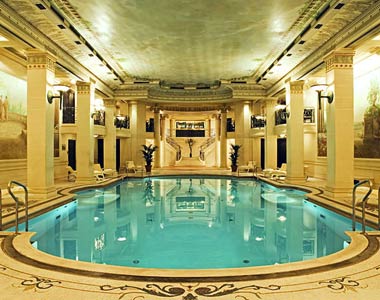
Bhava-4 provides the snake-hole aperture parents, police, and properties through which the ambitious Naga King slithers, slides, and springs upward.
Socially mobile via quickly ascending or ambitious parents.
Unusually adventurous, or unstable conditions in the early childhood home; parents unpredictable, exciting, cultural-mixers
disrupted or exotic qualities in the schoolings, such as foreign tutors
presence of persons from diverse and non-customary backgrounds in the childhood home
Passion for vehicles and properties
Rahu in bhava-4 may appear as a charlatan seeking personal advantage via folkways, local culture including
- folk religion
-
worth-ship
-
worship of ethnic deities,
-
roots in the land
-
the folkways
-
ancient customs
-
rhythmic seasonal habits
-
established cultural norms of a people
-
parenting
-
school teaching
-
family home life
-
the basis of all existence
-
grounding
-
foundations of human stability and security.
Rahu in classroom-4 motivates an urge to champion the defense [4] of foundational practices and customary [4] beliefs of the settled people. Most commonly, these are the mother's people.
Rahu in classroom-4 = a poseur seeking higher social privileges behind the guise of patriotism, defense of national boundaries, or defense of the habitual "way of life" of a settled people.
Ambition to achieve entitlements via
- owned-stewarded properties,
-
licenses,
-
vehicles,
-
marine and coastal lifestyles,
-
common folk,
-
Old Ways,
-
patriotism,
-
ethnic and ancient ritual continuity
Professor Rahu seeks obtainment of privileged importance via
- housing
-
shelter
-
real-estate
-
land ownership
-
environmentalism
-
vehicles
-
transportation
-
traffic commutes
-
owned properties
-
patriotism
-
parenting and one's own parents
-
policing
-
boundary-control
-
fencing
-
territory
-
places of settlement
-
ethnicity
-
roots
-
agriculture
-
aquaculture
-
belongingness
-
folkways
-
foundational schooling
-
protection of a way of life
-
habits and routines
-
rhythms and undulations
-
oceans and estuaries
craves privileged access to property-ownership opportunities
Rahu pursues social mobility via
- property-appropriation
-
boundary defense
-
sheltering
-
ethno-centricity
-
environmentalism
-
patriotism
-
nationalism
-
protectionism
PARENTS
Typically, parents crave and often achieve remarkable empowerment of their social mobility. They are important in their local environment, exceptional in education and housing, often key citizens in their village or town.
If Rahu-yuti with additional graha-in-4, ambitious parents provide more complication but also more empowerment. The biggest booster of the parents' desire for local importance is either Rahu-yuti-bandesha or Rahu-yuti-Chandra.
-
War and Peace 1828-1910 Leo Tolstoy [complaining-logical Chitra-2] LNT's parents were heritage aristocrats whose land-holdings were worked by multitudes of manorial serfs [4]. In the privilege hierarchy of the profoundly customary post-medieval Russian world, LT's parents were Very Important custodians of the local culture of servitude [Kanya].
However, Rahu-yuti with any graha invests bhava-4 with an exceptional climate of opportunism and hunger for parochial privilege.
often one hails from a land-owning ethnicity, who are in some sense outsiders in the place of settlement but who have cleverly staked land claims there
the parents are ambitious folk
house-proud
Rahu follows ambitious trajectories of important local boundaries
Rāhudrishti to 8, 10, 12 amplifies the discovery-secretive (8) institutional-governance (10) and sanctuary-isolation (12) attributes.
overleaps conventional boundaries in matters of parenting, patriotism, and property defense
seeks prestige via schooling-socializing, academic diploma, foundational examinations, professional-trade licensing
seeks extraordinary [Rahu] privilege within property-ownership, land-use, environmentalist, schooling, sheltering, parenting, protective, agricultural, pathways of transportation, customary, local-culture , roots settlement environments (4)
passion for prestige property, rhythms, routine, roots
special and important in domestic, environmentaland foundational-schooling roles
passion for schools, shelters, property, routine, roots
seeks a prestige diploma, license, educational credential
disguised as a protective, parental figure
passion for prestige property property property * lands homes schools farms ships carts
seeks privilege via providing nourishment, boundaries, continuity, rhythms, protection
urgently ambitious to gain prestige via housing, deeded properties, fencing, boundaries, cultivation of lands, transportation-shells (cars, ships, airplanes etc.)
fascinating breast, chest, stomach
seeks expedient utility of roots - routes - ruts - routines (4)
mesmerizing patriotism, ambitious defense of the land
craves prestige shelters, locations, and means of transpori
Professor Rahu-4 may crave watery resorts
-
ponds, lakes, coastal waterways, estuaries, beaches, bodies of water which may produce nourishment (fish, water-greens) and are bounded by lands
Patriotism * nationalism * defense of the Way of Life * Schooling * Local Transport
Rahu is Excited to gain Importance via the opportunities presented in acts of Boundary Defense such as local and regional policing, military defense of the nation-state and its interests, involvement in the folkways-boundaries discourse on what should-and-should-not (should = ethno-morality) be taught in the foundational schooling, all matters of vehicles and transportation such as management of local streets and traffic. Rahu seeks recognition in the Local sphere and all local activities offer Opportunity to Him.
Chalakaraka Rahu
Ris-rewarding Rahu's camouflage enables His ambitious desire to be recognized as an important patriot , parent, police, protector, custodian of the habitual practices, land-owner, school-teacher, and defender of the Folkways.
Intense desire to own houses and large tracts of land.
-
Ambitious, irregular, potentially fraudulent parent-figure. Professor Rahu teaching in classroom-4 appears in disguise as the parent, but the children may belong to another.
-
Real-estate and vehicle schemes.
-
"house-proud"
-
Hungry for privilege conferred by school diploma, deeds of title to lands and shelters. Relishes self-promoting opportunity afforded by defense of the land, policing, boundaries.
-
Insinuates association with the prestige of oceans, defense of the coastal boundaries, marine adventure.
-
Insinuates rootedness in the home-culture Yet, invites exotics into the home, may bring outsiders into the homeland. Each bhava-shift is self-elevating move up.
When He is teaching in classroom-4, professor Rahu impassions the mind with desire for
- owned-stewarded properties
-
dwellings
-
diploma, license
-
deeds of land-title
-
security, defense
-
boundary-patrol,
-
gardening, farming, fishing
-
oceans, coastlines, estuaries
-
land-and-water concern
-
environmental activism
Rahu provides an extreme desire to possess the power to secure ownership of lands, buildings, shelters, deeded properties, vehicles, along with the urge to satisfy that desire at nearly any cost.
Rahu will break taboos which normally would prevent:
extension of cultural legitimacy via schooling to underclass -- exempli gratia, impoverished, enslaved.
extension of cultural legitimacy to foreigners, outcast or taboo
-
abdicated King of England 1936 Edward-VIII, divorced American wife
A nationally important person in a conservative society obtaining foreign education
granting educational legitimacy to exotic types of schooling and licensing
challenges "roots " culture while retaining privileges
-
abdicated King of England 1936 Edward-VIII
Much volatility of matters regarding national affiliation and ethnic identity.
-
Accusations of illegitimacy in the folk roots which arise from Professor Rahu teaching in classroom-4 's association with foreigners [Rahu] upon the home turf (perhaps a steady stream of international guests in the home).
-
Professor Rahu in bhava-4 may be seen as a turncoat .
-
Or, professor Rahu teaching in classroom-4 has Professor Rahu in bhava-4 abroad fo fundamentals education-4 - which further implicates Professor Rahu teaching in classroom-4 as not fully invested in the folk ways of bhava-4.
The homeland is tumultuous and there are pretenders to the throne. Rahu in bhava-4 causes Professor Rahu in bhava-4 to leave one's homeland in search of excitement, but also to be involved intrigue and subversive activities which upset the established order in one's own homeland.
Rahu favors the use of deception and His style usually involves sneaking into forbidden places under culturally false pretenses.
-
Infrastructure of cities, towns, villages, settlements
roads, railroads, airports
utility lines, water pipes, energy provisioning for households
housing, warehousing, shelters, ports
Foundations - physical and cultural
Shelters and vehicles
-
property ownership-stewardship
-
Property in foreign lands
-
Leaving the homeland or consorting with foreigners in the home
-
Schooling, folkways education
-
Outsiders in the childhood home
-
erratic or exotic parenting
As the great taboo-breaker, Rahu destroys customary entitlement accountability and introduces unorthodox behaviors in the parents;
in the childhood home;
in property ownership-stewardship , and in folkways education.
-
Rāhu disrupts the customary methods of defining property and imposing cultural indoctrination.
Associated with Land Reform movements and with patriotic cultural revolutions,"the loyal opposition" . Professor Rahu teaching in classroom-4 uses one's education toward taboo-challenging purposes.
Outsiders who are present in the childhood home create a peculiar and unstable or highly diverse upbringing, in which the natural repetition o familiar habits and customs is disrupted (e.g., foreign education) and child is not entirely secure.
The parents might abandon their own cultural roots -- exempli gratia, parents might change their religious affiliation so that the childhood home has a different culture than other homes in the extended family network, or perhaps the parents adopt a new ethnicity, ethnoreligion, nationality, or set of folkways, ancient customs, and established cultural norms.
Professor Rahu in bhava-4 may be perceived by others as a foreigner or somehow not quite properly or regularly culturally aligned. There may be presence of foreign tradesmen, tutors, or dignitaries Or other exotic cultural influences in the childhood home.
Professor Rahu teaching in classroom-4 may receive indoctrination among the underclasses or in an exotic, ritually proscribed land.
-
In any case there is some Unusual element in one's basic socialization and folkways education.
-
Professor Rahu in bhava-4 may overtly or covertly reject the conventional educational process of one's people, preferring to carve a taboo-challenging path toward one's own cultural identity. (e.g., international boarding school or foreign tutors or learning with a shaman rather than a parent-replicator schoolteacher).
Excellent placement for a boundary-challenging multi-cultural educator .
Benefits owning property in foreign lands. Can accumulate a massive amount of property if Rahu's ruler is powerful
but Professor Rahu in bhava-4 does not directly own it.
Often drives a foreign car :)
May employ surreptitious or unconventional devices to obtain credibility in extremes in the world of real estate and education. Sudden changes of property ownership-stewardship ; damage to properties by natural catastrophe during Vimshottari periods of Rahu.
Family lineage is complex and perhaps exaggerated. Irregularities in the transmission of the mother's culture. May fabricate an exciting story of one's roots in a foreign land.
Restless Ambition to Amplify the empowerments and privileges of Home, Homeland, Parents, Root Culture, and Schooling
Rahu in 4 provides a source of fervent desire to break the boundaries of customary limitations of the root culture.
Professor Rahu teaching in classroom-4 is usually not an obedient student; may suffer lack of concentration, learning style conflict or disability from hyperactivity, aDD/ADHD or similar.
Professor Rahu teaching in classroom-4 moves from Professor Rahu in bhava-4 school to the next, from Professor Rahu in bhava-4 country to the next.
Supportive placement for an international schoolteachers.
At least Professor Rahu in bhava-4 of the parents is an unusual, risk-enjoying person.
Conditions in the family home are forever unsettled.
The Naga King's ambition may strike during a vehicular event:
-
chalakaraka Rahu = Ambition to obtain via whatever it takes
-
Rahu seeks the privileges accorded to important patriots , parents, protectors of the habitual practices, police, land-owner and vehicle operator, school-teacher, and defender of the Folkways
-
chidrakaraka Ketu = Ambivalence toward highest level of governing elite, executive duties, high-visibility social positions, public reputation, and the responsibilities of leadership.
Animosity and Conflict via Rahu-resides-4 = 6th-from = bhava-9 =
During Rahu bhukti if rogesha-6 from Rahu is fortified, entrancing Professor Rahu in bhava-4 may be forced into servitude, conflict, sickness, or crime by preachers, priests, professors, guru-figures, academic scholarship and religious convictions; by hostility of the father; also via sanctimonious or self-righteous 3rd marriage-partner
Academy + temple = 6/12 =
Rahu's shad-ashtakya awkward angle from father/guru-9 and from elder siblings/riends -11
bhava-9 = faith invested in doctrine (political, religious, scientific)+ university discorse upon matters of principle and theory. Rahu-9 = enters a shad-ashtakya 6/8 relative angle which can produce a feeling of entrapment within one's own paradigm of belief
-
the notoriously difficult 6th-from-Rahu = an attempt at quick self-elevation during which entrancing Professor Rahu in bhava-4 becomes the victim of fraud or tricky deceit by adversarial others in the academy or the temple
-
the notoriously difficult 12th-from-Ketu = an attempt to withdraw from involvements during which Professor Rahu in bhava-4 is prevented from clean cut separation because 12th-from-Ketu frustratingly 'dissolves the detachment' and re-invigorates the scholarship.
-
This sort of professorial or priestly role is adversarial and unsatisfying to the point of impoverishment or physical illness, yet psychically [Ketu] it is quite hard to get out of The intellectual commitment .
Smoky, oily qualities
in the childhood home and one's regular place, such as coal-burning stoves or living in a neighborhood which suffers heavy industrial pollution (, most large cities).
-
homeland may suffer from thick, oily air pollution
-
coastal waters, lakes, or rivers of the homeland may suffer oily pollution - Rahu causes water to catch on fire e.g. profoundly polluted burning rivers
Childhood home may be near natural or industrial sources of oil.
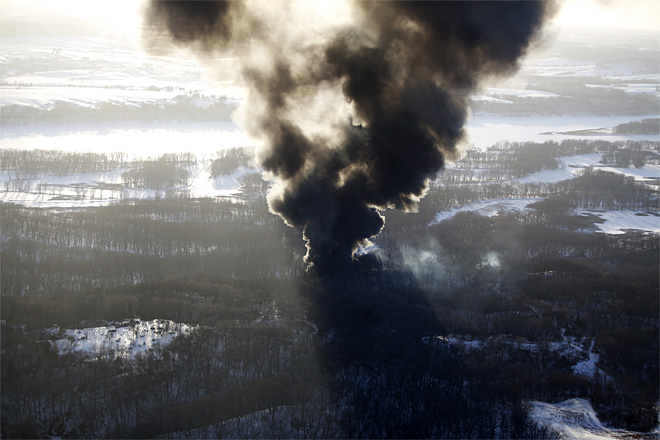
Oil tanker explosion USA trainwreck late winter 2015
Outcome depends on Rahu's ruler . In general, in general, rahu's transit via bhava-4 brings a disruptive but also fascinating influence into the childhood home and the schoolrooms, upon the parents and caretakers, and into the activities associated with land, shelters, and vehicles.
Frequently Professor Rahu teaching in classroom-4 = karaka for quick-social mobility, leap-to-privilege exotic or barrier-bending, taboo-twisting activities in the home-land or basis of life such as matters of farming, shipping, properties, or educational infrastructure.
Rahu in 4 is tempted into speculative real-estate markets. Professor Rahu teaching in classroom-4 may be mesmerized by the possibility to a quick leap to the top of the social hierarchy (or ability to obtain a level of privilege not yet earned) via real-estate "flip" techniques or other neighborhood-disrupting speculative buy-sell of family homes.
The early education is influenced by foreign cultural attributes, and this unconventional mix of traditional academic form (bhava-4) with the exotic international content [Rahu] is supported overtly or covertly by an adventurous-minded mother. Native typically enjoys a good quality education so long as Rahu's ruler is gracious.
The mother may have unsavory attributes if Rahu's ruler bring the unsavory, or the family home may be full of fascinating foreign dignitaries and exotic foods, if risk-rewarding Rahu's ruler brings refined foreign pleasures.
Professor Rahu is always promoting a distorted agenda, even when His contribution makes life more vigorous, interesting, and colorful than would conventionally be allowed. The home shelter (4) becomes a site for sudden changes, always fascinating and sometimes catastrophic. The nature of the disruption may be known via Rahu's ruler. When Rahu's ruler = highly impressionable graha like Chandra or Budha, character of the ruler will be causative alsor.
Hungry desire to be recognized as a property owner, parent or schoolteacher, although Professor Rahu in bhava-4 has not yet earned the entitlement to shelter others. Via Rahu's characteristic ambition for recognition, professor Rahu in bhava-4 may become involved in irregular property claims that may expose the fraudulence of unpreparedness when entrancing Professor Rahu in bhava-4 gets in over one's head.
The most salient effects of Rahu in bhava-4 - passion for prestige property, routine, roots occur during Rahu mahadasha. Maximum outcome during svabhukti of Rahu-Rahu and also during the bhukti of Rahu's rashi-pati.
Also strong results of Professor Rahu teaching in classroom-4 should be expected during each of the nine bhukti of Rahu which occur within the 120 year Vimshottari Dasha.
- During any Rahu bhukti, expectations must be adapted to the angle between the Mahadasha-pati and Rahu.
Professor Rahu teaching in classroom-4 generates urgent ambition to obtain greater social-material privileges via display of homes and landed properties; vehicles of land or sea; license examination or diploma; or caretaking, parenting policing entitlements.
The methods of expedient self-elevation for Professor Rahu teaching in classroom-4 include"appropriation" of the instruments of bhava-4 such as promotion to higher property-ownership rank, patriotic distinction, sheltering and custodial roles, transport vehicles of all kinds, parent-figure behavior, or involvement with maintenance of the Old Ways such as schoolteaching and parochial religious congregation.
Although Professor Rahu teaching in classroom-4 has not yet * earned* the higher entitlements which are normally accorded to property owners, parents, patriots, protectors, and parochial guardians of the local folkways, ancient customs, and established cultural norms, professor Rahu teaching in classroom-4 is motivated by a hungry desire to grasp these entitlements in a"fast-track" fashion. His obsession is boundless.
- Typically during the first portion of the Rahu period, Rahu will succeed in rising above the privilege accorded to His station of birth - sometimes dramatically so.
-
However, toward the end of the Rahu bhukti, just at the moment when He would appear to have achieved His goal, Rahu typically suffers a sudden fall from the improperly appropriated entitlements.
-
A more normal course of [akashic memory patterning] in the nativity is then recovered.
during Vimshottari periods of Rahu, professor Rahu teaching in classroom-4's upward trajectory may involve fraudulent or irregular parenting, schooling, caretaking, sheltering, or property-vehicle behaviors that are"over one's head" .
Final results depend on the disposition of the ruler of Rahu's rashi.


[How Readings Work] = [Sample Sacred Jewels Ratna Recommendationn] = [Seva]
f ile update =
07-Jun-2026
ile update =
07-Jun-2026
[Copyright © 1994-2034 by Barbara Pijan Lama] = [Contact] = [How to Request a Jyotishavidya Reading]
Barbara Pijan Lama Jyotishavidya Vedic Astrology Surya Sun Chandra Moon Mangala Mars Budha Mercury Guru Jupiter Shukra Venus Shani Saturn Rahu Ketu Graha Planets Dasha Timeline Calendar Nakshatra Navamsha Marriage Children Treasury Career Spiritual Wisdom Cycles of re-Death and re-Birth
The information on barbarapijan.com , including all readings and reports, is provided for educational purposes only. Wishing you every happiness and continuing success in studies!