

Rashi - Samchara - Bhava - Graha - Ratna - Nakshatra - Amsha - Varga
ruler of karma-sthāna located in the 12 bhava
dvadamsha = table of 12 sub-portions of bhava-10
- Surya in-bhava-10
- Chandra in-bhava-10
- Mangala in-bhava-10
- Budha in-bhava-10
- Guru in-bhava-10
- Shukra in-bhava-10
- Shani in-bhava-10
- Rahu in-bhava-10
- Ketu in-bhava-10
Vimshottari Periods of the Rulers of Bhava-1-to-12

OM sham shanaishcharaye namah
Learning Pathway 10
leadership & Reputation
Bhava-10
ख kha = space, sky, heaven
अम्बर ambara = sky, atmosphere
व्योमन् vyoman = space, sky, heaven
मेषूरण meṣūraṇa μεσουράνημα = [Greek] mid-heaven
मान māna = respect
कर्मन् karman = work, obligation, duty
व्यापार vyāpāra = occupation
natural ruler = Shani
public career
social dignity
reputation and regard
Leadership Portfolio
Responsibilities
recognition and respect
optimates [Latin]
lawful use of power over others
tribal chieftain
eminent status
Contribution to the Maintenance of the Social Order
executive decisions
iconic roles
hierarchical status
elite executive authority
social policymaker
burden of governance
matters of institutional rank and status
incumbent duties and rules
prominent positions
public recognition
l'haute monde
The Firmament
samsaric achievement
10th-amsha
the learning classroom of karma-sthāna-10
ruled by Professor Shani

Castle of Mt. Hohenzollern in Swabia / Suebia
built 1819-CE
QUOTATION Madhya Parashari, sarga-9, shloka-10
" Employment, occupation, honor, trade, and commerce (also of the father) etc. from the tenth house."
" The wise think of insult as nectar,
and fear honor as much as they would poison."
~~ Mahabharata Shanti Parva 229.21
" Power belongs to those who use it."
~~
" The greater the power, less the freedom.
The higher the rank, more a servant."
Slander cannot destroy an honest man - when the flood recedes the rock is there.
~~ Chinese proverb
Judge your success by what you had to give up in order to get it.
It includes integrity, caring, listening and respect for those you are working with.
Without those attributes, you are simply a tyrant who is successful.
Be more than good.
Be kind.
QUOTATION from Dee Wallace
Roman proverb
Melium est nomen bonum quam divitae multae.
A good name is better than great riches.
It seems to me that only love can surpass it, and love is a happy illness that can't be picked up as easily as a Ministry."
~~ de l'Amour 1822, Stendhal (Marie-Henri Beyle)
" An eagle was sitting on a tree resting, doing nothing.
A small rabbit saw the eagle and asked him, 'Can I also sit like you and do nothing?'
The eagle answered: 'Sure, why not..'
So, rabbit sat on the ground below the eagle and rested.
All of a sudden, a fox appeared, jumped on the rabbit and ate it.
Moral of the story:
- To be sitting and doing nothing, you must be sitting very, very high up."
-
[Shani] * Saturan - Sat-one * Kevan-Kaiwan
-
karma-bhava * Angles to the 12 sthāna
We must serve the law in order that we may become free.
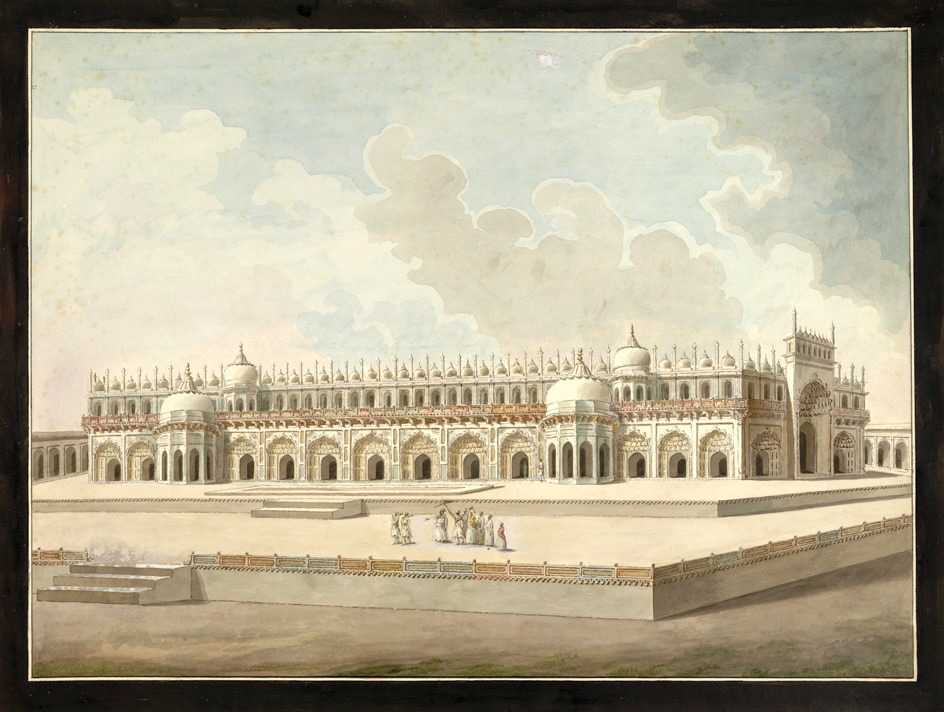
The Great Imambara of Asaf al-Daula, Lucknow [= laxshmanpur]
= 1795-CE
Watercolour of the Great Imambara of Asaf al-Daula, Lucknow,
part of the Hyde collection by an anonymous artist working in the Murshidabad style in c. 1790-1800.
Inscribed on the back in pencil and ink: 'Emaumbarree at Lucknow.'
Nawab Asaf ud-Daula of Awadh (r.1775-1797), requested architect Kifayat-ullah in 1784 to construct the Great Imambara, for the purpose of Muharram is the morning of the imams Ali, Hasan, and Hussein. Subsequently, imambara was used as a mausoleum for Asaf ud-Daula upon his death in 1797. Both the interior and exterior of the hall are highly decorated.
Image and text credit: Copyright © The British Library Board * provided by the Rare Book Society of India
Karma- sthāna = Mana-sthāna
- 10 social visibility, respect, reputation,
- elite positions, iconic stature,
- leadership, public-authority-roles
Meanings + implications
- Titles of Authority, seniority, respect
- Laws, lawmakers, lawgivers, regulators, judges
- Social dignity
Rank and Responsibilities
- Regulation, social ordering, hierarchical status
- Social Obligation, duty, Law and Order
- Top Positions, chieftaincy, tribal strongman
- Ability to Govern,
- ability to impose an Orderly Environment among humans
Reputation, vocation, profession
career, high social visibility, public approval, social reputation, hierarchical leadership positions; responsibilities, executive decisions; honor and rank
father's values and treasury
eldest grandchild's values and treasury
How the Learner Orders One's World = statutory law (not Divine Law) = Rules, regulations, methods, policies, principles
those who Impose the Law and its Consequences
Hierarchical Social Structures
" The Deeds which one is Required to Perform" requirements, obligations, rules
Executive Leadership, Vocation, institutional Governance, dignity, career, profession, civic duty, promotion
leadership roles, hierarchical status, position and attributes of distinction, rank and reputation, professional recognition, regulation of social environments, promotions, titles, government and bureaucratic details, policies and procedures, legislators and laws
career, public recognition, decision-making for organizations, social visibility, respect, reputation, elite positions, iconic stature, leadership, public-authority
10-public visibility, symbolic roles, leadership, enduring positions, reputation, command
QUOTATION
V. S. Apte, Practical Sanskrit-English Dictionary , p. 541
Karma
-
action - work - deed - effort - business - office - duty
QUOTATION Sanskrit Vocabulary for karma-bhava
-
Koeln Sanskrit Lexicon - www.sanskrit-lexicon.uni-koeln.de
व्यापार vyāpāra = occupation, profession, employment
- Occupation, employment, business, profession, civic duty, function
- The business of arrows " ' `" hitting the mark" '
-
Occupation of mind
- employment of speech, talk
- Occupation with domestic affairs
- doing, performance, action, operation, transaction, exertion, concern
- To perform any one's [gen.] business
- To render good offices in any affair
- To meddle in, to engage in, be effective
- To be concerned about, care for
- of the tenth astrological mansion
- engaging (in contest) with
- performing the function of, being occupied in, exercising or practising
- hindering the operation of. Opposed to the ways of
ख vacuity, empty space, air, ether, sky, heaven
व्योमन् vyoman = space, sky, heaven
= English cognate = heaven
- heaven, sky, atmosphere, air; through the air
- space; ether (as an element);
- wind or air (of the body)
- water
- talc, mica
- a temple sacred to the sun
- a very high number
- The 10th astrol. Mansion
- preservation, welfare
अम्बर ambara = sky, atmosphere
= English cognate ambient
- circumference, compass, neighborhood
- clothes, apparel, garment
- cotton
- sky, atmosphere, ether
- the tenth astrological mansion
- the lip; saffron
- a perfume (Ambra)
BPHS Sarga-7, shloka-39-43
" Whatever effects are to be known from the Karma and Labha Bhava
be also known from similar bhava counted from Surya ."
BPHS: Sarga-34, shloka-17
" The learned should deduce from Putra Bhava
amulets, sacred spells, learning, knowledge, sons,
royalty (or authority), fall from position, etc.." [8th from 10th]

Dignity,
rank
reputation
respect
success in public life,
father's wealth
Karma * Effort
obligatory governance roles
social regulations
-
10th bhava counted from kundali indriya-lagna
-
karmesha-10 * karma-pati
-
the emotionally dignified , social-ordering, leadership-seeking; 10th-from-Chandra + karmesha-10 -from-Chandra
-
10th-from-10th, or vīvāha-sthāna
-
graha in Makara * Capricornus within the Radix * D-1 varga
-
Radix karmesha-10 within navamsha * D-9 varga
-
Surya's condition in navamsha * D-9 varga
-
Radix karmesha-10 within dashamamsha -10 = D-10 varga
-
10th 'bhava' within D-10 varga
-
Sun and Moon within D-10 varga
-
Vimshottari Periods of the Rulers of Bhava-1-to-12
Various bhava-pati may alter one's style and ability in performance of active duty. Abenevolent bhava-pati in10th-amsha improves material outcomes for profession, authority.
A dusthamshapathi reduces social praise, but may be more productive spiritually.
-
For example + dhanapathi ruler-of-2 occupying karmabhava-10 puts the ruler-of-2 in occupation of the 9th-from-svakshetra, adecidedly auspicious angle connoting wise, broad perspective; inherent globalism; inclusive and generous attitudes.
-
Learners may exhibit broadly developed moral and aesthetic values (2 values). The angles of this particular view support financial well-being; often there is a profession handling some form of cultural or financial treasuries. The family heritage includes philosophical knowledge (9) in addition to material skill.
-
karmesha-10 rules 2nd-from-pitribhava = the marana-karaka who can cause decease of the father-figure. (However, in practice ruler of 7th-from-9th = vikrama-pati-3, = more commonly the pitri-maraka.)
Why does 10th-amsha almost never show personal finance, such as income, savings, or speculative wins?
in Jyotishavidya and in life, there is no necessary connection or correlation between career and finance.
Career, profession, public regulatory roles = 10th-amsha. Savings = 2. Earnings = 11. Game prizes = 5
Some careers are immensely authoritative but carry a relatively small paycheck [e.g., USA-POTUS]
Some careers are morally condemned but may supply huge revenue [e.g., drug-dealers].
Some famous celebrities may earn [11] grandly but fail to save [2, hoards] thus revenues of millions may leave them shortly broke .
Some humble service workers may save assiduously [2] from modest incomes [11] and live quietly comfortable lives .
Some people inherit all of their assets through hidden trusts [8] holding no publicly recognized jobs at all.
Others - whether high or low on the social register [10] -- may gain from brilliant gambles, or lose from dramatic mistakes [5].
Personal financial outcomes are not a function of career [10] but rather a function of amsha 2-5-11, and sometimes of 9 which is 5th-from-5 and 11th-from-11.
10th-amsha indicates respect and reputation, not money or assets, not profits or marketplace rewards.
legitimation of social authoruty via educational credentials, examinations, licensing, diploma
Professional diploma and certificates = yoga between bhava-4 and bhava-10.
When leadership roles are socially approved by formal education, examinations, certificates, diploma, license or other official credentialing, there is a positive relationship between bandhu-bhava, place where society guards and protects its people, and karma-bhava, place where social leaders issue lawful decisions and rules.
Graha drishti affecting karma-sthāna or karmesha -10
-
sukhagraha casting drishti upon karmesha-10 improve easy and skillful expression of vocation
-
sukhagraha on either side of the karmesha-10 also improve easy and skillful expression of vocation
-
papagraha casting drishti upon karmesha-10 create obstacles and impedance in expressing and developing the basis of moral leadership
-
papagraha on either side of the karmesha-10 slow down or thwart easy expression of career and vocation
The helpful news = periods of karmesha-10 evoke the spiritual path of karma yoga.
The effortful news = periods of karmesha-10 evoke the spiritual path of karma yoga.
Heavy public leadership and hierarchical management responsibilities might attend this period.
The up-side = dignity and respect attend these responsibilities.
The downside = getting stuck in work duties.
Can drain the joy out of life. Getting overburdened while pursuing the Path of Action (karma) can result in feeling trapped in a perpetual cycle of thoughts about time (never enough Shani) and resources (never enough Shani ) needed to properly execute one's public duties.
Learners may find little opportunity to pursue non-work activities
One's family may bear the weight to have the Learner so bound to duty; not relaxed;
and Yet, after the period is completed looking back Learners may approve of the work accomplished (presuming the lord is strong) not for one's egoic-mind membrane embellishment (that is Surya not Shani!) but rather as a service toward improving and sustaining an orderly society.
It is critically important to take out small amounts of time for rest and reflection despite the pressures of these karmesha-10 periods.
Leadership, prestige, position, status, social Dignity, rank
-
The first and most predominant signification of karma-bhava is social dignity . Astrong, positive karma-bhava virtually guarantees the individual a large measure of high status in their social group.
-
Along with status comes leadership. Auspicious Simha - Leya planets in karma-bhava give moral leadership. Beneficial Makara planets make a conservative leader, perhaps a captain of industry. Mithuna - Dvamdva will rise high in media communications industry.
-
Budha -10 suggests an administrative career. Shani in bhava-10 (with strength) shows a rise through toughness. Etc.
-
Promotions; increases in rank, title, and status; rises in popularity; and overall glory in social validation, are marked by karma-bhava, its occupying planets, and drishti to karma-sthāna.
Mahadasha of Empowered karmesha-10 (free of negative drishti) will give very high levels of professional respect and recognition.
Vimshottari Dasha periods of Karmesha
Puses the Leadership portfolio onto the Front Burner
Learners may also acquire executive duties that require making top-down decisions and imposing rule-based order. Even if the person does not conceive of oneself as a leader, some expression of social authority must arise.Education (4) of the spouse-partner (7)
As 4th-from-7th, karma-bhava indicates the level of educational achievement of the mate.
Bhava Lords and Karaka in the Career House
Leadership capability whether compassionate or authoritarian, whether popular or hated, whether in education, politics, commerce, law, finance, medicine, or a host of other marketplace specialties, will manifest through the 10th house and its lord.
-
Karaka in bhava-10 are also highly significant. As always with karaka in their own bhava, it is possible to find the dysfunctional effect of karako bhavo nashto- where too much of a good thing tends to overwhelm the balance of the bhava, and creates problematic situation in executive decision-making for even the most intelligent and well-meaning native.

Brugge
QUOTATION from Das, WRt
"A benefic is in 10 from Moon or a benefic is in 10."
" This combination is of some advantage to your career and rise in life and your reputation."
Government , social Institutions, and Large Corporations
karma-bhava = svabhava of Shani.
Makara represents skeleton-bones, pyramids, hierarchies. Strong 10th-bhava gives a proclivity to hold highly responsible executive level positions in government service or large corporate hierarchies.
Very little entrepreneurism (6th-from-10th) or creativity (8th-from-10th) is permitted in iconic bhava-10, which emphasizes strictly class-based social role modeling, status positions, and public accountability. Being 12th-from-11th karma-sthāna-10 gives (the appearance of) loss or dissolution of income through a loss of earnings mobility or flexibility in the marketplace, due to being committed to the governance duties and unable to seek other opportunities.
-
Strength in either dhanasthāna-9 or labhasthāna-11 can compensate the Learner for the losses inherent in karma-sthāna's public accountability.
-
High-level public leadership responsibilities largely preclude much dallying in the marketplace. Success in entrepreneurial business, even when it brings the Learner high levels of public recognition, is a function of the gainful 11th house. The essence of karmsthāna-10 is public service, through government.
A competent and committed public servant may become materially wealthy before entering the ranks of government regulatory duties, or afterward . Yet unless one is a criminal (e.g. empowered bhava-6-or-12 effects) Learners may likely not gain significant financial well-being via the status and respect accorded to leaders.
(As most Americans know, President of the United States earns a much smaller salary than most middle-ranking corporate executives!)
The Learner's overall relationship to one's government (in the Sanskrit texts, one's " favor with the king" ) is displayed in
- karma-bhava-10,
- karma-pati ruler of radicalagnesha-1 0,
- ruler of 10th-from-10th yuvatibhava indicating essential counsel and advice,
- graha ruler of the emotionally dignified , social-ordering, leadership-seeking; 10th-from-Chandra,
- ruler of 10th navamsha.
Large corporations function as extensions of government (or vice versa) as they are governed by elaborate hierarchies and the rule of law. High-level administrative work in a large corporation is also a function of a strong karma-bhava.
It may be beneficial in making a career assessment to also consider 10th-from-Sun and 10th dashamamsha (D-10)
Social Respect, dignity, Prestige
Achievement in the sense of accomplishing important goals, is found in Labha bhava-11. Social recognition and honor granted for having accomplished those goals is found in bhava-10.
-
Material-world status markers - position, title, social dignity, father's wealth - are seen through the 10th house and also the 10th-from-10th, yuvati bhava.
-
Even when the 10th house is not itself distinguished, mahadasha of ruler of-10 or auspicious transits through karma-bhava can bring social recognition for achievements.
-
A strong 10th at birth shows natural ambition to achieve leadership status, but ambition can also temporarily increase with positive dasha or transits as above. Note that auspicious transits to any house only have effect if the transiting planets is ALSO simultaneously mahadasha pati or bhukti pat!
-
As 2nd-from-pitribhava , karma-bhava shows The father's wealth and values.
-
Generally, leaders are born into leadership families. The child with a robust karma-bhava has a financially privileged father and who himself received a good education and has strong values.
-
To have full strength, karma-bhava must be free of malefic influences, and ruler of-10 must be in a good angle to the Moon.
-
4th-from any house is the vehicle of that house.
-
For example, your mother's car is your 7th house (7th is 4th-from-4th). When bhava-7 generates opportunities for polarizing catalysis , Learner may experience a crafted difficulty in the first marriage and your mom will have unreliable cars, be scared of driving, or vehicular karma of some variety!
-
As the 4th-from-7th , karma-bhava indicates the vehicle(s) of the first spouse. A distinguished karma-bhava = first spouse has nice cars. If 10th house = really glamorous but your own 4th house is so-so, your first spouse may have much nicer cars than you!
Twelfth-from = losses to that bhava. Labhastana = friends and community.
karma-bhava = 12th-from-11th = loss of connection to the marketplace and losses to your community,
-
especially losses to your closest friends who care for you like older siblings would.
If karma-bhava hosts empowered negative graha, one's close friends may experience financial, emotional, spiritual, or emotional dissolution. If your friends are unable to support oneself due to their own losses, then one's own social rank may decline.
-
Usually if karma-sthāna is comfortably situated, losses to friends will occasionally occur, but only during bhukti of karma-pati, or uncomfortable transits to karma-bhava .
-
From a business point of view, executive who leaves the company and takes a prestige public leadership position - perhaps temporarily entering government service for a defined period of time - is demonstrating the" loss " effects of bhava-10. Government leadership positions typically pay much less than equivalent roles in private business, which are more associated with gains.
-
In addition, character of a true leader is usually somewhat sacrificial financially: they are less concerned with their own gains and more concerned with the welfare of the people. bhava-10 does generally create a loss of" potential" wealth to those whose virtues include authentic leadership, and sincere concern for public welfare.
Children's Enemies, debt, or Illness
-
6th-from-5th indicates the debt (6th) of one's children (5th). Since karma-bhava is an auspicious house, parent who accepts responsibility for his child's debts usually receives public respect.
-
Ari bhava (6th house) contains major imbalances, such as medical problematics and consumer debt. Children's financial problem-set, medical problem-set, and other forms of animosity both internal and external, will affect the parent during the parent's mahadasha of karmesha-10 .
-
6th-from Any house tells about enemies, debt, and disease originating in that house. karma-bhava bespeaks the illness, if any, of the first child. Second child's illness 6th-from-7th would be Vyaya bhava, third child's illness 6th-from-9th = dhana bhava. Etc.
8th-from-3rd = difficult conditions in karma-bhava can signify catastrophic changes affecting the Learner 's younger siblings.
-
Also, if 10th-house planets are auspicious, subsequent healing of trauma, within the period of karmesha-10 .
-
Hidden matters erupting into the lives of teammates, exposure of secrets during small-group meetings, sudden changes in self-made financial well-being and configuration of neighbors, are all encompassed in the period of karmesha-10 .
QUOTATION from
Tenzing Gyatso The Path to Enlightenment.
Glenn H. Mullin (Trans. and Ed.)
" Karma has four main characteristics:
-
The first is its increasing effect : goodness heralds further goodness and evil heralds further evil.
-
Secondly, karma is definite : in the long run, goodness always produces joy and negativity always produces suffering.
-
Thirdly, one never experiences a joy or sorrow that does not have an according karmic cause .
-
And lastly, karmic seeds that are placed on the mind at the time of an action will never lose their potency even in a hundred million lifetimes, but will lie dormant within the mind until one day the conditions that activate them appear."
QUOTATION from
Tenzing Gyatso and d. Howard C. Cutler, m.D. The Art of Happiness at Work (1998, 2004).
" Question: ...
-
Let's say an individual starts analyzing, but then they discover that the type of work they are doing is ultimately harmful for the environment.
-
Or let's say they make a part that is used for weapons.
-
Once they think about it, they realize that it is not productive -- in fact, it's destructive in some way.
-
And Yet, at the same time, maybe they don't have a lot of resources -- they can't just quit their job and look for a better job because they have a family to support and there aren't many other industries in their area.
I'm wondering if you could address that issue in view of your definition of 'right livelihood.'
Dalai Lama:
This is a very complicated question.
-
There are so many factors at play here, it is very difficult to come up with a definitive approach to this question.
-
On the one hand, if your work turns out to be part of weapons production, if you look at the immediate purpose of a weapon, then you will come to realize that this is for destruction, this is for killing.
-
But at the same time if you look at the picture from the vantage point of overall society, unless there is a fundamental change in the society as a whole, for defense purposes for the society, or even on the global level, nations do need weapons for security purposes.
-
Especially in the American case, you look at the fact that in the world there are totalitarian regimes who are against democracy. Ithink so long as those nations are there, American military power must remain.
-
But then again if the President used American military power for destruction or elimination of a single individual, leader of a dangerous totalitarian regime for instance, idon't know if this is really appropriate or not, idon't know.
It's a very complex problem.
-
...And for example, there are Western European nations who produce weapons, but use them mainly for defensive purposes and do not abuse them.
-
And similarly, example of the United States, although the Russian threat is no longer there, so long as a totalitarian regime like China exists with a huge military power, some kind of deterrent power is necessary.
-
Then again there is a question whether the leaders of these countries will act responsibly in the use of the military power they have at their disposal.
-
All of these are very complex issues.
-
For an individual who comes up with moral qualms about being part of this company or this factory, and to what extent it is wise for him to give that job up, and how effective that is, is open to question.
Whether that individual decides to quit or not to quit may not make a difference.
-
It's a bit like the story of this old Tibetan woman who was so cross with the Tibetan government, it is said she turned her back to the government for a couple of years in protest -- which didn't really have any practical power or effect."
[end quote]


[How Readings Work] = [Sample Sacred Jewels Ratna Recommendation] = [Seva]
 file update =
05-Jun-2026
file update =
05-Jun-2026
[Copyright © 1994-2034 by Barbara Pijan Lama] = [Contact] = [How to Request a Jyotishavidya Reading]
Barbara Pijan Lama Jyotishavidya Vedic Astrology Surya Sun Chandra Moon Mangala Mars Budha Mercury Guru Jupiter Shukra Venus Shani Saturn Rahu Ketu Graha Planets Dasha Timeline Calendar Nakshatra Navamsha Marriage Children Treasury Career Spiritual Wisdom Cycles of re-Death and re-Birth
The information on barbarapijan.com , including all readings and reports, is provided for educational purposes only. Wishing you every happiness and continuing success in studies!