paalaasha pushpa sankaasham * taarakaa graha mastakam * Raudram raudra atmakam * ghoram tam ketu pranamaamyaham

Vimshottari Dasha - Rashi - Gochara - Bhava - Graha - Ratna - Nakshatra - Amsha - Karaka - Varga - Bala
- Surrendering Ketu reaches maturity = age 48
- Traditional Jyotishavidya Sacred Jewels Ratna for Ketu
- BPHS Ketu Mahadasha
- BPL modern commentary Ketu Mahadasha
Ketu in 12th-from-Chandra
- [Ketu in classroom-1]
- [Ketu in classroom-2]
- [Ketu in classroom-3]
- [Ketu in classroom-4]
- [Ketu in classroom-5]
- [Ketu in classroom-6]
- [Ketu in classroom-7]
- [Ketu in classroom-8]
- [Ketu in classroom-9]
- [Ketu in classroom-10]
- [Ketu in classroom-11]
- [Ketu in classroom-12]
- [Ketu-Mesha]
- [Ketu-Urisha]
- [Ketu-Mithuna]
- [Ketu-Karkata]
- [Ketu-Singha]
- [Ketu-Kanya]
- [Ketu-Tula]
- [Ketu-Vṛścika] = [svakshetra]
- [Ketu-Dhanus]
- [Ketu-Makara-Draco]
- [Ketu-Kumbha]
- [Ketu-Meena]
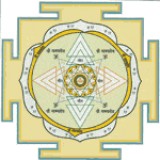
AUM kem ketave namah
OM shram shreem shroum sah ketave namah
केतु ketu
Professor Ketu
शिखिन् śikhin = comet, reaching peak knowledge
आकाश ākāśa = ether, space, vacuity
कावन्ध kāvandha = appearing as a headless trunk
रुण्डक ruṇḍaka = headless body
विशिरस्क viśiraska = headless
छिद्रकारक chidra-karaka = agent of cutting-off
resides in
व्यय vyaya
= passing away, mutable, decaying; disappearance, ruin, loss
शाला shālā = enclosure, court, hall
सत्त्र sattra = asylum, hospital, place of refuge
मन्त्रिन् mantrin
= wise, conjurer, enchanter, knowing sacred texts or spells
South Lunar Node
cauda draconis = tail of the dragon
caesura = cut
यति yati = pause, stop, break in recitation
-----
καταβιβαζόν kata-bibazon = catabibazon
= κᾰτᾰ = down + βαίνω = go
= go down, descend = descending-node
occupies
the twelfth house
carcer
see also: Caput Draconis in Piscium
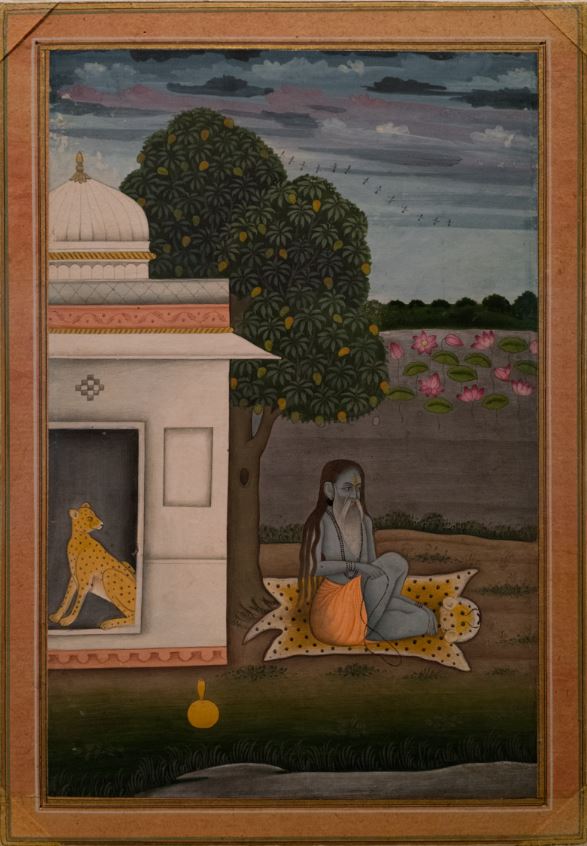
Ascetic Seated on Leopard's Skin, provincial Mughal school, India
en.wikipedia.org/wiki/Mughal_painting
Opaque watercolor on paper, Late 18th cen., Tokyo National Museum

crumbling sanctuary near to Grewelthorpe
in North Yorkshire, Place of the Yew-Trees
EXAMPLES
[Ketu-Mesha] = [liberating location for Ketu = papa-upa-graha in dusthamsha-12]
[for Urisha-born Learners]
-
check Kuja + Kuja-drishti to source Ketu's ambivalently forward-pushing, apatheticly pioneering, disintegrating inventiveness
[dispersed engagement with innovative conceptual thought] [dissolution of wartime back-channels] [restless apathy toward research competitors]
[surrenders pioneering visions] [forgives broken fresh-start private guidance] [abandons unsustainable vitality fantasies] [absent from empty dreams of championship]
- [may be passively fixated upon ambitiously diplomatic, instrumentally partnering , apparently fair-dealing Rahu-Tula -6 gracious enemies, pleasant animals, agreeable assistants, bargaining servants]
[disregards obsolete invasive clandestine conventions] [eccentric warrior of the dissolving interior spaces]
-
General Electric 1847-1931 Thomas Edison [dominating-arriviste Aśvini-1] = [vargottamsha]
-
[liberating location for Ketu = papa-upa-graha in dusthamsha-12]
[beneficial placement for
Mithuna indriya-lagna]
check Shukra + Shukra-drishti to source Ketu's vacuously sweet, ambivalently
evaluating, arbitrarily enriching sensuality
[dissociated from invisible historical roles] [few/no boundaries within sensual private spaces] [no barriers to asset movement between foreign lands]
[potentially unfettered awareness in cloistered earthy settings] [release from treasury-caused imprisonment] [unencumbered meditation upon dematerialized essence of inner values]
- [may be passively fixated upon ambitiously transformative , expediently shape-shifting, thrillingly dangerous Rahu-Vṛścika-6 hidden enemies, mysterious animals, camouflaged assistants, suddenly-changing servants]
[compensating financial agreements despite private disengagement]
[unlimited sound-color fantasy worlds] [unafraid of imagined annihilation of affluence] [may perceive non-verbal intuitive preservative guidance]
-
Microsoft global philanthropist Bill Gates [political-theatrical Mriga-1]
[Ketu-Mithuna] = [liberating location for Ketu = papa-upa-graha in dusthamsha-12]
[for Karkata-born Learners]
-
check Budha + Budha-drishti to source Ketu's spacey sentences, vague instructions, disinterested discourse
[disengaged from invisible management roles] [few/no boundaries within communicative private spaces] [no barriers to commercial movement between foreign lands]
- [may be passively fixated upon ambitiously inspirational, fabulously dogmatic, apparently righteous Rahu-Dhanus -6 believing enemies, uplifting animals, philosophical assistants, wise servants]
[potentially unfettered awareness in cloistered explanatory settings] [release from conversational imprisonment] [unencumbered meditation upon dematerialized essence of inner gestures]
[unlimited talkative fantasy worlds] [unafraid of imagined information annihilation] [may perceive non-verbal intuitive instructional guidance]
-
POTUS-pair-05 La belle Americaine 1768-1830 Elizabeth Kortright Monroe [innovative-heroic Punarvasu-1] + [Punarvasu-Ketu-yuti-Surya-Arudra] + [Punarvasu-Ketu-yuti-Shukra-Mriga] + [Punarvasu-Ketu-yuti-Shani-Arudra]
-
India-PM 1917-1984 Martial Law Indira Gandhi [governing-regulatory Arudra-2]
-
POTUS-pair-38 Addiction Recovery 1918-2011 Betty Bloomer Ford [diplomatic-adjusting Mriga-3]
[Ketu-Karkata] = [liberating location for Ketu = papa-upa-graha in dusthamsha-12]
[for Simha-born Learners]
-
check Chandra + Chandra-drishti to source Ketu's ephemerally calming, vaguely ancestral rhythms
[disengaged from invisible parenting roles] [few/no boundaries within sheltered private spaces] [no barriers to customary movement between foreign lands]
[potentially unfettered awareness in cloistered marine settings] [release from ritualized imprisonment] [unencumbered meditation upon dematerialized essence of inner security]
- [may be passively fixated upon ambitiously social-climbing, apparently regulatory, expediently normalizing Rahu-Makara-Draco -6 enemies, animals, assistants, servants
[unlimited defence of fantasy worlds] [unafraid of imagined land-ownership annihilation] [may perceive non-verbal intuitive protective guidance]
-
POTUS-pair-30 Deaf Schools 1878-1957 Grace G. Coolidge [bargaining-arranging Pushya-3]
-
POTUS-pair-34 Military Families 1896-1979 Mamie Doud Eisenhower [visionary-guided Aśleṣā-4]
-
Out on a Limb 1934- drama-esoterica Shirley MacLaine [hierarchical-regulatory Aśleṣā-2]
-
Hugging Saint 1953- Ammachi of Kerala [dramatizing-demonstrating Pushya-1]
[Ketu-Singha] = [liberating location for Ketu = papa-upa-graha in dusthamsha-12]
[for Kanya-born Learners]
-
check Surya + Surya-drishti to source Ketu's charmingly ambivalent, passively entitled, ceremonial detachment
[disengaged from invisible dramatic roles] [few/no boundaries within romantic private spaces] [no barriers to speculative movement between foreign lands]
- [may be passively fixated upon ambitiously associative, expediently interlinked, apparently goal-achieving Rahu-Kumbha -6 enemies, animals, assistants, servants]
[potentially unfettered awareness in cloistered mountaintop sunrise settings] [release from political imprisonment] [unencumbered meditation upon dematerialized essence of inner intelligence]
[unlimited demonstrative fantasy worlds] [unafraid of imagined gambling annihilation] [may perceive non-verbal intuitive idealistic guidance]
-
Iran-Shahani 1932-2001 Soraya Esfandiari Bakhtiari [optimistic-dogmatic Aryaman-1]
-
Jane Wyman first life-partner of Ronald Reagan = A-List actress of her day
[Ketu-Kanya] = [liberating location for Ketu = papa-upa-graha in dusthamsha-12]
[for Tulā-born Learners]
-
check Budha + Budha-drishti to source Ketu's dispassionate analysis, witnessing logic, distanced criticism
[disengaged from invisible service roles] [few/no boundaries within assistive private spaces] [no barriers to ministry in foreign lands]
- [may be passively fixated upon ambitiously imaginative expediently symbolic , astonishingly inner-wise Rahu-Meena -6 enemies, animals, assistants, servants, needy disadvantaged, victims]
[potentially unfettered awareness in cloistered agricultural settings] [release from unfair imprisonment] [unencumbered meditation upon dematerialized essence of inner humility]
[unlimited exploitive fantasy worlds] [unafraid of imagined medical annihilation] [may perceive non-verbal intuitive helping guidance]
-
UK-Princess Royal 1950- equestrienne Anne Windsor Laurence [visionary-charitable Uttaraphalgunī-4]
-
Archbishop of Canterbury 1950- mystical poet Rowan Williams [champion-pioneer Hasta-1] + [Aryaman-Mangala-yuti-Ketu-Hasta] = 5th-from-Chandra
[Ketu-Tula] = [liberating location for Ketu = papa-upa-graha in dusthamsha-12]
[energizing-identifying co-lagnesha co-ruler with Kuja]
[for Vṛścika-born Learners]
-
check Shukra + Shukra-drishti to source Ketu's pleasantly apathetic, ambivalently agreeable, unsustainable promises
[disengaged from isolated contractual roles] [few/no boundaries within arranged private spaces] [no barriers to diplomatic movement between foreign lands]
- [may be passively fixated upon ambitiously challenging, amazingly competitive, apparently triumphant Rahu-Mesha -6 enemies, animals, assistants, servants]
[release from just imprisonment] [unencumbered meditation upon dematerialized essence of inner balance] [unlimited mutual fantasy worlds]
[unafraid of imagined agreed-upon annihilation] [may perceive non-verbal intuitive negotiating guidance]
-
POTUS-pair-16 Illinois 1818-1882 Mary Todd Lincoln [secretive-eruptive Chitra-4] = [vargottamsha] Super-Ketu [navamsha Ketu-Vṛścika-uchcha]
-
POTUS-pair-37 Watergate 1912-1993 Pat Ryan Nixon [bargaining-arranging Chitra-3] = [vargottamsha]
***
-
Protestant Reformation 1483-1549 hymns Martin Luther [institutional-structuring Arcturus-2] + [Svati-Ketu-yuti-Kuja-Svati] + [Svati-Ketu-yuti-Guru-Svati] + [Svati-Ketu-yuti-Shukra-Viśākha] + [Svati-Ketu-yuti-Shani-Viśākha]
-
POTUS-22-24 Interstate Commerce 1837-1908 Grover Cleveland [governing-regulatory Arcturus-2] + [Viśākha-uchcha-Shani-yuti-Ketu-Arcturus]
-
USA-Sen-Tenn VPOTUS Climate Change 1948- Al Gore [champion-innovator Viśākha-1]
= [uchcha] = [liberating location for Ketu = papa-upa-graha in dusthamsha-12]
[for Dhanus - Haya-born Learners]
[super-Ketu, master of annihilation and rebirth]
-
check Kuja + Kuja-drishti to source Ketu's disinterestedly eruptive, fragmenting sudden discovery, disintegrating evolutionary force
[disengaged from invisible trauma-healing roles] [few/no boundaries within eruptively energized private spaces] [no barriers to undisclosed movement between foreign lands]
- [may be passively fixated upon ambitiously sensual, collecting, entreasuring Rahu-Urisha -6 enemies, animals, assistants, servants]
[release from secret imprisonment] [unencumbered meditation upon dematerialized essence of inner evolution] [unlimited frightening fantasy worlds]
[unafraid of imagined catastrophic annihilation] [may perceive non-verbal intuitive transformational guidance]
-
Total Surrender 1910-1997 Mother Teresa of Kolkata [sheltering-defensive Viśākha-4]
***
-
Principia Mathematica 1872-1970 philosopher Bertrand Russell [hierarchical-ranking Jyeṣṭha-2]
-
POTUS-34 Interstate Highways 1890-1969 Dwight D. Eisenhower [systematic-gridworked Jyeṣṭha-3] + [uchcha-Jyeṣṭha-Ketu-yuti-Shukra-Maitra]
-
UK-Prince 1984- Harry Sussex [ministering-logistical Anuradha-2] + [uchcha-Maitra-Ketu-yuti-Kuja-Jyeṣṭha]
= [liberating location for Ketu = papa-upa-graha in dusthamsha-12]
[for Makara - Draco-born Learners]
-
check Guru + Guru-drishti to source Ketu's ungrounded convictions, nebulous worldview, disengaged belief
[disengaged from isolated theological roles] [few/no boundaries within doctrinal private spaces] [no barriers to inspirational movement between foreign lands]
- [may be passively fixated upon ambitiously messaging, managing, instructional, commercial Rahu-Mithuna -6 enemies, animals, assistants, servants]
[release from ideolologically-caused imprisonment] [unencumbered meditation upon dematerialized essence of principled inner faith] [unlimited theoretical fantasy worlds]
[may perceive non-verbal intuitive philosophical guidance]
-
UK-Queen 1926-2022 Elizabeth-2 [optimistic-believing Aryaman-1] = [vargottamsha]
[Ketu-Makara-Draco] = [liberating location for Ketu = papa-upa-graha in dusthamsha-12]
[beneficial placement for Kumbha indriya-lagna]
-
check Shani + Shani-drishti to source Ketu's orderly wandering, socially approved emptiness, legitimate surrender
[disengaged from invisible hierarchical roles] [few/no boundaries withiin conventional private spaces] [no barriers to orderly movement between foreign lands]
- [may be passively fixated upon ambitiously protective, instrumentally defensive, amazingly domestic Rahu-Karkata -6 enemies, animals, assistants, servants]
[release from legalized imprisonment] [unencumbered meditation upon dematerialized essence of inner architecture] [unlimited elite fantasy worlds]
[may perceive non-verbal intuitive structured guidance]
-
Fashion economics 1981- real-estate Ivanka Trump Kushner [governing-commanding Uttarāṣāḍha-2] = [vargottamsha]
[Ketu-Kumbha] = [liberating location for Ketu = papa-upa-graha in dusthamsha-12]
[beneficial placement for Meena - Antya-born Learners]
-
check Shani + Shani-drishti to source Ketu's marketplace-regulated evacuations, formally friendly vagueness, profitable abandonments
[disengaged from invisible marketplace roles] [few/no boundaries withiin communal private spaces] [no barriers to profitable movement between foreign lands]
- may be passively fixated upon ambitiously speculative, instrumentally gaming, expediently showy Rahu in Singha -6 enemies, animals, assistants, servants]
[release from economically-caused imprisonment] [unencumbered meditation upon dematerialized essence of inner gridworks] [unlimited interlinked fantasy worlds]
[may perceive non-verbal intuitive friendly guidance]
-
Photographer 1941-1998 vegetarian activist Linda Eastman McCartney [commercial-managing Pūrvābhādra-3]
[Ketu-Meena] = [liberating location for Ketu = papa-upa-graha in dusthamsha-12]
[for Mesha-born Learners]
-
check Guru + Guru-drishti to source Ketu's broadly dispersive, cheerfully ghostlike, expansively dreamy beliefs
[disengaged from invisible visionary roles] [few/no boundaries withiin imaginative private spaces] [no barriers to movement between dreamlike foreign lands]
- [may be passively fixated upon ambitiously ministering, fabulously helpful, apparently assisting Rahu in Partha -6 physicians, medication, ailment, military, accusations, criminals, unfair conditions, broken promises, service providers, servants, domestic animals, helpers]
[release from slumbering imprisonmen t] [unencumbered meditation upon dematerialized essence of inner wisdom] [unlimited clairsentient fantasy worlds]
[may perceive non-verbal intuitive symbolic guidance]
-
Human Rights 1978- attorney Amal Alamuddin Clooney [discovering-concealing Andromeda-4]
***
-
Homeopathy 1755-1843 Dr. Samuel Hahnemann [transformative- regenerating Andromeda-4] = [navamsha Ketu-Vṛścika-uchcha] + [Andromeda-Ketu-yuti-Surya-Revatī] + [Andromeda-Ketu-yuti-Chandra-Andromeda] + [Andromeda-Ketu-yuti-Budha-Andromeda]
-
POTUS-21 Civil Service 1829-1886 Chester A. Arthur [political-demonstrating Andromeda-1]
-
Banker to the Poor 1940- microcredit Muhammad Yunus [governance-regulatory Revatī-2] + [Revatī-Ketu-yuti-Chandra-Andromeda]
-
VPOTUS Military Weapons Contracts 1941-2025 Dick Cheney [bargaining-diplomatic Andromeda-3]
-
Franc-Pres 1977- financier Emmanuel Macron [inspirational-preaching Revatī-1]
surrendering
KETU
occupies enclosed
VYAYA-STHANA
intermittent ambivalence toward matters of 11, such as quietude, sleep, private spiritual guidance, or research
- May have pronounced eccentric characteristics, signalling an underlying apathy under the foggy guise of contemplation, social invisibility, private environments
- May seem haughty if Surya or Guru = empowered.
- much of the outcome depends upon graha-yuti-Ketu ++ Ketu's ruler
Similar effects = Ketu in 12th-from-Chandra
Ketu diffuses, scatters, nebulizes matters of His residential bhava.
[Ketu in classroom-12] benefits from a lack of restrictions on matters of the Other World,
- including imagination, subconscious, prisons voluntary-and-involuntary, bedroom, meditation, privacy, distant lands, father's mother, mother's father, isolation, sanctuary, clairsentience and claircognizance
Professor Ketu teaches on the topics of liberation from fixed form, freedom from conventional limitations, dispersal of burdens, and spiritual wandering.
Effects of Ketu include wandering in cloud-form (nebula) and unsettled, liberated behavior in the bhava.
Ketu grants the passive benefits of freedom-from , not the active benefits of freedom-to
[Ketu in Bhava-12] [beneficial] analgesia (incomplete pain)
- Unsettled, disoriented, free-wandering, scattered imagination.
- Often dissociated from private spiritual guidance.
- Tends to walk away from fixed isolation.
- Abandons conventional sanctuaries.
- Disregard for the authority structures that maintain invisible institutions, such as hospitals, prisons, monasteries
- Liberation via understanding that private environments are impermanent by design, including one's own bedroom,walled enclosures, or bridges to Other Worlds .
Ketu/12
-
disregard for folkways, ancient customs, and established cultural norms of who belongs in the bedroom
-
perpetual underlying psychic grief for some ineffable lost connection to sanctuary
-
Often an apparently successful person due to the materially favorable exploitations of Rahu-6
No-contact Ketu does not interfere with clairsentient spiritual communications. Ketu-12 is an asset to the practicing visionary. Ketu-12 does often shatter (Ketu shatter, split) the institutionalized prayer structures of conventional religion. Suddenly cut off from the source of reliable sanctuary.
Often Ketu-12 must wander the invisible worlds of bedroom, monastery, sanctuary, imagination. May expose the private life to unwanted public scrutiny. Dusthamsha-residing Ketu = particularly facilitates learning via achievement of psychic freedom.
Yet, if dissociative Ketu has difficult companions Ketu-12 can yield an incoherent imagination, hearing voices or wandering in search of sanctuary. Naturally, any graha yuti-Ketu can alter the outcomer.
EXAMPLE
Gospel of Wealth 1835-1919 Andrew Carnegie [analytical-strategic Anuradha-2] + [Maitra-Ketu-yuti-Surya-Maitra] + [Maitra-Ketu-yuti-Kuja-Jyeṣṭha] + [Maitra-Ketu-yuti-Shukra-Jyeṣṭha]
-
AC's dreamlike pamphlets mixed fact and fiction in an emphatic, impassioned, exhilarating evangelical style.
-
AC self-published, or paid to have his visionary opinions published in working periodicals. AC distributed his writings vigorously [Kuja].
-
Unfortunately, much of the supposedly factual information that he quoted was ungrounded in reality [Ketu]. Critics called AC's self-glorifying sermons as economic fiction [12]
Professor Ketu in the 12th bhava affects relationships in the private bedroom, meditation hall, prayer sanctuary, monastery, and the dream world.
Tends to surrender the integrity of boundaries between the material world and the spirit world, such that Professor Ketu's narrative of disconnected wandering may become the tool of strong spirits.
In practical terms, may be Learning Challenge to establish any reliable boundaries in Professor Ketu's classroom, and there may be rather hopeless struggle to defend one's private sanctuary against a prying public.
The bedroom perimeter (12) may be less well-guarded, due to Ketu's propensity to dissolve boundaries. if the ruler is uncomfortable , Professor Ketu in His unbounded, unwalled, unrestricted attempts to explore the romantic imagination (12) may be intruded upon. Often a quixotic Don Juan figure in the romance department. As always with Rahu-12 or Ketu-12, results of nodes in 12 = the bedroom, meditation sanctuary, distant lands, or clandestine research laboratory = will depend largely upon characteristics of Ketu's ruler.
Dusthamsha Beneficial Effects = Freedom from Connection to polarizing catalysis
Professor Ketu delivering His instructions via classrooms in sthāna-6, sthāna-8, or sthāna-12 may produce the apathetic, egoic-mind disconnected " teflon" advantage.
Ketu-dusthamsha effects a slip off from the waking consciousness and the Learner does not feel connected to previously productive polarizing catalysis (6,8,12) statements, commitments, declarations, relationships, etc.
Professor Ketu in bhava-12 provides a classroom consisting of distant lands, invisible activities, and abstract (not concrete) often unsupportable ideas
Apathetic or detached toward conditions of privacy, fantasies, imaginative worlds, enclosed pleasure-sanctuary relationships, animosity in contractual relationships, animosity with the spouse, long journeys, foreign travels , loss of identity, sanctuary, monastery, hospital, prison, concentration camps, asylum, meditation, enclosures, labyrinths, research, libraries, imagination, foreign identity, pilgrimage, surrender.
Neglects, fails to observe, or expresses disinterest in the boundaries which normally enclose private enclosures, imagination, intuition, privacy, sanctuary spaces, monasteries, meditation, foreign lands, long journeys, one's own parallel lives , hospitals and hospital officials.
Tends to act with disregard for conventional rules against medical advice in matters of release from hospital, from imprisonment, escape from capture, from distant lands.
Professor Ketu may create a classroom experience in which one wanders aimlessly, disregarding offers of sanctuary. Professor Ketu may instruct the Learner to hop fences "and cross barriers as one has little regard for separations or boundaries, personal, ethical, ethnic, religious, legal, or material.
Due to His no-barriers character, professor Ketu's classroom-12 lacks privacy . Normally Professor Ketu in sthāna-12= too weak to provide effective separation from predators, either social-material or psycho-spiritual.
Gifted in imaginative works, conducting long journeys, and creation of sanctuary spaces, by one who is too restless to meditate, always disappointed in travel experiences, and cannot retain possession of the products of one's own imagination.
Dismemberment, dissolution, distance, deportation, departure
The corpse undergoes peculiar forms of disintegration, and may be dismembered [Ketu] after death (12).
EXAMPLE
Total Surrender 1910-1997 Mother Teresa of Kolkata
-
MTK's corpse , while thankfully not dismembered, was moved numerous times after her death. Her burial was long delayed.
-
;MTK died in the motherhouse of her religious order. Then, corpse was moved into a nearby church.
-
Then, after eight days (and probably some more shifting) her shriveled corpse was loaded onto a historic gun-carrier wagon (the same one used in the funerals of Gandhi and Nehru)
-
In this box, it was paraded through Kolkata for a state funeral.
Few limits or controls upon environments of 12 such as bedroom, hotel, hospital, hospice, distant lands, enclosures, cloister, sanctuary, meditation space, research lab, private retreats, or clandestine places.
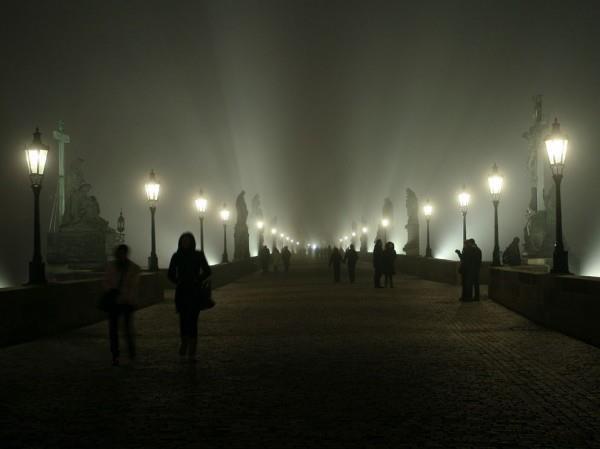
Foggy night, bridge in Praha [= Prague]
Ketu in the 12th house indicates apathy or detachment toward sanctuary enclosures. Tends toward un-bound-aried expenditure, meditation and identity loss.
Similar effects may be felt when Ketu the Releaser occupies 12th-from-Chandra
Papa-graha in dusthamsha while materially frustrating may give beneficial spiritual results.
Ketu = wanderer. Ketu wants to meditate, to be psychically attuned through neutral clairsentience and claircognizance -- seeing and hearing communication from the spirits, but NOT reacting to it and not getting committed to any relationship.
Ketu does not want the burden of responsibility to maintain an intimate relationship. Occasional intimacy is OK, but Ketu will not support a contract like a marriage, or any long-term commitment. Ketu is quite detached: the Witness.
Ketu wants peace and quiet, especially in the bedroom for sleeping. Ketu needs more sleep than normal.
Feet
Potential for damage to the feet (12) via accident or injury when Ketu the Undefended receives malefic drishti which signals a ghostly attack.
Foot reflexology and massage of feet, anointing of feet in religious ceremonies, may be deeply healing and facilitate clairsentient listening.
Vimshottari period of Ketu
Similar effects = Ketu in 12th-from-Chandra
During Ketu bhukti of any mahadasha and acutely during the Ketu-Ketu svabhukti, one born with Ketu in Vyaya Bhava may have a sensation of material anchors slipping away in regard to matters of 12, such as
- spiritual guides,
- prayers,
- divinations,
- dreams,
- imagination,
- non-verbal intuitive conceptual thought,
- research environments,
- interior guidance,
- hallucination,
- long sojourn in foreign lands (e.g., military assignment)
- private matters
- enclosure such as dormitories and hospitals (12)
These matters seem to be rather persistently out of one's intentional control .
This Ketu-Bhukti feeling of being a drifting spectator toward the conditions of one's own life may be even more profound when either Chandra or the indriya-lagna occupy a Nakshatra of Ketuva - Aśvini, Magha - Regulus, or Moola.
EXAMPLE
-
Total Surrender 1910-1997 Mother Teresa of Kolkata [sheltering-defensive Viśākha-4] = Moola indriya-lagna
QUOTATION from Das commentary WRT Ketu in bhava-12 \
www.goravani.com ]
" In your mind you think of spiritual life as real and true and so you know that material life is not the aim of life.
-
This comes gradually as you get older, as material expectations are one by one ruled out as unfulfilling.
-
Therefore, gradually through life, you spend more of your time and energy towards serving good causes.
Also, in an attempt to sort things out in this transition, you become restless ,
-
and sometimes try to spend for pleasure, only to feel increased frustration.
Overall, you should do well because of your sincere approach to life .
Areas to try to prevent disease troubles would include
-
the feet, eyes, and private parts."
[end quote]
As a rule, Papagraha in a dushthamsha generally can be expected to produce conflict-reduction and less fretting about adversarial conditions in 6-8-12.
Tends to disorient the potential difficulties of crossing the 12-bridge, which requires dissolving the embodied identity in order to experience the astral self. [Ketu disorientation]
May connect very successfully with the quieter spirit guides who frequent serene, private, enclosures.
Regardless of how one is personally handling the world of private imagery and meditative practice, Learner can passively reflect the fantasy lifestyle image of the psychic projections of the collective unconscious.
" No barriers " Ketu places the Learner upon vyaya's astral-material bridge (12) through direct intuition. No analysis, no cultural filters. In bhava-12, experience is entering sanctuary of the inner mind.
Karaka Ketu-12 for"abandonment in the grotto" .
-
Illness and argumentation of the spouse are ignored.
-
Learners may be not interested in the spouse's conflicts with others, including spouse going to jail or other consequences of spousal conflict with others.
Marginalized by the ashram, hospital, sanctuary, or research establishment. Private fantasies are weak, and closed-door negotiations fail.
-
One loses interest in dreams and bed-pleasures.
-
The marriage partner may seek alternatives, but one is not concerned with such a loss.
Ketu the Witness accepts losses.
Ketu the Witness accepts everything.
Results Depend upon the bhava ruled by Ketu's lord.
Double detachment. Native is highly sensitive to communications from spirits and presences without bodies. May not be inclined toward any specific spiritual practice, but tends to wander from temple to temple, or landscape to landscape, just looking.
during bhukti of Ketuva, there = Disengagement and Witness Wisdom via pilgrimage, wandering, and clandestine operations in foreign lands.
-
Favors wandering in foreign lands, long retreats, deep meditations, and extraordinary psychic channeling. If one is engaged in psychic work one should request an outside grounding control to ensure protection from hitch-hiking or predatory spirits.
-
Tends to be a loner and while one can channel spiritual information from the ancestors for the benefit of others, one rarely can do this service for one's own self.
-
Does not connect consciously to the world of dreams, simply lives with this background awareness until asked to give a read-out.
The material manifestation of the bhava that are ruled by Ketu's lord are not harmed.
Psychological expectation of abandonment and rejection by the ancestors, by meditation guides, and by shepherds or pathfinders in general (Ketu = abandonment, chidrakaraka)
Tends to surrender or give away Learner's fantasies, privacy, sanctuary, dreams.
-
Feels that meditation, sleep, prayer, and philosophical reflection are merely a mirage .
Malefic graha in dushthamsha can give comfortable and pleasing results .
Learners may be disconnected from his inner sanctuary but he becomes available for helping those most deeply in need
Collapsing Ketu signals disconnection/ Vyaya-sthāna signals dreamy, intuitive disconnection from the logical constraints which enable to imagination. Despite initial restlessness, Learners may settle into enthusiastic giving away of outdated attachments - which weren't going to last anyway.
Prognosis for spiritual release and deep neutrality toward all attachments, even those emotional attachments which exist only in fantasy and dreams. the Learner tends to enjoy a calm meditation space, but this Learners may not be much interested in elaborate meditative instructions. Natural adept of"surrender"and"release" .
Strange experiences when traveling in foreign lands.
Potential for damage to the feet (12) or the astral imaging system [clairsentience and claircognizance, dreams] (13) via accident or injury when Ketu the Undefended receives malefic drishti which signals a ghostly attack.
Long spiritual walks which vigorously exercise the calves may generate spiritual"hearing" .[Ketu]
A bit jumpy until age 60. Then, increasing alignment with the Divine cycle of manifestation and dissolution, breathing in and breathing out.
Neutral awareness of the vivid imagery of the aural and visual imagination. Aware that life is but a dream. Apathetic toward psychic capabilities yet possessed of them. If other graha are with Ketu, may activate the dream-interpretive or psychic-healing skills.
As always with Rahu-Ketu the planetary lord defines Ketu's effect. If the lord = strong benefic there can be great waste seeking after bed pleasures. More sensible approach to loss if the lord = neutral or malefic. However, even this resolves with time.
Dissatisfaction, ambivalence and uncertainty regarding the privilege to express intuitive awareness and dreamlike perception.
Depending on the ruler of Ketu's rashi, Learner may have prayer and meditation skills or ability to handle matters of hospitals, ashrams, cloister and sanctuary -- but Learners may feel detached from their value.
-
Peculiarities of the complex reflexological patterns of the feet.
-
Must take care to protect the feet from psychic incursion of grief, due to an effable sense of loss .
-
Psychic vitality runs out through the"leaky" feet chakra.
Resistance to validation through dream-work, prayer and communication with the Ancestors;
the maternal grandfather, elder sibling's in-laws, and the enemies of the spouse seems distant and unconnected to one's essential self.
EXAMPLE
Total Surrender 1910-1997 Mother Teresa of Kolkata
-
often mentioned that she felt her prayers were inferior and ineffective, even rejected.
Dissatisfaction, ambivalence and uncertainty ]
regarding the privilege to express social, conceptual, and electronic networking as well as material achievements and gains .
Depending on Ketu's lord, Learner may have perfectly competent networking skills or ability to set and achieve important material goals -- but Learners may feel detached from the exercise of these skills.
Peculiarities of the skin and nerves . Must take care to protect the skin and The nervous system (sympathetic and parasympathetic) from psychic incursion of grief, due to an ineffable sense of loss .
Resistance to validation through earnings, profits, and successful goal achievement; The elder sibling and spouse of the eldest child seem distant and unconnected to one's essential self.
power-vacuum in the topics of 12, a bhava of meditator-teacher-preacher Guru:
Ambivalence , apathy, abandonment, dispersion, absence of barriers [Ketu] toward
-
distant lands , prayer and meditation, imagination, conceptual thought, theory, first principles, research, interior guidance, hallucination, ancestor -guides, and dreams; yet no resistance to the intuitive streams of wise direction which flow from disembodied sources; unable to maintain privacy; disconnected in bedroom activities.
Rahu-6 pairings = a complementary ambitious risk-positive desire for recognition [Rahu] as
a clever adversary , adventurous druggist, expedient accuser, or agent of conflict.
Self-elevation in the worlds of usury, medicine, pharmacology, theft, exploitation, accusations and criminal defense, argumentative litigation, military, fraudulent or work with oils and oily smoke, animal butchery, toxicity and pollution * chemical, social, emotional
*****************
sees the weakness in the ancestor's spiritual guidance
lacks accountability toward the ancestral guides, toward clairsentient experience, toward the products of one's own imagination
distant lands, private worlds, spiritual telepathy
apathy toward matters of the bedroom, clandestine undertakings, sanctuary, hospitals, hospice, hostels, and hotels
psychic approach to spiritual guidance, imagination, conceptual thought, theory, first principles, research, interior guidance, hallucination, divination, dreams and non-petitionary prayer
dismemberment, dissolution, distance, deportation, departure
no barriers against the invisible, psychic, inconspicuous; open access to astral imagery conducted via spiritual guidance indecisively
indecisively unable to make up the mind in matters of meditation, out-of-body identity, dream-world, spiritual guidance, prayer, clairsentience and claircognizancedisregards dreams
Ketu in classroom-12 benefits from a lack of restrictions on matters of the Other World, including imagination, subconscious, prisons voluntary-and-involuntary, bedroom, meditation, privacy, distant lands, father's mother, mother's father, isolation, sanctuary, clairsentience and claircognizance.
Collapsing Ketu-12 limitless, unstructured conduct in private spaces
Dispersed, distanced, disengaged, and dissatisfied from the privileges of bhava-12 = privacy, sanctuary, hermitage, invisibility, spiritual guidance, clairsentient direction, sleep. Potential for insomnia.
Ketu in classroom-12 represents a wanderer, moving over the surface of the world like a floating vaporous cloud. Collapse.
Professor Ketu's connection to the source of sanctuary is somehow severed. similar to Ketu in 8, this = fairly good or anyway relatively less problematic placement.
-
Ungrounded imagination
-
Scattered sleep; wandering ancestors.
-
Cut off from spirit guides, or their imagery can be unclear
Professor Ketu longs for - but cannot sustain [Ketu] peaceful reflection and bed pleasures.
Professor Ketu longs for - but cannot sustain [Ketu] privacy, invisibility, sanctuary
-
dispersal of energies into environments such as refugee camp, summer camp, training camp, climbing camp, scout camp, workers camp, concentration camp, transient camp, college campus
[Ketu in Bhava-12] = busts-up, nebulizes, scatters privacy; disperses the imagination; eliminates conventional social restrictions on transactions in distant lands.
Bhukti of Ketuva can give splendid results for extended spiritual retreat.
Gives meditative instincts and private pleasures if Ketu's lord is fortified, but Ketu-12 may feel distanced, disengaged, and dissatisfied with these gifts.
Concluding Ketu -12 has relatively little interest in foreign lands (unless Ketu yuti other graha). Disregards instruction from the inner teachers (12). Finds the inner practices of meditation and divination (12) to be fairly useless. No limits in the private bedroom. No limits on imprisonment.
Residing in 8 or 12, dissociative Ketu may be unable to hold onto things which are not, by definition, materially sustainable. Yet papagraha are well-placed in dusthamsha. The results are often favorable or at least not too difficult to manage.
Scattered Ketu's weak psychic boundaries create Learning Challenge to achieve, obtain, maintain, or retain connection to
-
Sanctuary , sacred enclosure, peace of mind, prayerful states of mind, pleasant dreams
-
Ancestors and spirit guides, dreams, clairsentience and claircognizance
-
Distant Lands, long sojourn or residence in distant lands,
-
spa, retreat, hospital, hostel, hotel, monastery, cloister, prison,
-
taking refuge, holiday resort
-
seclusion, isolation, privacy, bedroom,
-
imagination, meditation, artist's studio, science laboratory
father-guru-professor's caretakers or parents (4th from 9), partner's enemies, illness of the spouse (6th from 7), wealth of friends (2nd from 11), social recognition for communications messaging (10th fr 3)
Ketu in bhava 12 = Rahu in bhava 6
-
ambivalence [Ketu] toward privacy, meditation, retreat, ancestor -guides, and dreams; scattered approach toward obtainment of sanctuary
-
Ketu-12 = disregard for the conventional protocol of the bedroom, meditation sanctuary, hospital, and the prison
-
desire [Rahu] to be recognized as a powerful agent of conflict and distrust : a clever adversary , asmart criminal (6), ashrewd litigator, an exotic druggist, or renegade genius of military (6) logistics
Scattering instruction conveyed by ancestral voices
-
Their message = "abandon all hope" .
Fragmented or disconnected intuition due to weak psychic boundaries while an ambitious and charismatic criminal [Rahu] enjoys an adversarial or exploitive environment (6). The mothers relatives may have predatory characteristics and while Professor Ketu is aware of this situation, He is unable to prevent their illicit activities.
Scattering effects within enclosures such as hospitals and hotels. Beneficially, enemies of Learner's lifepartner are dispersed. However, father's caretakers (4th-from-9th) are not a wholesome influence.
Directive signals from the ancestors (12) may become scattered; although dream-life is easy to access. Beneficially, apreponderance of instruction from spirit guides which emphasizes and instructs on the topics of sacrifice, severance, surrender, release, and forgiveness.
Ketu = generally not interested in conventional methods of reflection and prayer. Public * worth-ship * worship may be coherent but private * worth-ship * worship may be eccentric and eclectic.
Beneficially, opportunity for direct clairsentient revelation on a private basis is wide open, presuming that ruler-of-12 is well disposed. Ketu-12 may grant exceptionally gifted clairvoyance.
Yet, if clairsentient gifts are noticed there can be initial negative effects of incomplete grounding and inability to control an inconsistent flow of guidance. It may be difficult to "turn off" the source of intuitive instruction.
CASE STUDY
Concluding Ketu -Makara-12 ]
The ideal place for this Ketu would be a high rocky monastery in the middle east or the Gobi desert or the Karakoram ... somewhere inaccessible except after a long climb up, and somewhere very quiet and windy, very regulated, with a fixed schedule of activities every day. There are still some places like that in Egypt, Yemen, Greece, syria, turkey... wars and the drama of the people below do not affect these ancient monastery retreats.
A great place to be or be associated with would be any type of retreat center which features a fairly strict or regulated routine night and day. It could be run by a conservative religious order. Someplace like an addictions or detox center would be good - lots of drama going on around you, but you are only there to validate spirit, not to get involved in the psycho-social relationships.
Professor Ketu wants to work and quite possibly live in a hospital, nursing home, dormitory, asanctuary, amonastery or convent, asecluded camp, or any environment which is private, behind walls or inside a fence -- even a prison.
Professor Ketu-Makara/12 also likes to be associated with the elderly and people who are dried out. The people Ketu is attracted to can be young but still dried out from"windy" diseases, from fasting, or just constitutionally they are parched, wrinkled, creaky and boney. Ketu even likes alcoholics who are trying to dry out.
Professor Ketu also likes people who are trying to reduce their over-involvement with things; those who are trying to separate and disconnect from a part of the past that is finished. For example, people who are trying to reduce contact with the outside world by entering a monastery, or who are trying to reduce their weight by going to a residential diet spa, or reduce drugs/alcohol, or reduce some type of outdated behavior.
Professor Ketu likes all of these people and when you work with them, serve them, Ketu provides sustenance.
Because Professor Ketu in bhava-12 is all about enclosures, Ketu-Makara-12 also likes demarked ethnic reservations, if those are suitably dry and rocky places, like the big Hopi and Navajo lands in the USA-Southwest or the dry dusty, detached-from-mainstream reservations in the deserts of eastern Oregon and Idaho.
However, many parts of reservation life are quite disorderly, especially the rampant alcoholism and the gambling. Ketu does not like the disorderly parts. Only the orderly parts, such as a place of ritual worship, amedical clinic, or a school.
QUOTATION Alan Watts commentary ]
" It = special kind of enlightenment to have this feeling that the usual, way things normally are, is odd, uncanny and highly improbable.
-
G. K. Chesterton once said that it is one thing to be amazed at gorgon or a griffin, creatures which do not exist
-
but it is quite another and much higher thing to be amazed at a rhinoceros or a giraffe, creatures which do exist and look as if they don't.
This feeling of universal oddity includes a basic and intense wondering about the sense of things."
QUOTATION from H.
H.
Dalai Lama. (2003).
Compassion .
Mental Obstacles to Meditation
" Buddhist texts speak of four principal obstacles that one must overcome for meditation to be successful.
The first is mental scattering or distraction ,
-
which arises at the coarse level of mind and refers to the tendency for our thoughts to be scattered.
The second obstacle is dullness and drowsiness,
-
or the tendency to fall asleep.
The third is mental laxity ,
-
which means that our mind is unable to retain sharpness and clarity.
Finally, at a more subtle level, there is mental excitement, or agitation
-
which stems from the fluctuating, changeable nature of our mind."

Forest Fog in Estonia


[How Readings Work] = [Sample Sacred Jewels Ratna Recommendationn] = [Seva]
 file update =
07-Aug-2026
file update =
07-Aug-2026
[Copyright © 1994-2034 by Barbara Pijan Lama] = [Contact] = [How to Order Jyotishavidya Readings]
Barbara Pijan Lama Jyotishavidya Vedic Astrology Surya Sun Chandra Moon Mangala Mars Budha Mercury Guru Jupiter Shukra Venus Shani Saturn Rahu Ketu Graha Planets Dasha Timeline Calendar Nakshatra Navamsha Marriage Children Treasury Career Spiritual Wisdom Cycles of re-Death and re-Birth
The information on barbarapijan.com is provided for educational purposes only. Wishing you every happiness and continuing success in studies!